
SPME-GC-MS结合ROAV分析腐乳中的主体风味物质



目的:腐乳以其独特的口感在市场上深受消费者喜爱,因其制作配料有所不同,产品之间的风味也各有差异。本文对自制腐乳(M1和M2)和市购腐乳(C1和C2)的风味特征和成分差异进行研究分析,探讨家庭作坊制作的腐乳风味组成和主要风味物质,旨在为研究腐乳的特征挥发性风味物质和制作提供基础性数据,为优化腐乳的生产加工提供理论支撑。
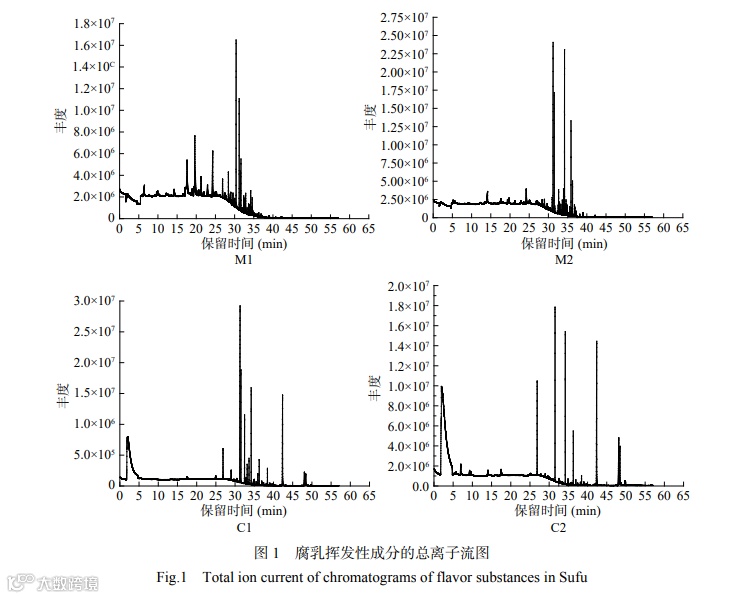
方法:实验样品来源自制和超市购买,用全自动固相微萃取装置(Gerstel MPS,Supelco 50/30um DVB/CAR/PDMS)进行样品前处理,精确称取3 g腐乳加入20 mL顶空瓶中,在60 ℃平衡10 min,萃取30 min,250 ℃下解析300 s后进入气相色谱-质谱联用仪(Agilent 7890A-5975C,DB-5 ms(30 m×250 μm,0.25 μm))进行分离检测,不分流进样,色谱柱温度35 ℃,保持5 min,以3 ℃/min升到80 ℃,保持5 min,再以10 ℃/min升到200 ℃,保持20 min。传输线温度是280 ℃,离子源是EI,离子源温度是230 ℃,四极杆温度150 ℃,电子能量是70 eV,数据采集模式为全扫描,质量扫描范围m/z 30~450 amu。质谱数据经与NIST08.L标准谱库检索鉴定,将计算得到保留指数值与其他文献测定的保留指数值进行对比确认,进一步对腐乳的挥发性成分进行定性;采用峰面积归一化法进行定量,计算得到各风味物质的相对含量。结合香气阈值和相对气味活度值法确定腐乳的主体风味物质。
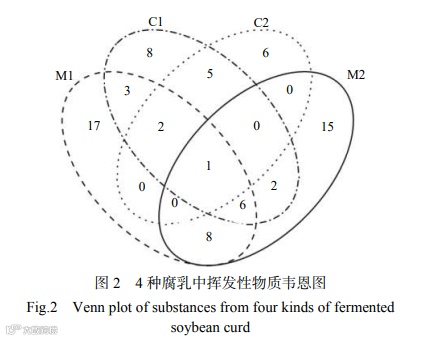
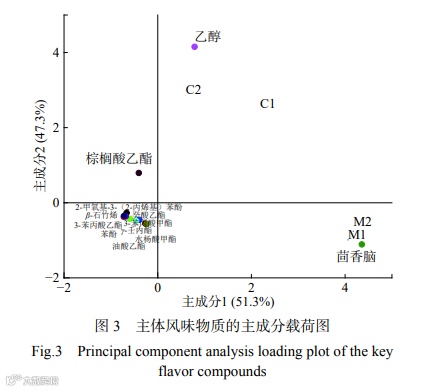
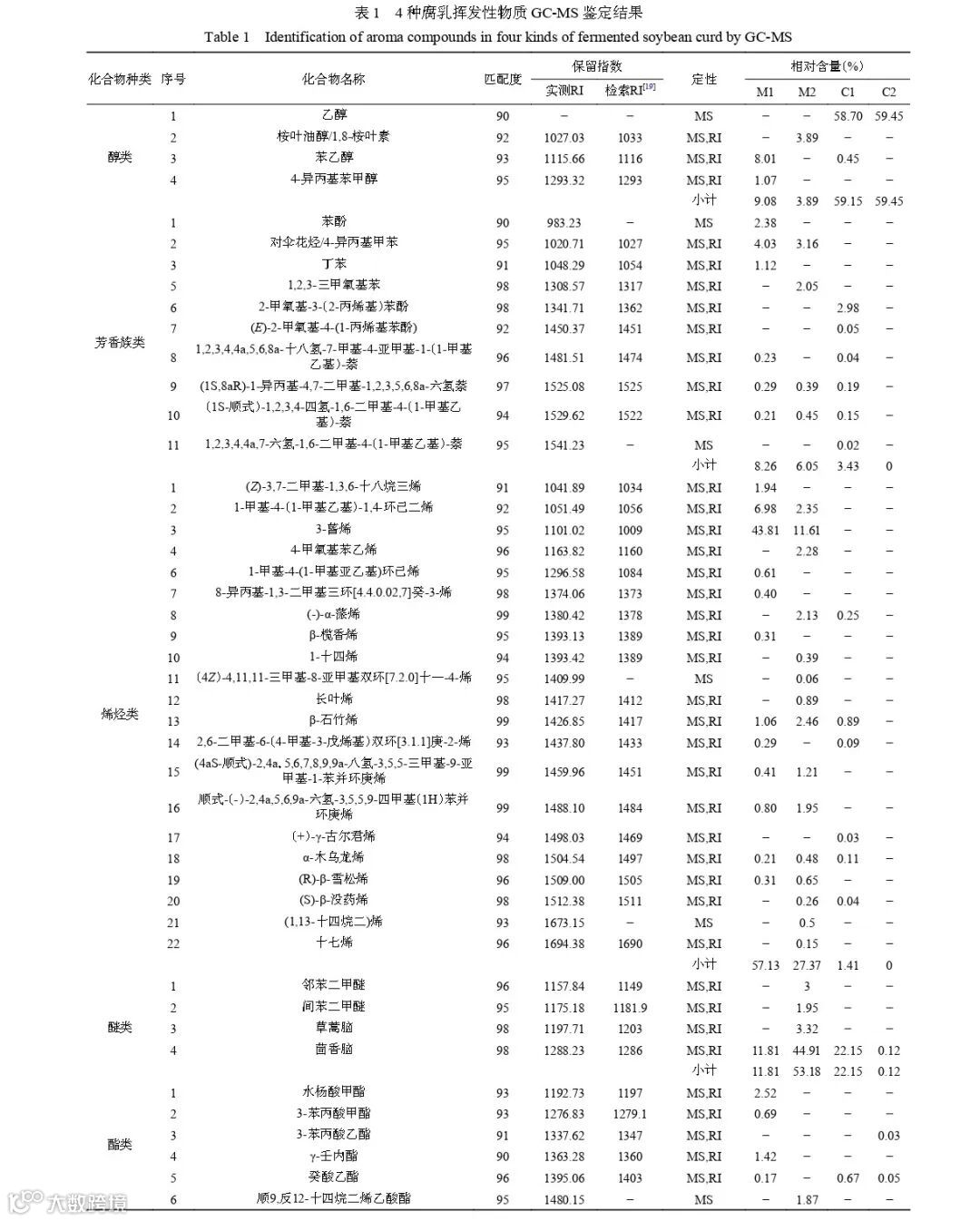
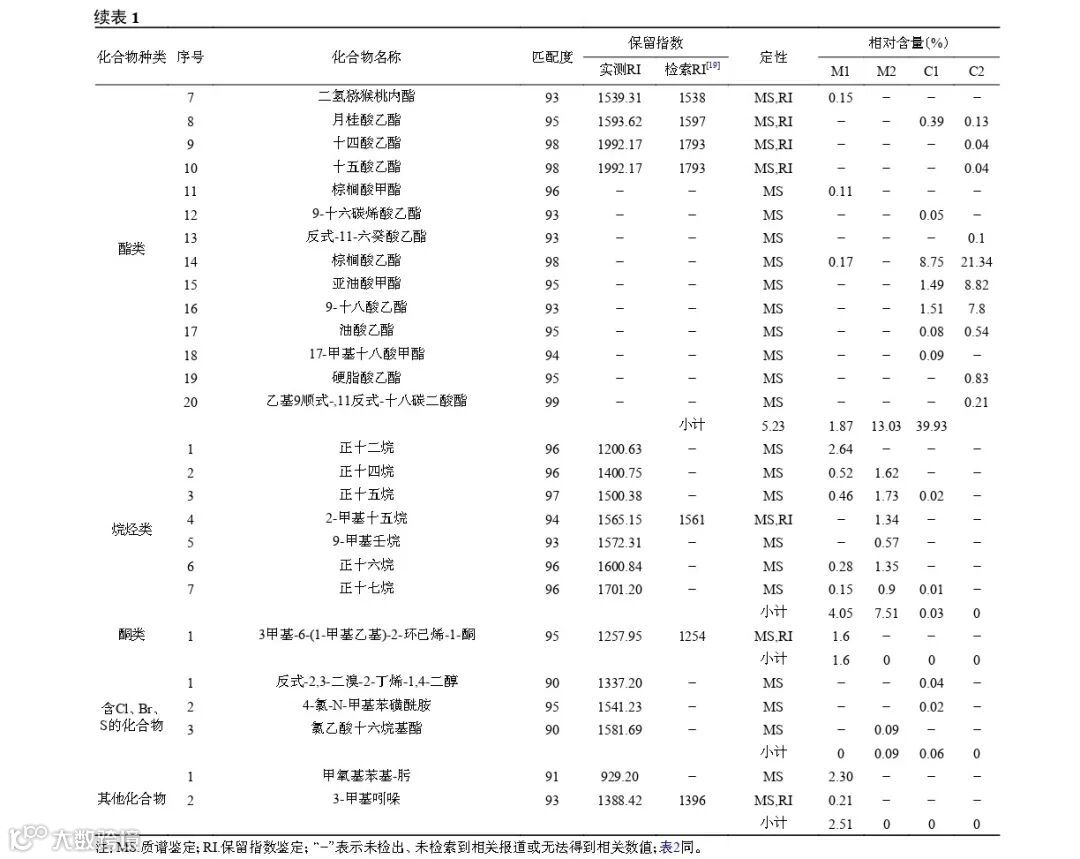
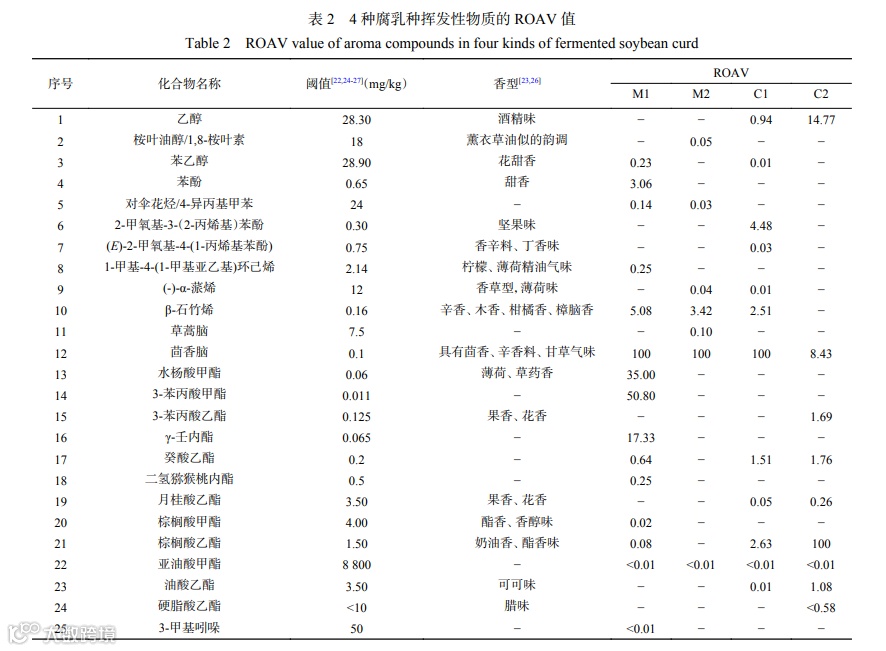
结果:4种腐乳样品挥发性物质的种类和相对含量都有明显差异,共检测出74种挥发性风味物质。自制腐乳M1和M2中风味物质种类较市购腐乳C1和C2丰富。M1共鉴定出36种挥发性物质,相对含量最高的为烯烃类物质,其中萜烯类物质3-蒈烯占了43.81%;M2共鉴定出31种挥发性物质,相对含量最高的为醚类物质,其中茴香脑占了44.91%,是其他腐乳相对含量的2~374倍;烃类物质是在M1和M2中被检出挥发性物质中种类和含量都较高的成分。C1和C2共鉴定出挥发性物质分别为27种和14种,二者中检出的乙醇是相对含量最高的醇类物质,分别为58.70%和59.45%。C1和C2中的酯类物质相对含量较M1和M2检出率高,分别为13.03%和39.93%。4种腐乳样品的主体风味物质分别是乙醇、苯酚、茴香脑、β-石竹烯、2-甲氧基-3-(2-丙烯基)苯酚、水杨酸甲酯、3-苯丙酸甲酯、3-苯丙酸乙酯、γ-壬内酯、癸酸乙酯、棕榈酸乙酯和油酸乙酯。
结论:实验结果表明自制腐乳和市购腐乳在主体风味物质及其相对含量上存在差异性,这可能与所用原辅料和加工工艺不同有关。研究结果将为腐乳特征挥发性风味物质形成机理的研究以及生产加工提供理论支撑。本研究由于实验条件所限,未能采用气相色谱-嗅闻-质谱联用技术,今后可在样品的前处理和检测方法的多样性上展开研究。
图片来源于图司机


Objectives:Fermented soybean curd is deeply loved by consumers in the market because of its unique taste. Due to different ingredients, the flavor of products is also different. This paper studied the difference of flavor characteristics and components between self-made (M1 and M2) and supermarket(C1 and C2), to compare and analyze the flavor compositions and the key flavor substances of self-made products. The research findings provide basic data for the study of fermented soybean curd's flavor substances and production, as well as a reference for the development of high-quality products.
Methods: 3 g of sample was transferred into 20 mL vail successively crimp sealed with a PTFE septum cap. The aroma volatiles of the sample were prepared by a SPME method as follows: heated at 60 ℃ for 10 minutes using an automatic sampling system Gerstel MPS, and extracted with a coated 50/30um DVB/CAR/PDMS fiber for 30 minutes, then the fiber was desorbed for 300 seconds, The injector temperature was set at 250 ℃ and desorption was processed in splitless mode. The separation was carried out in an Agilent DB-5ms capillary column (30 m×250 μm i.d. ×0.25 μm film thickness). The GC oven temperature program started at 35 ℃(held for 5 minutes) and then was ramped to 80 ℃ at 3 ℃/min(held for 5 minutes) and to 200 ℃at 10 ℃/min (held for 20 minutes). The MS transfer line, source, and quadrupole temperature were 280 ℃, 230 ℃ and 150 ℃, respectively. The electron ionization mass spectrometer was operated at 70 eV in full scan mode (mass range: 30-450 amu). The volatile compounds were identified by comparison of their mass spectra with the NIST08 MS library, and using Kovats retention index (RI) based on the retention time of standard n-alkanes, Quantitative analysis was expressed as a relative ratio of the area of the volatile compound in the sample with the whole volatile compounds area of the sample. The main flavor substances were evaluated by combing the aroma threshold and relative odor activity value (ROAV).
Results:There were significant differences in the types and relative contents of volatile substances between the self-made products (M1 and M2) and supermarket products (C1 and C2). A total of 74 volatiles were identified. The number of flavor substances in M1 and M2 was more than those in C1 and C2. A total of 36 volatiles were identified in M1, with the highest relative content being alkenes, among which 3-carene accounted for 43.81%; A total of 31 volatiles were identified in M2, and the highest relative content was ether substances, of which anethole accounted for 44.91%, the content of anethole in M2 was 2~374 times that of anethole in other fermented soybean curd; The contents of hydrocarbons were the most in M1 and M2. A total of 27 and 14 volatiles were identified in C1 and C2, respectively. in which ethanol accounted for 58.70% and 59.45%, respectively. The relative content of esters in C1 and C2 is higher than that in M1 and M2, with a detection rate of 13.03% and 39.93%, respectively. ROAV showed that the key flavor substances were ethanol, phenol, 1-methoxy-4-(1-propenyl)-benzene, caryophyllene, 2-methoxy-3-(2-propenyl)-phenol, methyl salicylate, benzenepropanoic acidmethyl ester, benzenepropanoic acidethyl ester, dihydro-5-pentyl-2(3H)-furanone, decanoic acidethyl ester, hexadecanoic acidethyl ester and ethyl oleate.
Conclusion: The experimental results showed that there were differences in the main flavor substances and their relative contents between self-made fermented soybean curd and supermarket fermented soybean curd, which may be related to the different raw materials and processing technologies used. The research results will provide theoretical support for the formation mechanism of fermented soybean curd’s characteristic volatiles, and optimize production technology. GC-O-MS will expected to be used in future analytical study with a broad capacity for the identification of volatile compounds.
《食品工业科技》特邀主编专栏征稿
《食品工业科技》特邀主编专栏征稿:枸杞、红枣、沙棘等食药同源健康食品研究与开发 ☚
《食品工业科技》特邀主编专栏征稿:食品中天然产物提取分离、结构表征和生物活性☚
群聊:食品工业科技作者群

温
馨
提
示

我刊正式组建微信作者群,为作者提供更多的学术与论文资讯,如需进群,请联系刘老师(微信:上方二维码,电话:87244117-8062)。

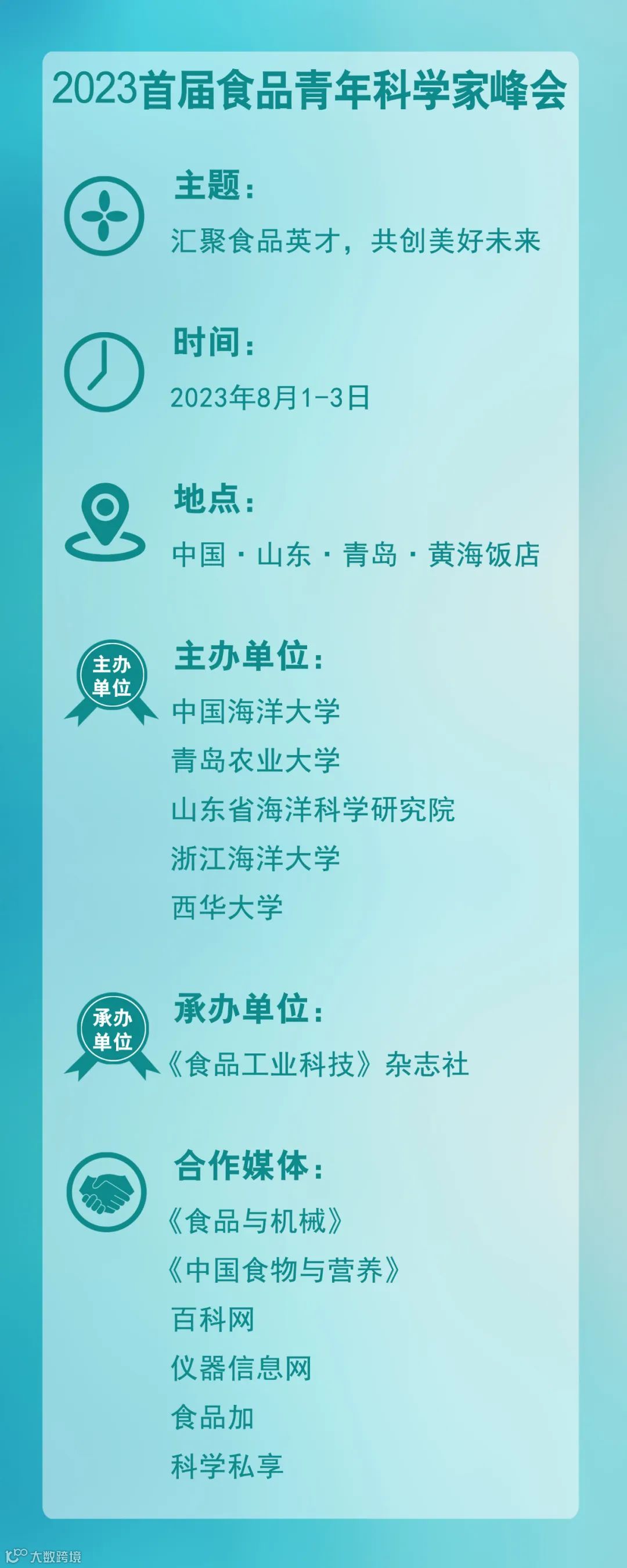

8月1日下午 编委会换届选举
8月1日晚上 编委会招待晚宴
8月2日上午 大会主论坛
主办单位领导致辞
大会主旨报告
8月2日下午 青年科学家分会场报告
8月3日上午 青年科学家分会场报告
博士才俊报告专场
8月3日下午 青年科学家分会场报告
硕士新锐报告专场



报告征集

报告方向:食品及其交叉学科
报告时长:20 min
报名方式:请将个人简介、职务/职称、照片、报告题目及摘要(点击下方“阅读原文”获取模板)发送至邮箱
zhouhao03071995@163.com。

报告方向:食品及其交叉学科
报告时长:20 min
报名方式:请将个人简介、学校、照片、报告题目及摘要(点击下方“阅读原文”获取模板)发送至邮箱
zhouhao03071995@163.com。

报告方向:食品及其交叉学科
报告时长:15 min
报名方式:请将个人简介、学校、照片、报告题目及摘要(点击下方“阅读原文”获取模板)发送至邮箱
zhouhao03071995@163.com。




论文方向:食品及其交叉学科的科研成果及综述
投稿途径:稿件题目上方注明“Food Junction:食品青年科学家峰会投稿”
投稿网址:www.spgykj.com
截止日期:2023年8月4日
录用及见刊方式:依照《食品工业科技》对论文的要求,择优录取,并于《食品工业科技》正刊发表。
绿色通道:论文发表费95折。审核通过的稿件按照书面录用通知的APC费用的95折进行缴纳。



在职人员
|
在校学生
|
2400元/人
|
1500元/人
|
同一单位3人及以上,在职人员2000元/人
|
|
费用包含:会议资料、部分允许共享的演讲内容PDF版、会议午餐
费用不含:住宿(会务组代订会议酒店)、交通费
学生:凭学生证参会

报名联系人
刘编辑 17746598288(微信同手机号)


版权声明