

传统发酵乳制品中微生物多样性研究



目的:传统发酵乳制品中的微生物极为丰富。这些微生物直接影响传统发酵乳制品的风味、组织质地、稳定性等方面。全面分析传统发酵乳制品的生物多样性、核心菌群及其相关性,为开发具有优良品质的工业发酵剂奠定理论基础。本文利用454高通量测序技术对传统发酵酸牛奶、酸马奶和酸驼奶的微生物群落多样性进行了分析,探究传统发酵乳制品中的核心微生物群。
方法:对采集自新疆维吾尔族自治区特克斯镇一大队局马洪(奇勒乌泽克乡)牧民家使用传统发酵方法制备的酸牛奶、酸马奶和酸驼奶样品进行微生物多样性分析。首先,使用试剂盒对样品中微生物宏基因组DNA进行提取。其次,分别采用16S rRNA V1-V3和18S rRNA引物进行扩增后,使用454 Roche GS-FLX进行测序。随后根据演变barcode变化进行筛选并进行质控。通过PyNAST对序列进行校准排齐,在给定相似度97%水平上进行分类操作单元(Operational taxonomic units,OTUs)划分,将ChimeraSlsayer软件检测属于嵌合体的OTU去除;将OTU代表性序列与RDP(Ribosomal database project,Release 11.5)和Greengenes(Release 13.8)数据库进行同源性比对,整合两个数据库的比对结果,确定每个OTU最终的分类学地位;使用FastTree软件绘制基于OTUs代表性序列的系统发育进化树,并计算样品的α和β多样性。
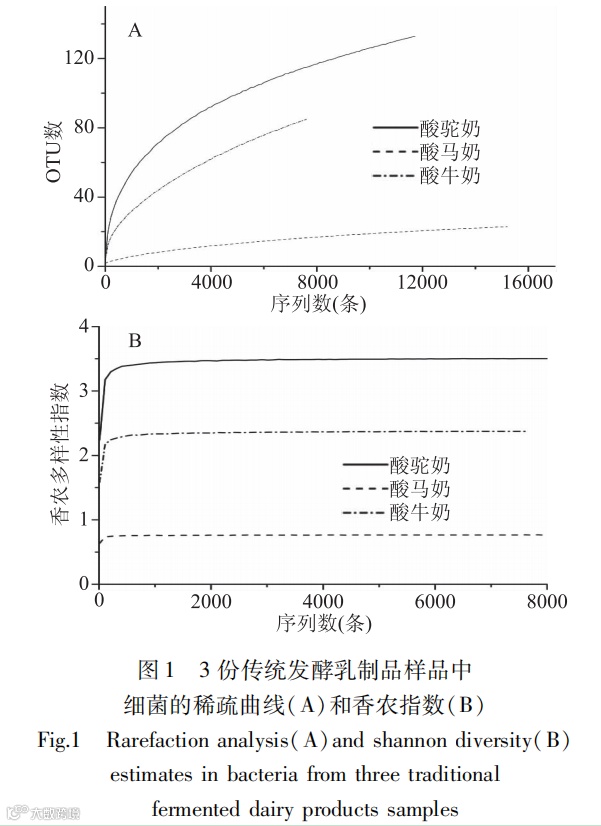
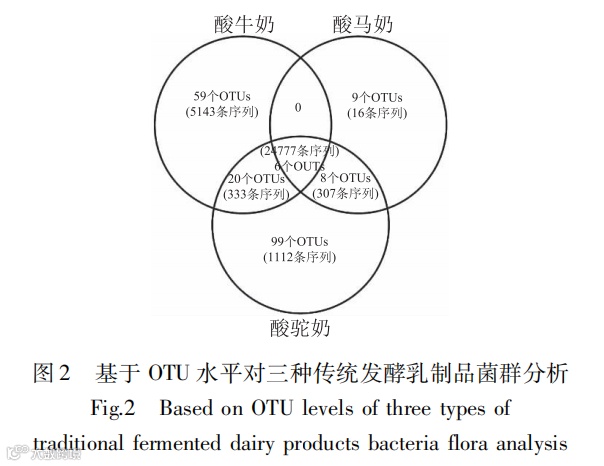
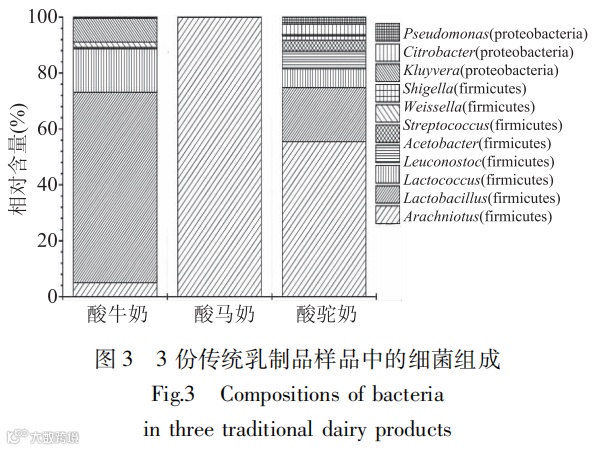
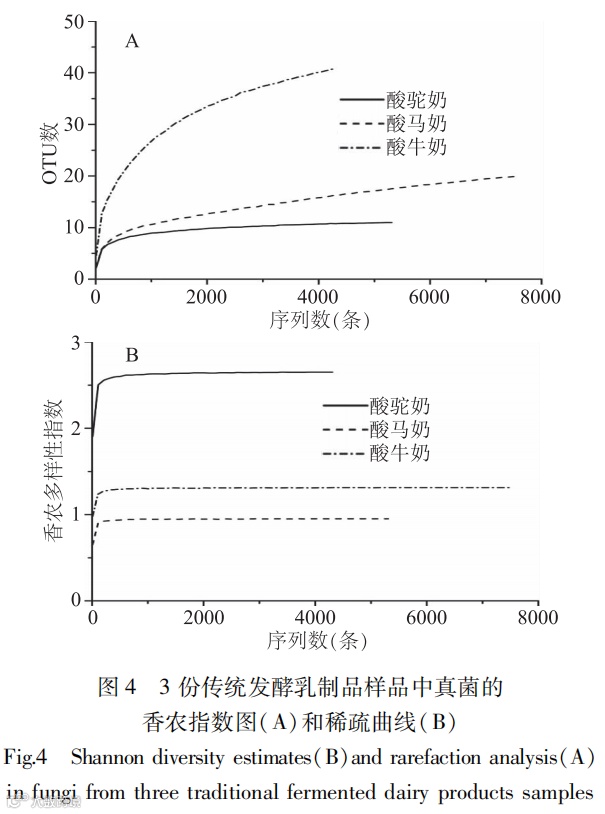
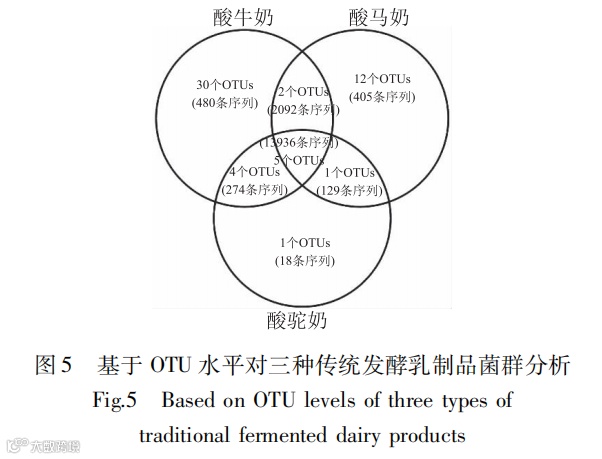
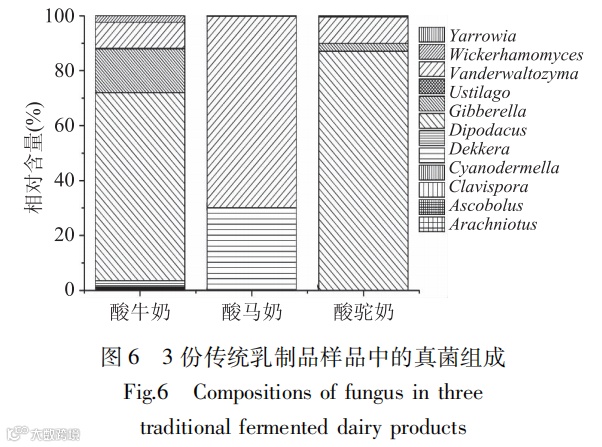
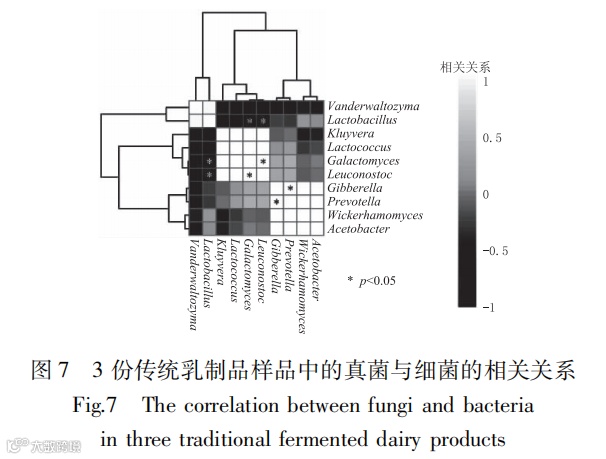
结果:通过微生物多样性分析发现不同传统发酵乳制品存在一定的共有群落:a.随着测序量的增加,样品中可发现更多新的真菌或细菌种系,但样品中真菌和细菌的多样性不再发生变化。b.酸牛奶、酸马奶与酸驼奶三份传统发酵乳制品中共有的细菌OTUs为6个,包含24777条序列,占全部序列的71.4%;分别拥有59个、9个和99个独有细菌OTUs,包含5143条、16条和1112条独有序列,占全部序列的14.8%、0.05%、3.2%。c.三份传统发酵乳制品均以Firmicutes(硬壁菌门)和Ascomycota(子囊菌门)为主要的细菌门和真菌门,酸牛奶样品中的细菌属以Lactococcus(乳球菌属)为主,真菌属以Galactomyces(耐碱酵母属)为主;酸马奶样品中的细菌属以Lactobacillus(乳杆菌属)为主,真菌属以Vanderwaltozyma(范氏酵母属)为主;酸驼奶样品的优势细菌属以Lactobacillus(乳杆菌属)为主,优势真菌属以Galactomyces(耐碱酵母属)为主。d.三份传统发酵乳制品共有的真菌OTUs为5个,其中包含13936条序列,占全部序列的80.4%;分别拥有30个、12个和1个独有OTU,包含480条、405条和18条独有序列,占样品全部序列的2.8%、2.3%、0.1%。e.Lactococcus与Galactomyces、Lactococcus与Leuconostoc的相对含量存在显著负相关(P<0.05),而Leuconostoc与Galactomyces、Gibberella与Pseudomonas的相对含量存在显著正相关(P<0.05)。
结论:传统发酵乳制品中的微生物极为丰富。因此,本文通过454高通量测序技术对传统发酵酸马奶、酸牛奶和酸驼奶的微生物多样性进行分析,在核心微生物群落分析发现传统发酵乳制品中存在共有微生物,且核心微生物群之间存在一定相关性。
图片来源于图司机


Objectives: Traditional fermented dairy products contain extremely rich microbial diversity. These microorganisms have a significant impact on the flavor, texture, and stability of traditional fermented dairy products. A comprehensive analysis of the biodiversity, microbial community, and their correlation in traditional fermented dairy products is of great significance for the scientific screening and development of high-quality industrial starter. In this paper, 454 high-throughput sequencing technology is used to analyze the microbial community diversity of traditional fermented yogurt, koumiss, and kurut, and explore the core microbial communities in traditional fermented dairy products.
Methods: Analyze the microbial diversity of yogurt, koumiss, and kurut prepared by traditional fermentation methods collected from herdsmen's homes in Mahong (Qile Wuzeke village), Xinjiang Autonomous Region. Firstly, used a kit to extract the microbial metagenomics DNA from the sample. Secondly, 16S rRNA V1-V3 and 18S rRNA primers were used for amplification, and 454 Roche GS-FLX was used for sequencing. Subsequently, screening and quality control would be carried out based on the evolving barcode changes. Calibrate and align the sequence using PyNAST, and divided the Operational taxonomic unit (OTUs) at a given similarity level of 97%, removing OTUs belonging to chimeras detected by ChimeraSLayer software. The representative OTUs sequences were compared through RDP (Ribosomal database project, Release 11.5) and Greengenes (Release 13.8) databases, and the comparison results of the two databases were integrated to determine the final taxonomy status of each OTU. Draw a phylogenetic evolution tree based on OTUs representative sequences using FastTree software and calculate the α and β diversity.
Results: From the analysis of microbial diversity, it could be seen that different traditional fermented dairy products have certain common communities: a. With the increased of sequencing quantity, new fungi or bacteria would be found from the samples, but the diversity of fungi and bacteria in the samples had no longer changed. b. Six bacterial OTUs were found in the three traditional fermented dairy products, including yogurt, koumiss, and kurut, containing 24,777 sequences, accounting for 71.4% of the total sequences. There were 59, 9, and 99 unique bacterial OTUs, respectively, containing 5143, 16, and 1112 unique sequences, accounting for 14.8%, 0.05%, and 3.2% of the total sequences. c. Firmicutes was the dominant phylum of bacterium and Ascomycota was the dominant phylum of fungi in the three samples. Lactococcus was the dominant genera in bacterium and Galactomyces was the dominant genera in bacterium in the yogurt sample. Lactobacillus and Vanderwaltozyma were there respectively dominating bacteria and fungi, in the koumiss sample. And Lactobacillus was the dominant genera in bacterium and Galactomyces was the dominant genera in bacterium in the kurut sample. d. Three traditional fermented dairy products shared 5 fungal OTUs, including 13,936 sequences, accounting for 80.4% of the total sequences; there are 30, 12, and 1 unique OTU, respectively, containing 480, 405, and 18 unique sequences, accounting for 2.8%, 2.3%, and 0.1% of the total sequences in the sample. e. There was a significant negative correlation (P<0.05) between the relative content of Lactococcus and Galactinomyces, and between Lactococcus and Leuconostoc, while there was a significant positive correlation (P<0.05) between Leuconostoc and Galactinomyces, Gibberella and Pseudomonas.
Conclusion: Traditional fermented dairy products are rich in microbial resources. Therefore, this paper analyzed the microbial diversity, especially the core community, of traditional fermented yoghurt, koumiss, and kurut by 454 high-throughput sequencing technology, and found that there are core microbial community in traditional fermented dairy products, and there is a certain correlation between the core microbial communities.

通信作者简介


孙天松,女,博士、教授,博士研究生导师,1967年11月出生于内蒙古。主要研究方向:乳品微生物及生物技术,主持和参与国家科技支撑,863计划、973前期专项及国家自然科学基金项目16项的研究工作,在本领域发表科研论文152篇。其中,以第一作者或者通讯作者发表SCI论文33篇,以第一作者或者通讯作者发表SCI-JCR1区9篇,主编、参编出版教材、专著4部。

第一作者简介

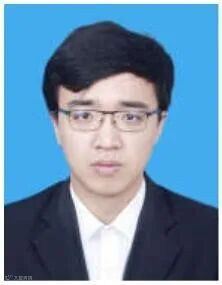
李伟程,博士研究生,农学硕士学位,研究领域为乳酸菌生物多样性、乳酸菌群体遗传学、益生基因组学与肠道微生物。
2019年毕业于内蒙古农业大学,获得农学硕士学位(师从孙天松教授),同年攻读博士学位(师从孙志宏研究员)。主要研究方向为乳酸菌群体遗传学,发表学术论文50篇,H-index 11(Google Scholar),其中以第一作者发表学术论文12篇,其中在Bioresource Technology(IF=9.642)、Food Chemistry(IF=9.231)、Microbiology Spectrum(IF=9.043)和 Food Research International(IF=7.452,2篇)等SCI期刊发表学术论文收录11篇(其中中科院一区期刊5篇,Top期刊5篇,IF>9分3篇;食品科学与工程领域高质量科技期刊T1级期刊发表论文3篇,环境科学领域高质量科技期刊T2级期刊论文1篇),CSCD收录1篇(食品科学与工程领域高质量科技期刊T1级期刊发表论文1篇,入选2011~2022年高PCSI论文、高下载论文、高倍引论文,入选2022年F5000论文名单),授权发明专利3项。先后获得2018 年“创青春”浙大双创杯大学生创业大赛第十一届“挑战杯”大学生创业计划竞赛铜奖、内蒙古自治区2018年“创青春”大学生创业大赛特等奖、第十五届益生菌与健康国际研讨会优秀论文、第十六届太阳岛博士论坛论文三等奖、第六届内蒙古营养与食品安全学术年会青年科技工作者及研究生论坛一等奖等奖励,2022 年获内蒙古自治区高等学校“三好学生”荣誉称号,2019年获得内蒙古自治区“优秀大学毕业生”荣誉称号,获得2018年、2020年和2021年研究生国家奖学金。中国食品科学技术学会学生会员,学术期刊 Frontiers in Microbiology、Food Bioscience、Frontiers in Ecology and Evolution和Frontiers in Genetics审稿人。
《食品工业科技》特邀主编专栏征稿
《食品工业科技》特邀主编专栏征稿:食源性功能物质挖掘与评价 ☚
《食品工业科技》特邀主编专栏征稿:枸杞、红枣、沙棘等食药同源健康食品研究与开发 ☚
群聊:食品工业科技作者群

温
馨
提
示

我刊正式组建微信作者群,为作者提供更多的学术与论文资讯,如需进群,请联系刘老师(微信:上方二维码,电话:87244117-8062)。



8月1日下午 编委会换届选举
8月1日晚上 编委会招待晚宴
8月2日上午 大会主论坛
主办单位领导致辞
大会主旨报告
8月2日下午 青年科学家分会场报告
8月3日上午 青年科学家分会场报告
博士才俊报告专场
8月3日下午 青年科学家分会场报告
硕士新锐报告专场



报告征集

报告方向:食品及其交叉学科
报告时长:20 min
报名方式:请将个人简介、职务/职称、照片、报告题目及摘要(点击下方“阅读原文”获取模板)发送至邮箱
zhouhao03071995@163.com。

报告方向:食品及其交叉学科
报告时长:20 min
报名方式:请将个人简介、学校、照片、报告题目及摘要(点击下方“阅读原文”获取模板)发送至邮箱
zhouhao03071995@163.com。

报告方向:食品及其交叉学科
报告时长:15 min
报名方式:请将个人简介、学校、照片、报告题目及摘要(点击下方“阅读原文”获取模板)发送至邮箱
zhouhao03071995@163.com。




论文方向:食品及其交叉学科的科研成果及综述
投稿途径:稿件题目上方注明“Food Junction:食品青年科学家峰会投稿”
投稿网址:www.spgykj.com
截止日期:2023年8月4日
录用及见刊方式:依照《食品工业科技》对论文的要求,择优录取,并于《食品工业科技》正刊发表。
绿色通道:论文发表费95折。审核通过的稿件按照书面录用通知的APC费用的95折进行缴纳。



在职人员
|
在校学生
|
2400元/人
|
1500元/人
|
同一单位3人及以上,在职人员2000元/人
|
|
费用包含:会议资料、部分允许共享的演讲内容PDF版、会议午餐
费用不含:住宿(会务组代订会议酒店)、交通费
学生:凭学生证参会

报名联系人
苑编辑 18742059548(微信:y18742059548)


版权声明