




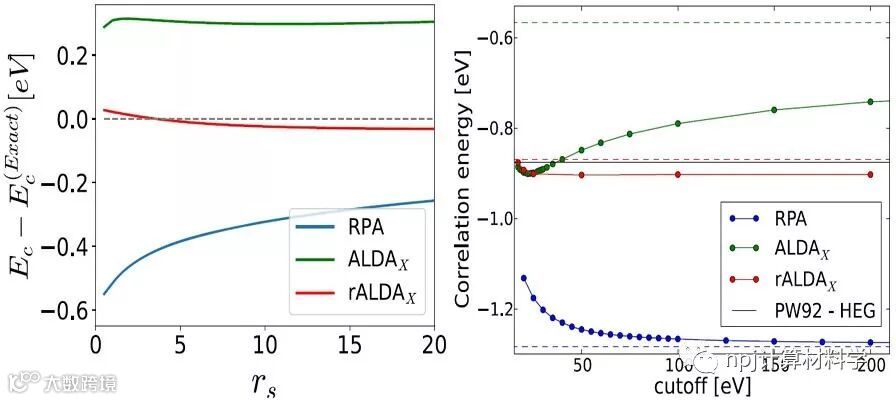
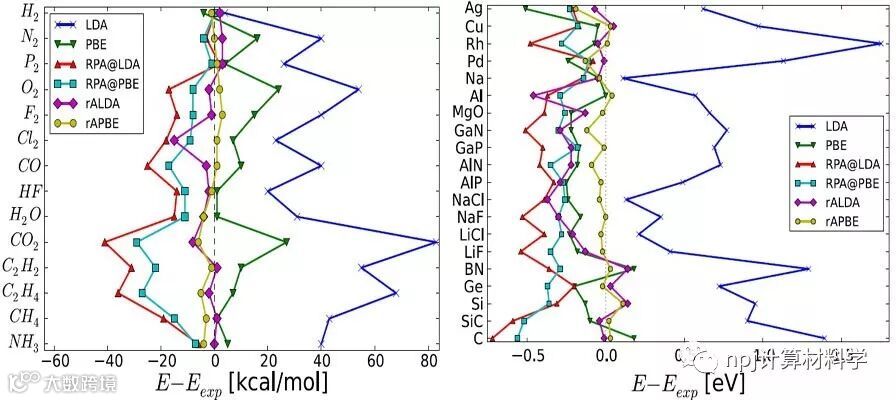
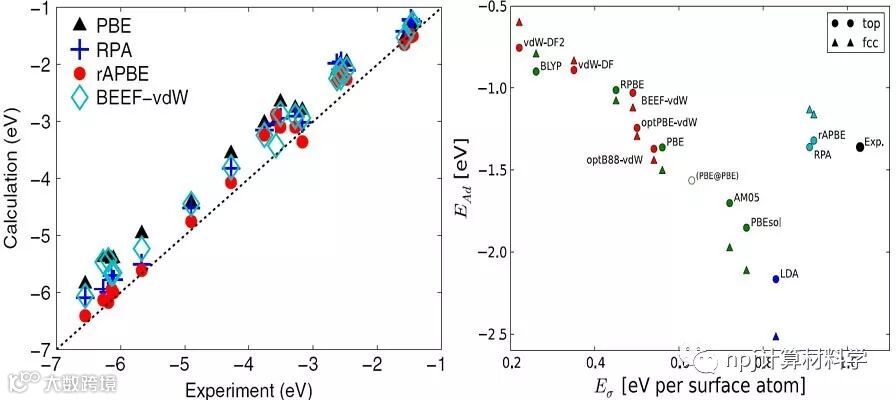
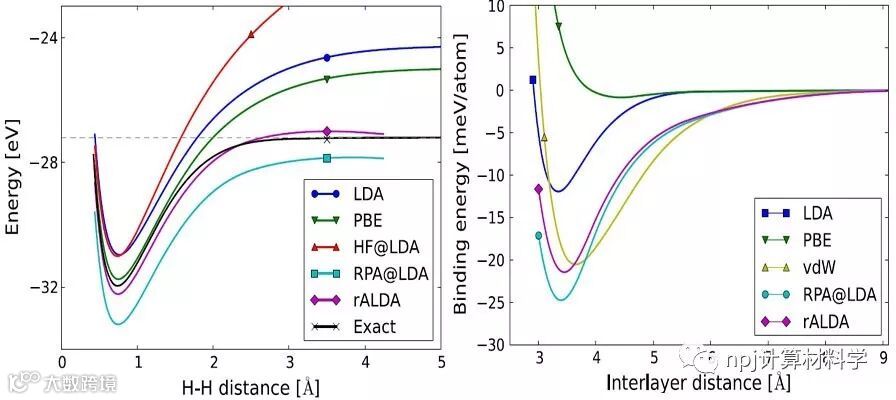
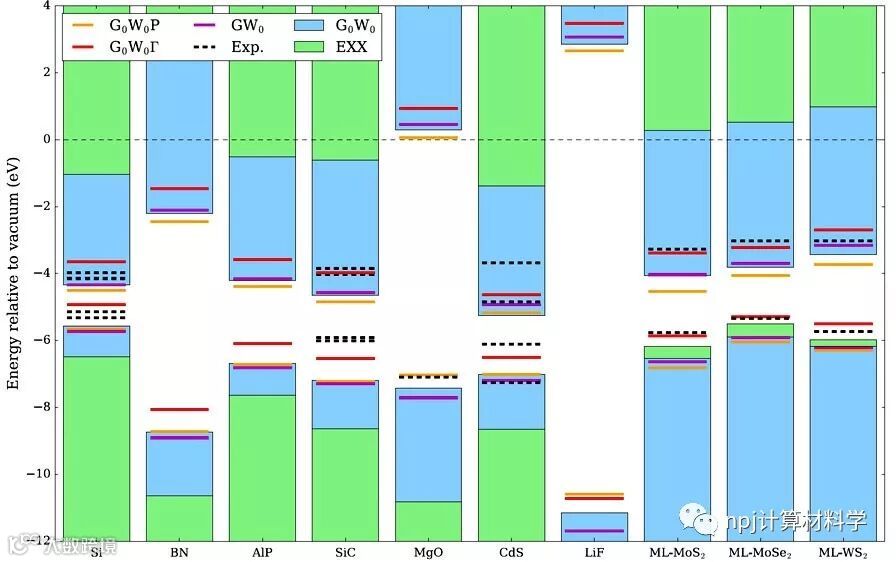
本文综述的重点是含时密度泛函理论(TDDFT)中的静态非局部交换关联泛函所描述的RPA和GW方法中的物理理论、实现途径和意义。来自丹麦技术大学物理系计算原子尺度材料设计(CAMD)的Thomas Olsen教授带领的团队,并没有详述RPA和GW方法本身,该方法的综述已在另一篇综述中阐明。在“理论”一节中,他们分别介绍了基于绝热连接涨落耗散定理和Hedin方程的基态和QP能量计算的基本理论。作者为HEG引入了几个非局域的交换关联泛函,并描述了从(半)局域交换关联泛函构造非局域交换关联泛函的重整化过程。在“实现”一节中,作者描述了非局域交换关联泛函的数值实现,包括将HEG泛函推广到非均匀密度体系的不同策略、倒空间格点和基集收敛性等方面。在“结果”一节中,作者提供了一系列计算结果,用以说明交换关联泛函对总能量和QP能带结构的影响和重要性。具体而言,作者评估了重整化绝热局域密度近似(rALDA)和重整化绝热广义梯度近似(rAPBE)在固体结构参数、共价固体和共价分子的原子化能、氧化物形成能、vdW键、静态关联的原子二聚体的解离、表面和化学吸附能、结构相变,以及块体和二维半导体的QP能等方面的性能。最后,对全文进行了总结和展望。该文近期发表于npj Computational Materials 5: 106 (2019)。
Editorial Summary
Ground state and quasiparticle energies: Accurate description
This review focuses on the theory, implementation, and implications of physics beyond the RPA and GW methods as described by static non-local xc-kernels from TDDFT. A team led by Prof. Thomas Olsen from the Computational Atomic-Scale Materials Design (CAMD), Department of Physics, Technical University of Denmark, did not dwell on the RPA and GW methods themselves but refer the interested reader to one of the existing reviews on these topics. The review is organized as follows. In section “Theory,” they present the basic theory of ground state and QP energy calculations based on the adiabatic connection fluctuation dissipation theorem and Hedin’s equations, respectively. They introduce several non-local xc-kernels for the HEG and describe a renormalization procedure for constructing non-local xc-kernels from (semi) local xc-functionals. In section “Implementation,” they describe the numerical implementation of non-local xc-kernels including different strategies for generalizing HEG kernels to inhomogeneous densities and some aspects of kk-point and basis set convergence. In section “Results,” they present a series of results serving to illustrate the effect and importance of the xc-kernels for both total energies and QP band structures. Specifically, authors assessed the performance of the renormalized adiabatic local density approximation (rALDA) and renormalized adiabatic Perdew–Burke–Ernzerhof (rAPBE) xc-kernels for structural parameters of solids, atomization energies of covalently bonded solids and molecules, oxide formation energies, vdW bonding, dissociation of statically correlated atomic dimers, surface and chemisorption energies, structural phase transitions, and QP energies of bulk and two-dimensional semiconductors. Finally, they conclusions and outlook the whole content of the review. This review was published in npj Computational Materials 5: 106 (2019).
原文Abstract及其翻译
Beyond the RPAand GW methods with adiabatic xc-kernels for accurateground state and quasiparticle energies(精确基态和准粒子能量描述的非绝热xc-内核RPA和GW计算方法)
Thomas Olsen, Christopher E. Patrick, Jefferson E. Bates, Adrienn Ruzsinszky & Kristian S. Thygesen
Abstract We review the theory and application of adiabatic exchange–correlation (xc)-kernels for ab initio calculations of ground state energies and quasiparticle excitations within the frameworks of the adiabatic connection fluctuation dissipation theorem and Hedin’s equations, respectively. Various different xc-kernels, which are all rooted in the homogeneous electron gas, are introduced but hereafter we focus on the specific class of renormalized adiabatic kernels, in particular the rALDA and rAPBE. The kernels drastically improve the description of short-range correlations as compared to the random phase approximation (RPA), resulting in significantly better correlation energies. This effect greatly reduces the reliance on error cancellations, which is essential in RPA, and systematically improves covalent bond energies while preserving the good performance of the RPA for dispersive interactions. For quasiparticle energies, the xc-kernels account for vertex corrections that are missing in the GW self-energy. In this context, we show that the short-range correlations mainly correct the absolute band positions while the band gap is less affected in agreement with the known good performance of GW for the latter. The renormalized xc-kernels offer a rigorous extension of the RPA and GW methods with clear improvements in terms of accuracy at little extra computational cost.
摘要 本文综述了在绝热连接涨落耗散理论和Hedin方程的框架内,用于基态能量和准粒子激发的从头算绝热交换-关联(xc)泛函的理论与应用。首先介绍了各种源自均质电子气中的不同交换关联泛函,此后重点介绍了一类特定的重整化绝热泛函,特别是rALDA(重整化绝热局域密度近似)和rAPBE(重整化绝热PBE广义梯度近似)。与随机相位近似(RPA)相比,这些泛函极大地改进了电子短程关联的描述,从而显着提高了关联能。这种效应大大减少对误差消除的依赖,而这些消除差在RPA中是必不可少的。同时,该效应也系统地提高了共价键能,同时保留了RPA中对色散相互作用的良好描述。对于准粒子能量,交换关联泛函考虑了GW自能中缺失的顶点修正。在这种情况下,本研究显示,短程关联主要校正了绝对能带的位置,而对带隙的影响较小,这与GW已知的良好性能是一致的。重整化的交换关联泛函提供了RPA和GW方法的严格扩展,在几乎没有增加计算成本的情况下,准确性得到了明显的改进。
文献链接:
https://www.nature.com/articles/s41524-019-0242-8
文章来源: npj计算材料

免责声明:本文旨在传递更多科研信息及分享,如涉及侵权,请联系下方邮箱,我们将及时进行修改或删除。转载请注明出处,如原创内容转载需授权,请联系下方微信号。
邮箱:janechou@imeta-center.com
微信号:18305163023