

理解材料中的自旋弛豫和传输机制对于自旋电子学和基于自旋的量子信息技术都至关重要。在相关应用中,选择材料的一个关键指标是材料的自旋寿命 (τs),τs通常需要足够长的时间才能实现稳定检测和自旋操纵。在基于二维材料的自旋电子器件中,材料通常被支撑在衬底上。因此,对于这些器件的设计,了解衬底对自旋弛豫的影响尤为重要。
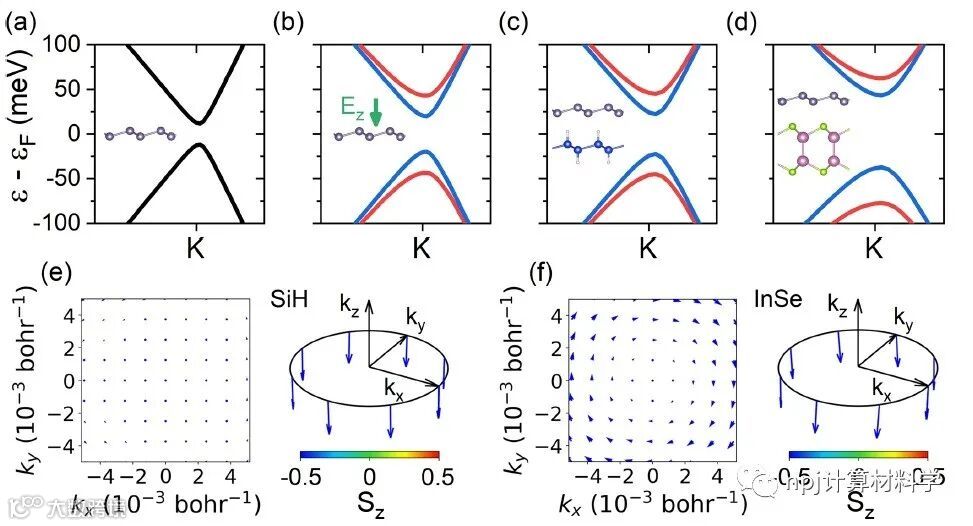
Fig. 1 Band structures and spin textures around the Dirac cones of ML-Ge systems with and without substrates.
此前大多数关于衬底对自旋弛豫影响的理论研究都是基于模型哈密顿量和简化的自旋弛豫模型。虽然这些模型提供了丰富的机理见解,但与第一性原理理论相比,它们缺乏预测能力和定量准确性。另一方面,大多数第一性原理研究只模拟了异质结构的能带结构和自旋极化/纹理,这不足以理解自旋弛豫。
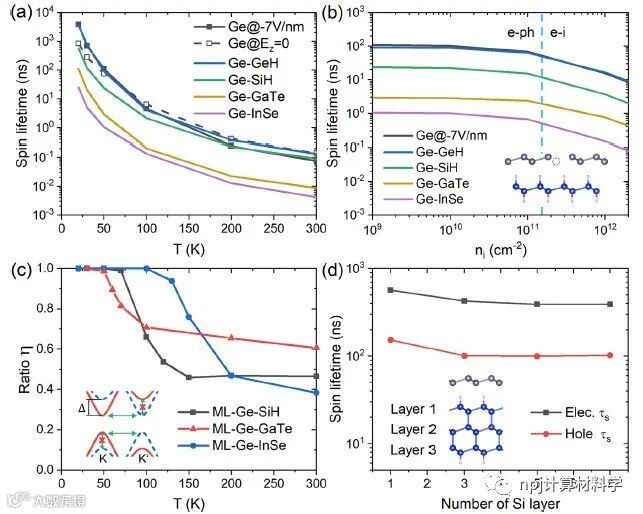
Fig. 2 The out-of-plane spin lifetime τs of intrinsic free-standing and substrate-supported ML-Ge.
来自加州大学圣克鲁兹分校化学与生物化学系的Junqing Xu与Yuan Ping等,以锗烯为原型,系统地研究了不同绝缘衬底对具有强自旋轨道耦合(SOC)狄拉克材料自旋弛豫的影响。
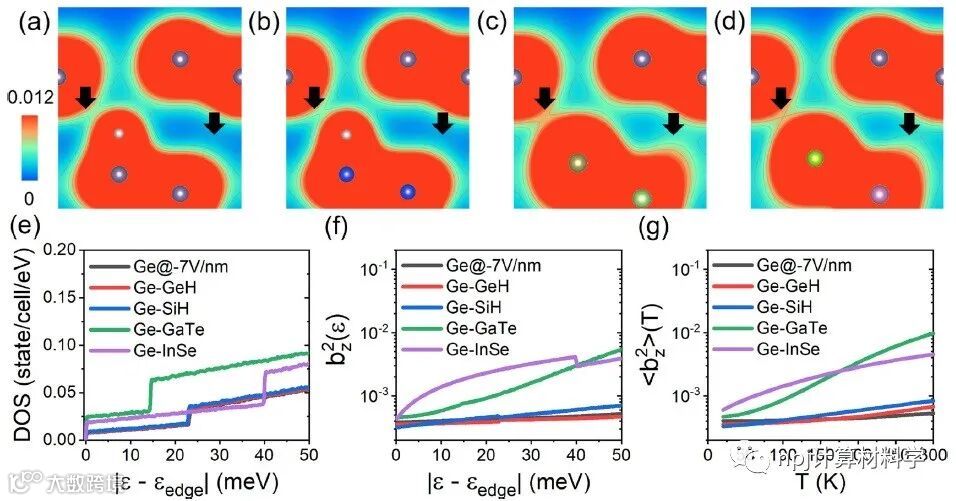
他们研究了四种不同的绝缘衬底,包括锗烷、硅烷、GaTe 和 InSe支撑的单层锗烯,并与没有支撑的锗烯做对比。通过对单独的和有衬底支撑锗烯自旋寿命(τs)的第一性原理密度矩阵 (FPDM) 模拟,表明不同的衬底对τs的影响可能有数量级上的不同。具体而言,锗烷和硅烷支撑的锗烯,τs 与没有支撑的锗烯具有相同的数量级,但 GaTe 和 InSe 支撑的锗烯,随着温度从 20 K 增加到 300 K,τs显著缩短了1-2个数量级。
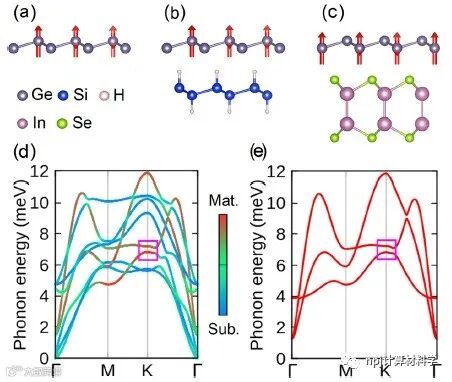
Fig. 4 The analysis of phonons of free-standing and substrate supported ML-Ge.
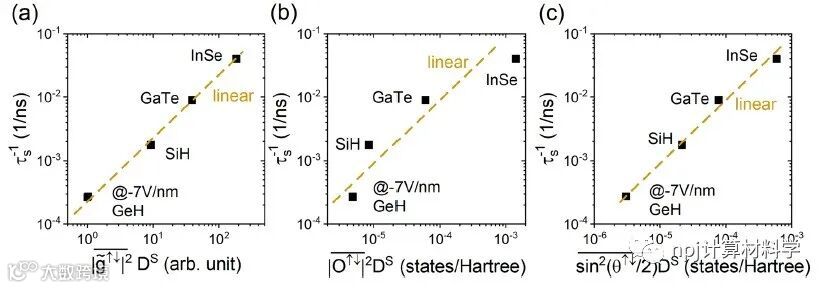
此外,他们还提出了一个新的电子量,称为自旋翻转角θ↑↓,通过谷间自旋翻转散射来表征自旋弛豫。研究发现,τs-1与sin2(θ↑↓/2)的平均值近似成正比,可作为控制自旋弛豫的指导参数。该工作为优化材料合成和控制材料自旋弛豫提供了有价值的见解和指导。该文近期发布于npj Computational Materials 9: 47 (2023).
Editorial Summary
Understanding spin relaxation and transport mechanism in materials is of key importance for spintronics and spin-based quantum information technologies. One critical metric for ideal materials in such applications is spin lifetime (τs), often required to be sufficiently long for stable detection and manipulation of spin. In 2D-material-based spintronic devices, the materials are usually supported on a substrate. Therefore, for the design of those devices, it is crucial to understand substrate effects on spin relaxation. Previously most theoretical studies of substrate effects on spin relaxation were done based on model Hamiltonian and simplified spin relaxation models. While those models provide rich mechanistic insights, they are lack of predictive power and quantitative accuracy, compared to first-principles theory. On the other hand, most first-principles studies only simulated the band structures and spin polarizations/textures of the heterostructures, which are not adequate for understanding spin relaxation.
Junqing Xu and Yuan Ping from the Department of Chemistry and Biochemistry, University of California, using germanene as a prototypical example, systematically investigated the spin relaxation of strong SOC Dirac materials affected by different insulating substrates. They studied free-standing monolayer (ML) Ge and ML-Ge supported by four different insulating substrates, i.e., germanane (GeH), silicane (SiH), GaTe and InSe. Through first-principles density-matrix (FPDM) simulations of τs of free-standing and substrate-supported ML-Ge, they showed that substrate effects on τs can differ orders of magnitude. Specifically, τs of ML-Ge-GeH and ML-Ge-SiH have the same order of magnitude as free-standing ML-Ge, but τs of ML-Ge-GaTe and ML-Ge-InSe are significantly shortened by 1-2 orders with temperature increasing from 20 K to 300 K. Furthermore, they proposed a new electronic quantity, named spin-flip θ↑↓, to characterize spin relaxation through intervalley spin-flip scattering. They found that τs-1 is approximately proportional to the averaged value of sin2(θ↑↓/2), which serves as a guiding parameter of controlling spin relaxation. This work provides valuable insights and guidelines for optimizing spin relaxation in materials synthesis and control. This article was recently published in npj Computational Materials 9: 47 (2023).
原文Abstract及其翻译
Substrate effects on spin relaxation in two-dimensional Dirac materials with strong spin-orbit coupling (衬底对强自旋-轨道耦合二维狄拉克材料自旋弛豫的影响)
Junqing Xu & Yuan Ping
Abstract Understanding substrate effects on spin dynamics and relaxation is of key importance for spin-based information technologies. However, the key factors that determine such effects, in particular for materials with strong spin-orbit coupling (SOC), have not been well understood. Here we performed first-principles real-time density-matrix dynamics simulations with SOC and the electron-phonon and electron-impurity scattering for spin lifetimes (τs) of supported/free-standing germanene, a prototypical strong SOC 2D Dirac material. We show that the effects of different substrates on τs can surprisingly differ by two orders of magnitude. We find that substrate effects on τs are closely related to substrate-induced modifications of the SOC-field anisotropy, which changes the spin-flip scattering matrix elements. We propose a new electronic quantity, named spin-flip angle θ↑↓, to characterize spin relaxation through intervalley spin-flip scattering. We find that Ts-1 is approximately proportional to the averaged value of sin2(θ↑↓/2), which serves as a guiding parameter of controlling spin relaxation.
摘要理解衬底对自旋动力学和自旋弛豫的影响对于基于自旋的信息技术至关重要。然而,决定这种影响的关键因素,特别是对于具有强自旋轨道耦合(SOC)的材料,尚未得到很好的理解。在本工作中,我们利用包括SOC、电子-声子、电子-杂质散射的含时密度矩阵动力学,模拟了有衬底支撑和无衬底支撑的锗烯(一种具有强SOC的二维狄拉克材料)的自旋寿命(τs)。结果表明,不同的衬底对τs的影响可以惊人地相差两个数量级。我们发现,衬底对τs的影响与衬底引起SOC场各向异性的变化密切相关。这种变化改变了自旋-翻转散射矩阵元素。我们提出了一种新的电子量,称为自旋翻转角θ↑↓,通过谷间自旋翻转散射来表征自旋弛豫。我们发现,τs-1与sin2(θ↑↓/2)的平均值近似成正比,是控制自旋弛豫的指导参数。