

FUTURE | 远见 闵青云 选编
近日,吉林大学陈岐岱团队联合香港科技大学陈子亭团队以「On-chip single-photon chirality encircling exceptional points」¹为题在Chip上发表研究论文,报道了实现单光子手性传输功能的非厄米光子芯片。第一作者为田振男,通讯作者为陈岐岱、陈子亭、张旭霖。本文被遴选为本期封面文章和本期Featured in Chip编辑特选文章之一。Chip是全球唯一聚焦芯片类研究的综合性国际期刊,是入选了国家高起点新刊计划的「三类高质量论文」期刊之一。
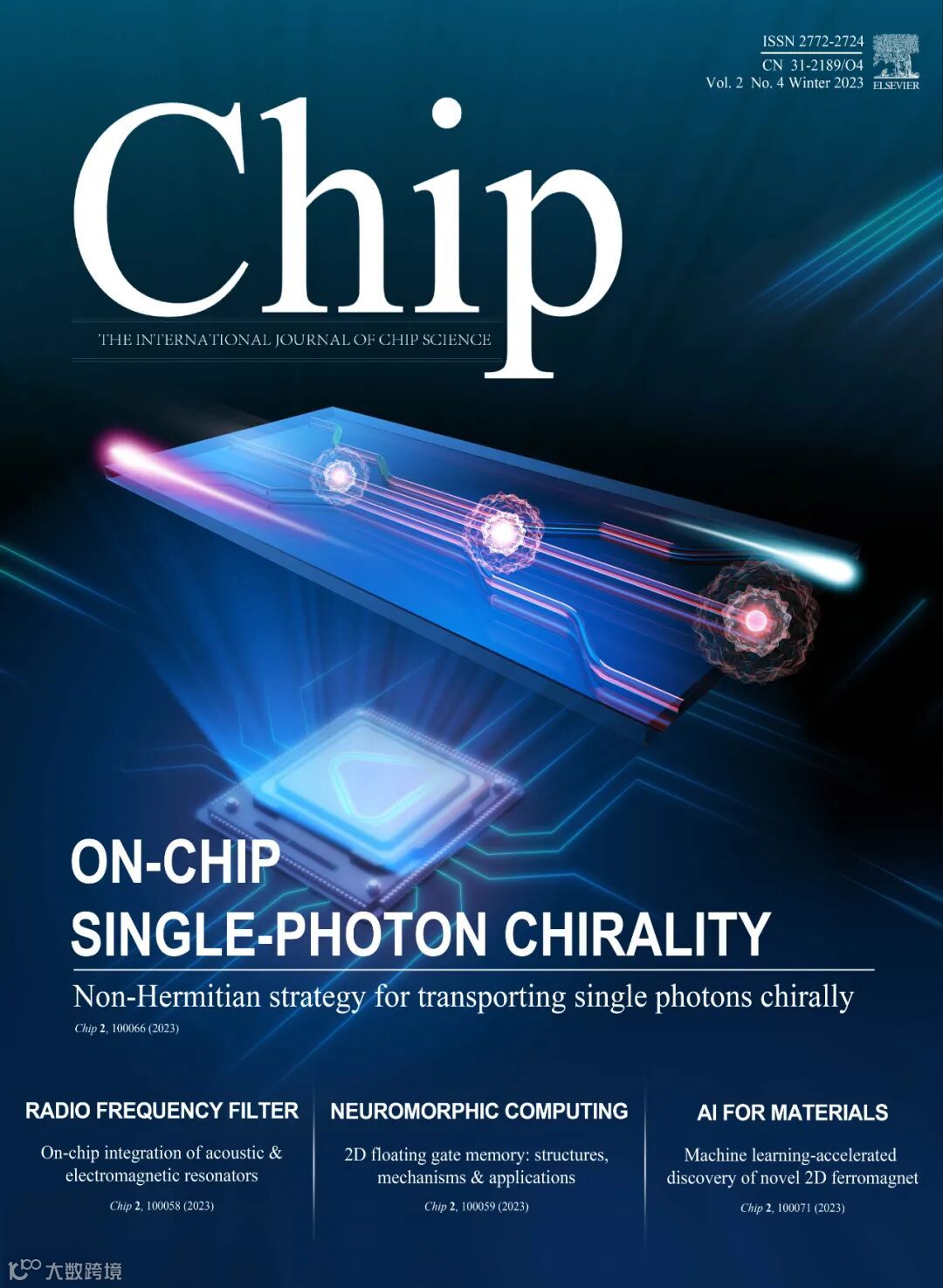
Chip 第2卷第4期(2023年冬季刊)封面
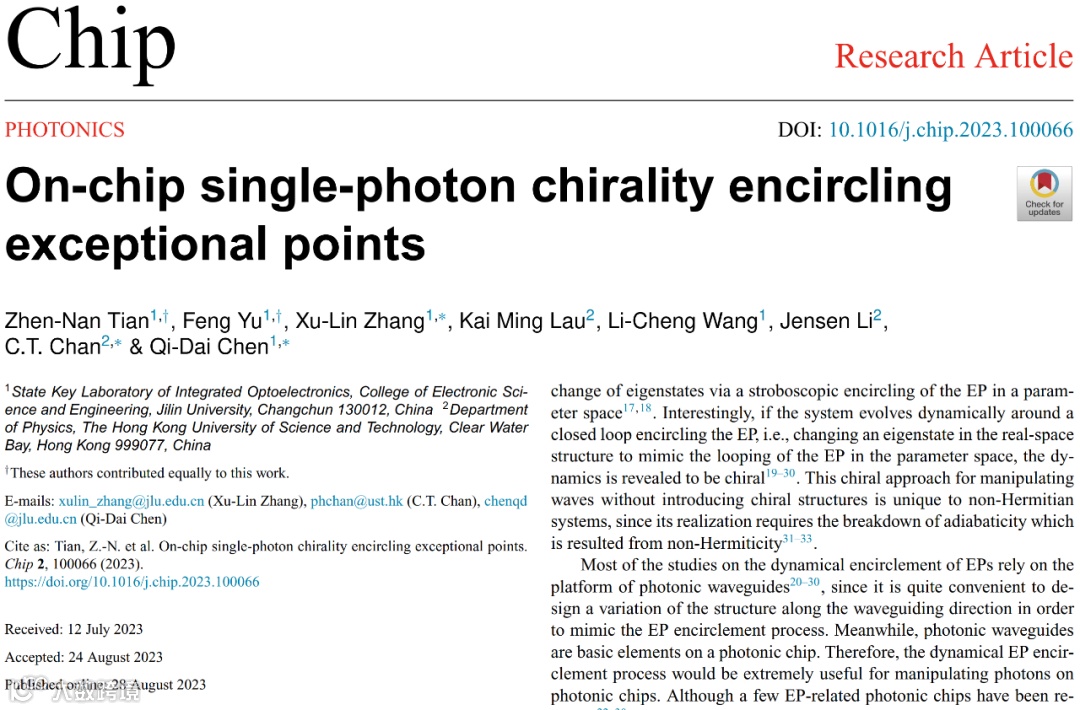
非厄米物理系统在近些年引起了研究者们广泛的兴趣,其有趣的特征包括支持一种特殊的简并点—奇异点,以及由奇异点组成的奇异线、奇异环等非厄米拓扑结构²;本征波函数可以都局域在边界的非厄米趋肤效应也成为近期的研究热点³,这些非厄米现象带来了传感增强等非厄米新应用⁴。这其中,奇异点附近自交叉的黎曼面拓扑结构,为非厄米系统中本征态的相互转化提供了高鲁棒性通道。片上光传输和光信息处理等应用的本质都是实现光子在不同状态之间的转换,因此非厄米奇异点原理为在光子芯片上操控光子提供了新手段。
基于非厄米奇异点原理的应用潜力,该工作报道了可实现单光子手性传输的非厄米片上光子器件。该非厄米器件由飞秒激光直写技术制备,器件由三根光波导组成(图1)。研究人员发展了基于飞秒激光直写的重复曝光技术,在中心波导中引入散射体,进而为系统引入所需的非厄米损耗。通过控制曝光时间、激光功率以及相邻散射体间隔,该非厄米损耗可以被精确定量控制。该非厄米系统具有反宇称-时间对称性⁵,通过引入由两个波导间距组成的参数空间,光在器件中传播可等效成在该参数空间中动态环绕一个奇异点。由于非厄米系统本征态之间不正交,动态环绕奇异点会引发非对称的本征态转化,进而可实现器件中光子态的手性传输。研究人员利用激光实验,通过测试输出光场分布,在实验上验证了光子的手性传输现象(图2)。更进一步,研究人员将单光子入射到器件中,并通过光子符合计数实验,验证了单光子的手性传输现象;研究人员也制备了叠加态,发现该手性现象仍然保持(图3)。
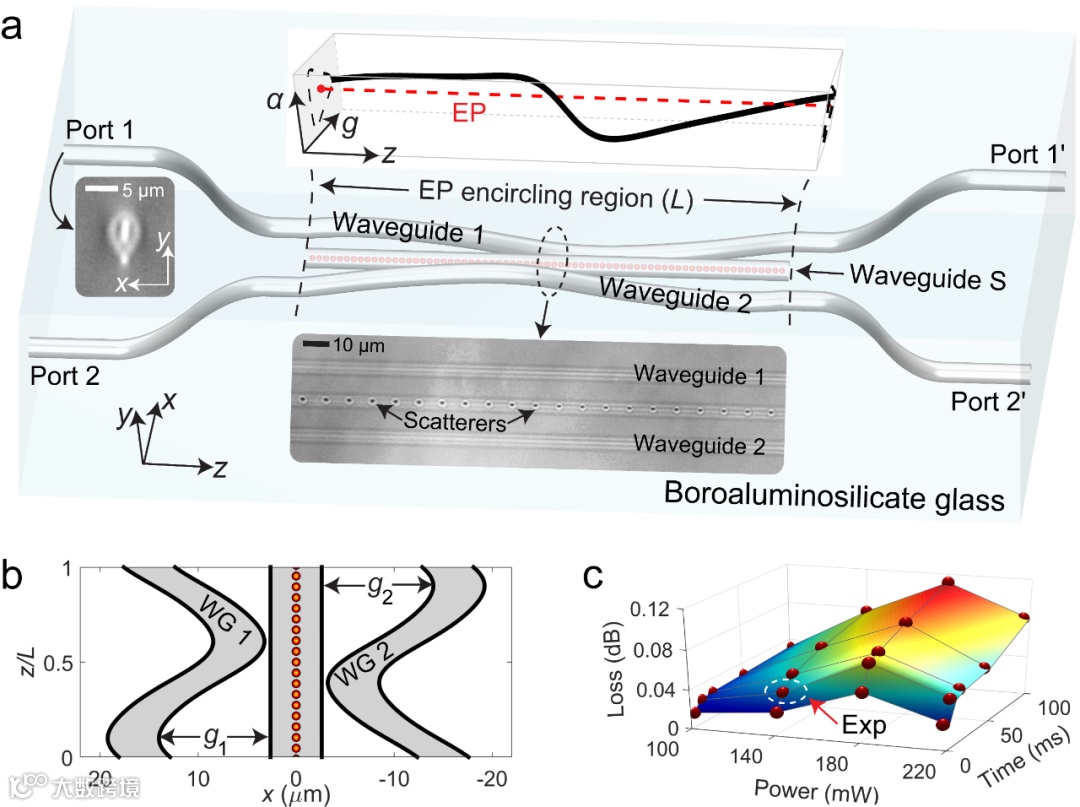
图1 | 片上非厄米光子器件结构示意图。
针对该工作的单光子实验,研究人员在理论上研究了该开放量子体系刘维尔算子的本征值,发现该系统的刘维尔奇异点与经典系统的哈密顿奇异点位于参数空间的同一点,但是由于量子系统支持叠加态,刘维尔能量面具有更复杂的拓扑结构。在该工作的基础上,若在系统中引入两个以上光子,非厄米量子体系将存在比经典体系更丰富的物理现象,未来有望利用这些原理发展非厄米片上量子新应用。
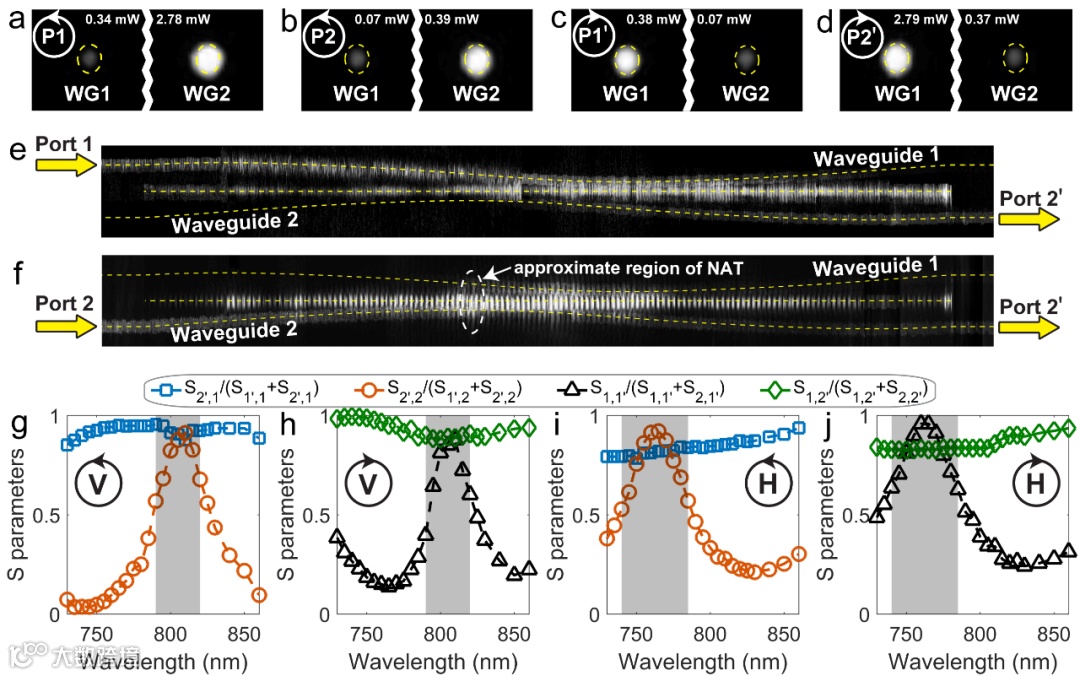
图2 | 非厄米光子器件的激光测试结果。
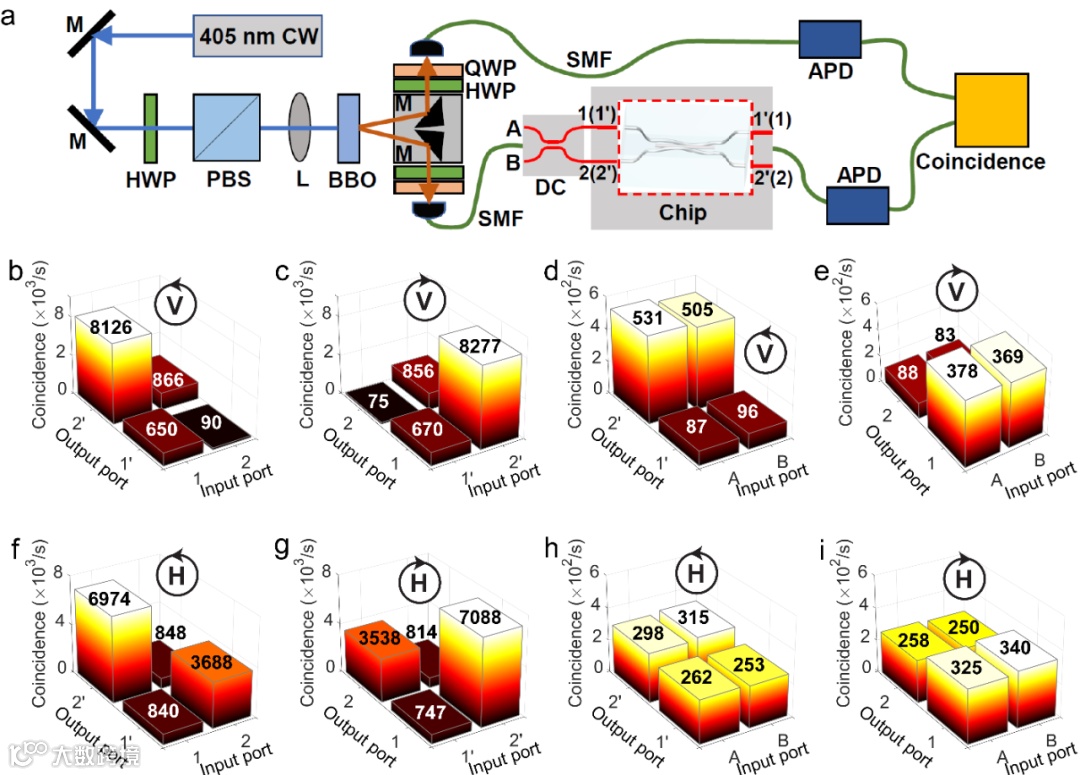
图3 | 非厄米光子器件的单光子符合计数测试结果。
On-chip single-photon chirality encircling exceptional points¹
In recent years, non-Hermitian systems have attracted extensive research interest. Their interesting features include the support of a special type of defective point, namely exceptional point, as well as non-Hermitian topological structures such as exceptional lines and exceptional rings². The non-Hermitian skin effect, where eigenstates are localized at the boundaries, has also become a hot research topic recently³. These non-Hermitian phenomena have given rise to new applications such as enhanced sensing near exceptional points⁴. Among these, the topological structure of self-intersecting energy surfaces near exceptional points can provide a robust passage for the transformation of eigenstates in non-Hermitian systems, leading new means to manipulate photons on photonic chips.
Given the potential for applications based on non-Hermitian exceptional points, this work reports a non-Hermitian on-chip photonic device that can achieve chiral transmission of single photons. The non-Hermitian device was fabricated using femtosecond laser direct writing techniques. The device consists of three photonic waveguides. The researchers have developed a re-exposure technique based on femtosecond lasers to introduce scatterers into the central waveguide, which can introduce desired non-Hermitian losses into the system. By controlling the exposure time, laser power, and spacing between adjacent scatterers, the non-Hermitian losses can be precisely controlled. This non-Hermitian system possesses anti-parity-time symmetry⁵. By introducing a parameter space composed of two gap distances, light propagation in the device can be equivalent to dynamically encircling an exceptional point in that parameter space. Due to the non-orthogonal eigenstates in non-Hermitian systems, dynamically encircling an exceptional point induces asymmetric eigenstate conversion, which can achieve chiral transmission of light in the device. The researchers have used laser experiments to test the output light field distributions and experimentally verified the chiral transmission of light. Furthermore, they have injected single photons into the device and verified the chiral transmission through photon coincidence measurements. They have also prepared superposition states and found that the chiral effect still persists.
For the single-photon experiments in this work, the researchers have theoretically studied the eigenvalues of the Liouvillian of the open quantum system. They found that the exceptional point of the Liouvillian is located at the same point in the parameter space as that of the Hamiltonian of the classical system. However, due to the fact that quantum systems support superposition modes, the energy surface of the Liouvillian has a more complex topology. Based on this work, if more than one photon is injected into the system, non-Hermitian quantum systems will exhibit richer physical phenomena than classical systems. It is expected that these principles can be used to develop new non-Hermitian quantum applications on photonic chips in the future.
参考文献:
1. Tian, Z.-N. et al. On-chip single-photon chirality encircling exceptional points. Chip 2, 100066 (2023).
2. Li, A. et al. Exceptional points and non-Hermitian photonics at the nanoscale, Nat. Nanotechnol. 18, 706-720 (2023).
3. Okuma, N., Kawabata, K., Shiozaki, K. & Sato, M. Topological origin of non-Hermitian skin effects. Phys. Rev. Lett. 124, 086801 (2020).
4. Chen, W., Özdemir, S. K., Zhao, G., Wiersig, J. & Yang, L. Exceptional points enhance sensing in an optical microcavity. Nature 548, 192-196 (2017).
5. Zhang, X. L., Jiang, T. & Chan, C. T. Dynamically encircling an exceptional point in anti-parity-time symmetric systems: asymmetric mode switching for symmetry-broken modes. Light Sci. Appl. 8, 88 (2019).
作者简介

Chip(ISSN:2772-2724,CN:31-2189/O4)是全球唯一聚焦芯片类研究的综合性国际期刊,已入选由中国科协、教育部、科技部、中科院等单位联合实施的「中国科技期刊卓越行动计划高起点新刊项目」,为科技部鼓励发表「三类高质量论文」期刊之一。
爱思唯尔Chip官网: