
文章来源:FUTURE远见
近日,清华大学任天令团队以「Challenges and recent advances in HfO₂-based ferroelectric films for non-volatile memory applications」¹为题在Chip上发表长篇综述论文,对氧化铪基铁电存储技术以及当前存在的挑战进行了概述,并提出了对未来研究方向与发展前景的展望。共同第一作者为邵明昊和赵瑞婷,通讯作者为任天令和刘厚方。Chip是全球唯一聚焦芯片类研究的综合性国际期刊,是入选了国家高起点新刊计划的「三类高质量论文」期刊之一。
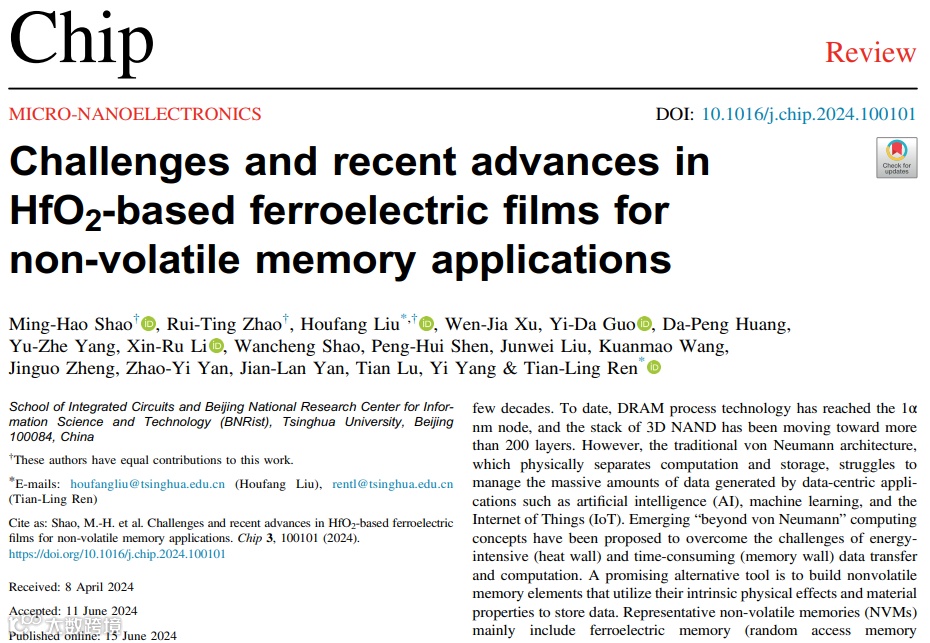
该综述聚焦于铁电HfO₂应用的发展,主要对铁电HfO₂材料的制备方法、铁电存储器应用、限制其产业化的关键因素以及相应的优化机制进行系统总结与介绍,并对铁电HfO₂器件的发展前景进行了展望。
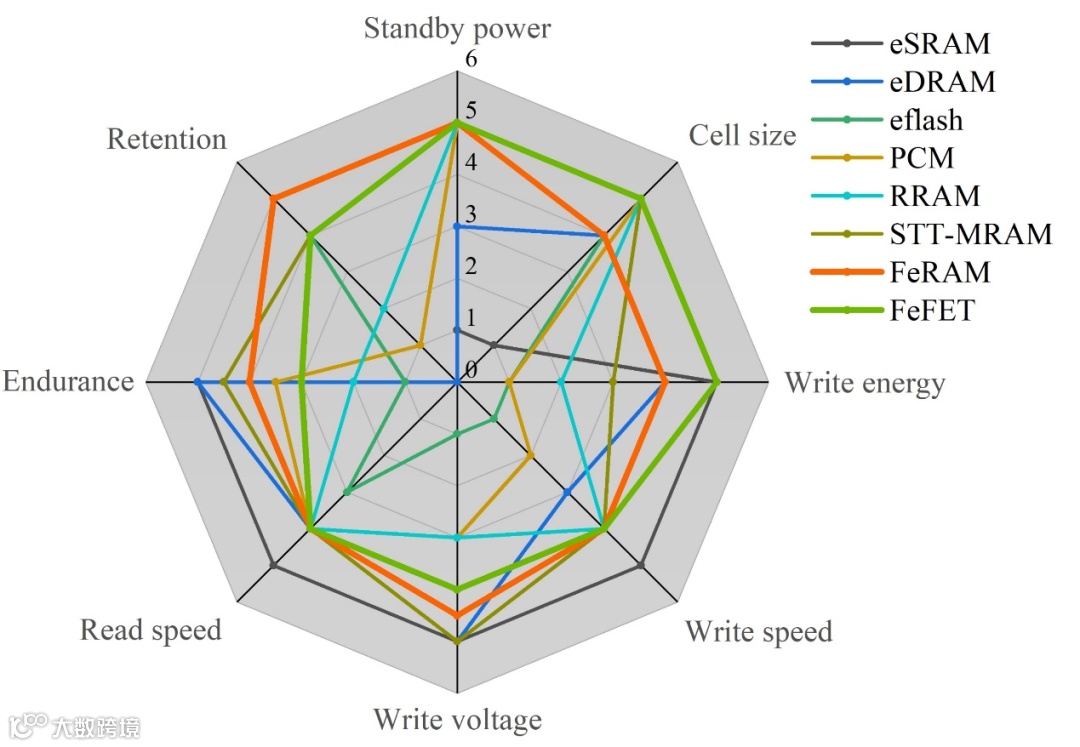
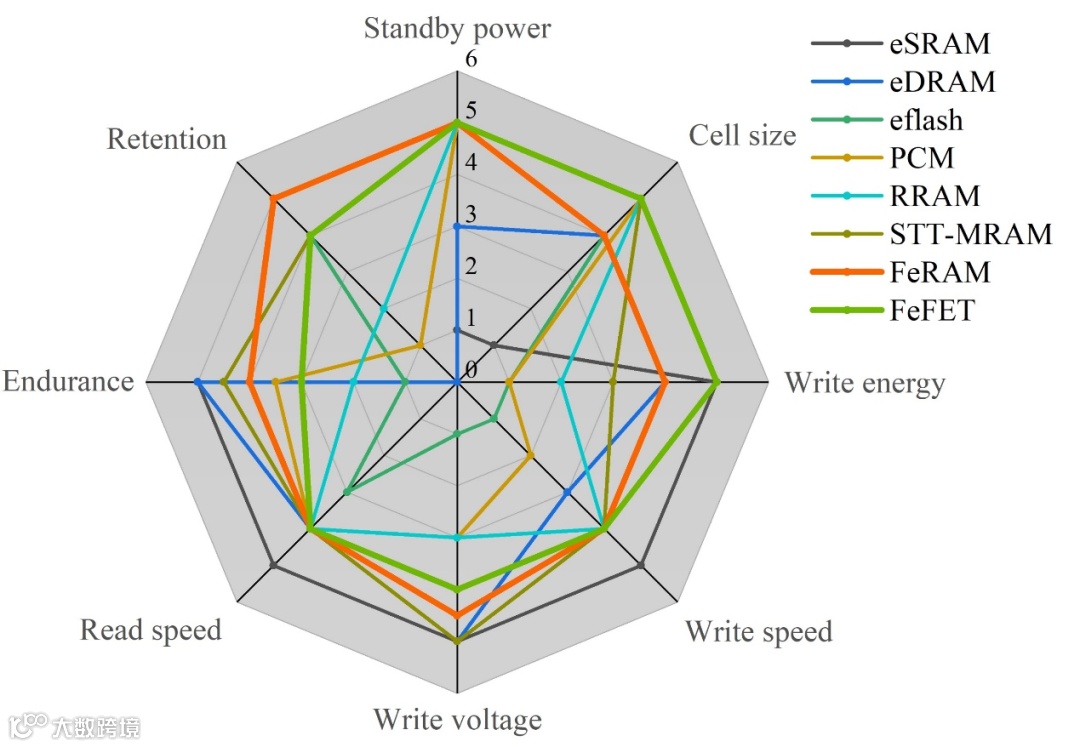
图1 | 主流存储技术间的关键性能比较。其中FeRAM与FeFET基于铁电HfO₂,性能指数越高,表明器件性能越好。
铁电存储技术的发展可以追溯到1952年³,然而传统的钙钛矿型铁电材料存在固有的弊端,如厚度大,与互补金属氧化物半导体(Complementary Metal Oxide Semiconductor,CMOS)工艺不兼容,退火温度较高以及需要单晶薄膜等,限制了铁电存储器的进一步发展。2011年Si掺杂HfO₂中铁电性的发现为铁电存储技术的发展带来了新的曙光⁴,因为它具有一系列出色物理特性,如低至1 nm的超薄厚度,低退火温度,高矫顽场以及与现代CMOS工艺的良好兼容性,受到了广泛的关注与研究⁵。尽管许多工作都对铁电HfO₂的发展进行了总结,但仍缺少对铁电HfO₂的应用发展、面临的挑战以及可能的优化方向方面的概述。
该综述首先阐述和分析了目前铁电HfO₂的三种主要制备方法的研究进展,包括原子层沉积(Atomic Layer Deposition,ALD),脉冲激光沉积(Pulsed Laser Deposition,PLD)和溅射(Sputter Deposition),并概述了氧化铪铁电性起源的研究进展。接着介绍了三种基于氧化铪的铁电存储器,包括FeRAM, FeFET和FTJ,如图2所示,分别阐述分析了三种存储技术的当前进展以及各自的优缺点,并总结了在氧化铪基铁电材料与器件方面取得的关键成果,如图3所示。尽管如此,为了实现铁电氧化铪的产业化,仍有许多工作亟需开展,尤其是氧化铪铁电材料的性能优化。因此,该综述接下来从材料的角度总结了铁电氧化铪关键性能的研究进展,包括觉醒效应、疲劳效应、保持特性以及一致性,并分析了不同的优化途径。最后,对氧化铪基铁电存储器在实现存内计算,突破冯•诺依曼瓶颈方面的应用进行了总结与展望。
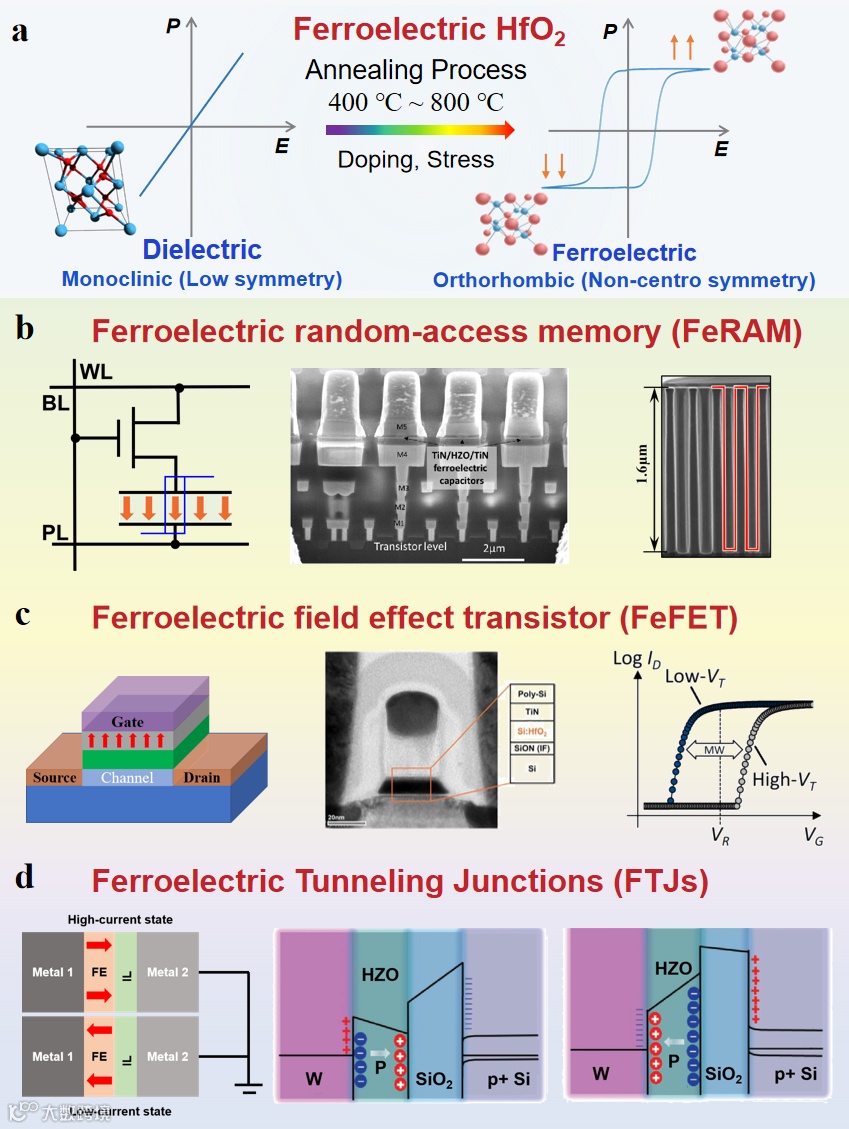
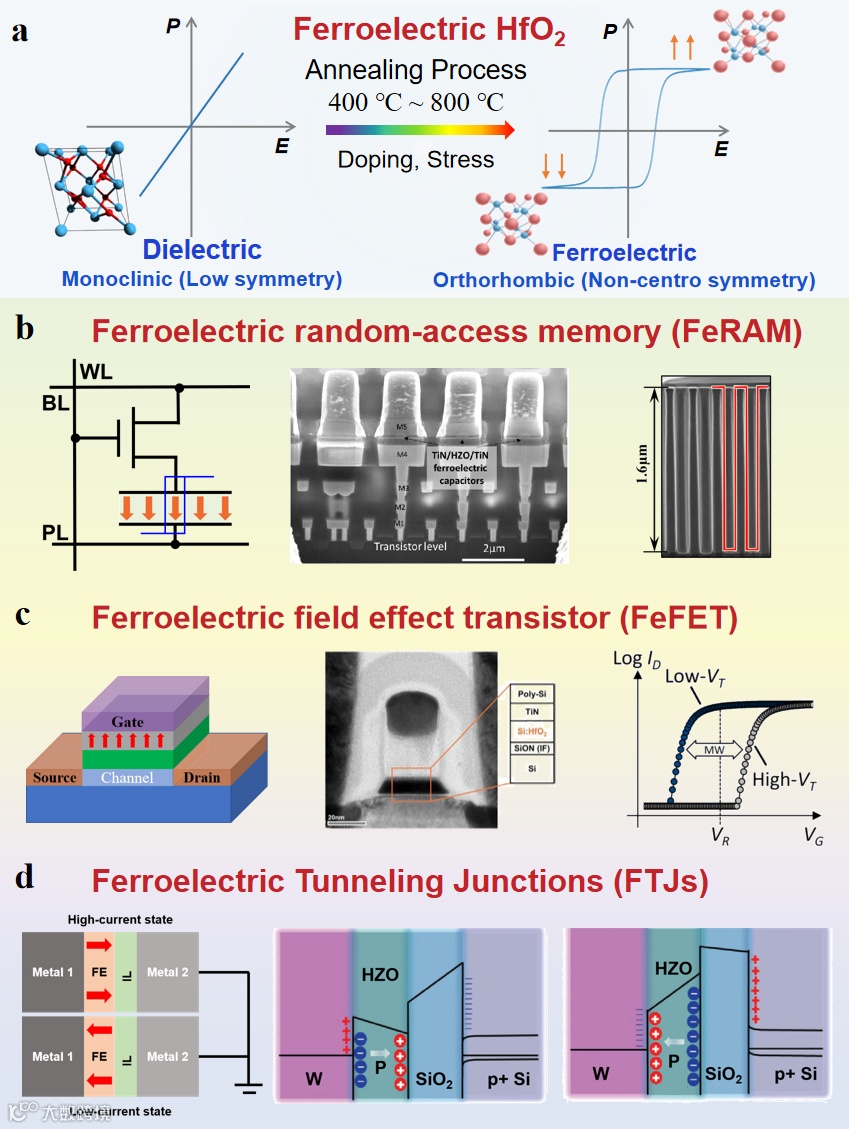
图2 | 铁电氧化铪的基本性质及应用。a, 氧化铪的晶格结构和相应的电滞回线示意图。b, FeRAM的1T-1C单元示意图、MFM电容结构的SEM图以及3D垂直铁电电容阵列的SEM图。c, FeFET的结构示意图、SEM图以及转移特性曲线。d, FTJ的结构示意图与工作原理。
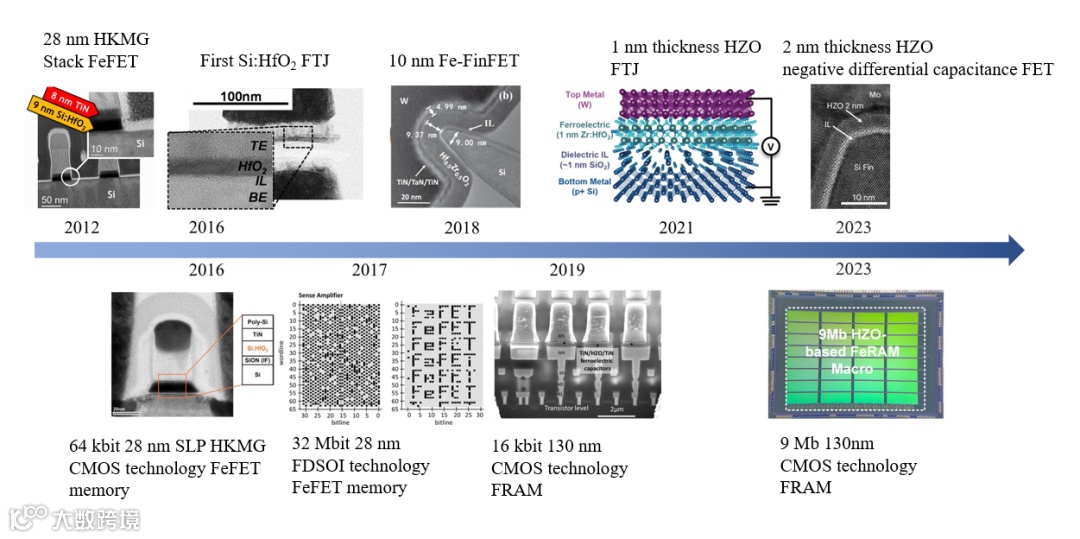
图3 | 氧化铪基铁电存储器的代表性研究进展。其中时间轴的上部分显示单个设备的进展,下部分表示集成阵列的进展。
Challenges and recent advances in HfO₂-based ferroelectric films for non-volatile memory applications¹
This review focuses on the development of ferroelectric HfO₂, mainly summarizes and introduces the preparation methods of ferroelectric HfO₂ materials, ferroelectric memory applications
(random access memory (FeRAM), ferroelectric transistor (FeFET) and ferroelectric tunneling junction (FTJ)), the key factors limiting its industrialization, and the corresponding optimization mechanism, and offers insights into future research directions and prospects.
With the development of data-centric applications such as artificial intelligence (AI), machine learning and the internet of things (IoT), the data that computers need to process has exploded, and the delay problem caused by the mismatch between CPU and memory speed has become increasingly prominent, limiting the performance of computers. A promising approach is to use the inherent physical effects and material properties of memory cells to store data, achieving characteristics of non-volatility, fast speed and low power to fill the 「memory wall」. Representative non-volatile memories mainly include ferroelectric memory (FeRAM, FeFET and FTJ, magnetoresistive random access memory (MRAM), resistive random access memory (RRAM) and phase change random access memory (PCRAM)). Among them, ferroelectric memory stands out to be a promising nonvolatile storage technology with low power consumption, high speed, high endurance, and anti-irradiation capability², as shown in Fig. 1.
Ferroelectric memory technology was first introduced in 1952³. However, several inherent weaknesses of traditional ferroelectric perovskite materials, such as relatively large thickness, toxicity to the complementary metal-oxide-semiconductors (CMOS) process, high annealing temperature, and the requirement for monocrystalline films, have greatly hindered the further development of ferroelectric memory.
Since ferroelectricity in Si-doped HfO₂ with a fluorite crystal structure was first reported in 2011, widespread researches have been concentrated on ferroelectric HfO₂⁴. In comparison to traditional perovskite ferroelectric materials such as Pb(Zr,Ti)O₃ (PZT), SrBi₂Ta₂O₉ (SBT), and BaTiO₃ (BTO), HfO₂-based ferroelectric materials have exhibited a series of superior physical properties such as ultrathin thickness even down to 1 nm, low annealing temperature, high coercive electric field and perfect compatibility with modern CMOS processes, making them ideal ferroelectrics for high-performance memory devices⁵. Numerous review papers have been published to summarize the progress of ferroelectric HfO₂. However, relevant reviews on the progress, challenges, and optimal proposals for the application of ferroelectric HfO₂ still remain scarce. This review focuses on the development of ferroelectric HfO₂ applications. Firstly, we introduce the preparation of ferroelectric HfO₂ materials, including the investigations on the physical mechanism of ferroelectric origin. Subsequently, the current progress in ferroelectricity is presented, specifically in the areas of FeRAM, FeFETs, and FTJs, as shown in Fig. 2. Afterwards, the key factors that restrict the further commercial application of ferroelectric HfO₂ and the corresponding optimization schemes are then summarized. Finally, the prospects of ferroelectric HfO₂-based devices are presented.
In conclusion, HfO₂-based ferroelectric memories have achieved significant progress over the past decade, as depicted in Fig. 3. Nevertheless, much work remains to be conducted to elucidate the physical mechanisms and improve the integrated performance, which will be the focus for the future research. This paper provides a comprehensive review of recent advances in hafnium-based ferroelectric preparation methods, various ferroelectric devices and material parameter optimization, beneficial for a total understanding of ferroelectric HfO₂.
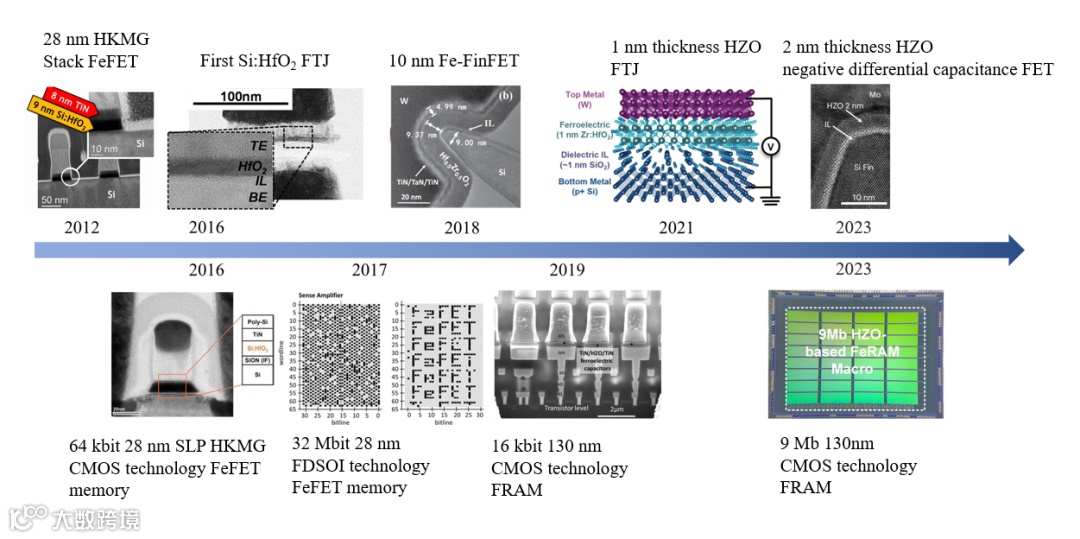
Fig. 3 | Representative advances in HfO₂-based ferroelectric memories. The upper part of the timeline shows the progress of a single device, and the lower part presents the progress of integrated arrays.
参考文献
作者简介
邵明昊,清华大学集成电路学院博士,研究方向主要为铪基铁电材料的原理探索与性能优化,以及其在非易失存储中的应用。
Minghao Shao obtained his PhD degree in School of Integrated Circuits, Tsinghua University. He is working on the optimization of ferroelectric HfO₂ and corresponding applications in non-volatile memory.

Houfang Liu is an associate research fellow in Beijing National Research Center for Information Science and Technology. He received his PhD degree from Institute of Physics,Chinese Academy of Sciences in 2013. His research interests include Intelligent sensing chip and integrated microsystem, new micro and nano functional devices integrating memory and logic, and novel RF devices and system applications. He has published more than 50 articles in recent years.
任天令,教育部长江学者特聘教授,国家杰出青年基金获得者。1997年博士毕业于清华大学现代应用物理系,2003年起担任清华大学微电子所(集成电路学院)教授。近年来,承担国家自然科学重点基金、科技部重点研发计划等多项国家重要科技项目。主要研究方向为智能微纳电子器件、芯片与系统,包括:智能传感器与智能集成系统,二维纳电子器件与芯片,柔性、可穿戴器件与系统等。在国际重要期刊和会议上发表论文600余篇,拥有专利70余项。
Tianling Ren is Changjiang Distinguished Professor of Ministry of Education, and Distinguished Young Scholar of National Nature Science Foundation of China. He received PhD degree from Department of Physics, Tsinghua University in 1997, and has been a professor at the Institute of Microelectronics (School of Integrated Circuits), Tsinghua University since 2003. He has undertaken many important research projects such as National Natural Science Foundation, and National High Technology Program of Ministry of Science and Technology. His research interest covers a broad range of advanced micro- and nano- devices and systems, including 2D-material based devices, sensors and MEMS, memory device, flexible devices, etc. He has published more than 600 papers in international journals and conferences, and more than 70 patents.