

文章来源:FUTURE | 远见
近日,清华大学任天令教授团队以「Frequency-tunable sound amplification in a conch-like cavity with graphene thermoacoustic resonance」为题在Science Advances上发表研究论文,设计了一种结合石墨烯与3D打印腔体的可穿戴声学器件,通过热声共振机制实现了谐振频率可调谐与声压增强。华东师范大学副教授韦雨宏、清华大学博士生郭展锋、清华大学工程师林涛等为共同一作,通讯作者为清华大学任天令教授、杨轶教授、田禾教授和陶璐琪副研究员。
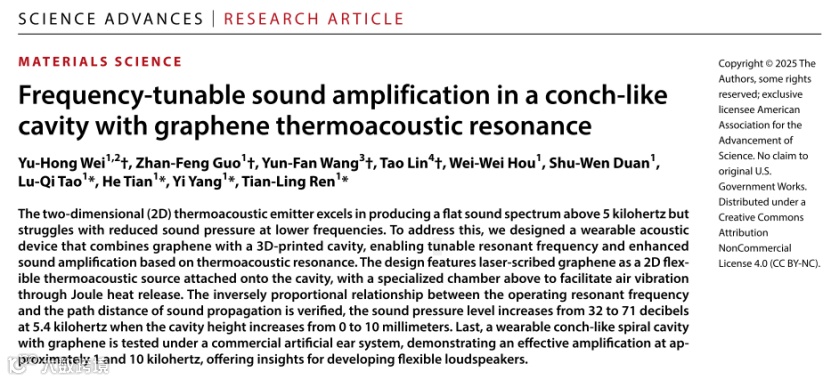
本研究针对二维热声器件在5 kHz以上频段声谱平坦、但低频声压不足的问题,设计了一种结合石墨烯与3D打印腔体的可穿戴声学器件。该器件以激光直写石墨烯作为二维柔性热声源附着于海螺式螺旋腔体底部,基于热声效应释放焦耳热引发空气振动形成声音,经过腔体内部螺旋结构实现热声共振,其谐振频率可调并增强了共振声压。实验验证了器件工作的谐振频率与声传播路径距离的反比关系:当腔体高度从0增至10 mm时,5.4 kHz频率下的声压级从32 dB提升至71 dB。最后在商用人工耳系统测试中,实现1 kHz与10 kHz双频点的有效声放大,为柔性扬声器开发提供新思路。
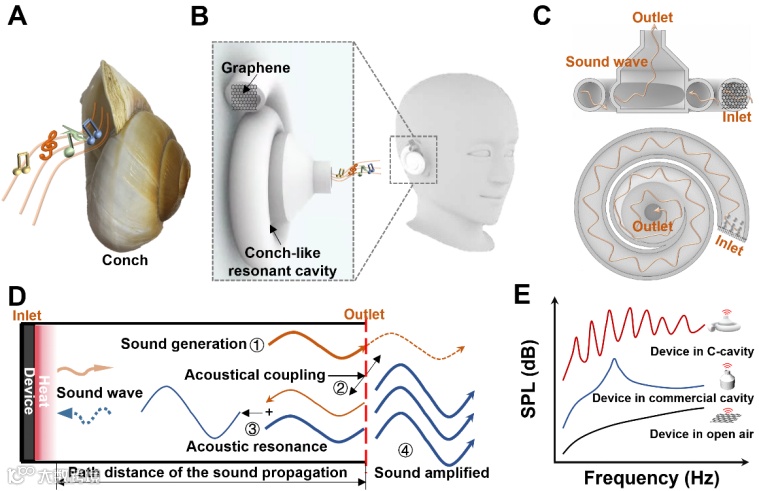
图1
如图1所示,受天然海螺壳体的声学特性启发,研究人员开发出一种可穿戴式类海螺的亥姆霍兹共振腔(图1A-C)。该装置将超薄石墨烯热声器件集成于腔体入口,通过独创的螺旋腔体设计实现热声共振放大机制:热声转换产生声波→腔体出口声阻抗变化引发声波反射→反射波与原声波形成共振→亥姆霍兹腔增强声压(图1D)。性能测试表明,装配有该仿生腔体的声学器件在可听频域内呈现多频段增强效应,声压提升效果显著优于开放环境及传统耳机壳体,为柔性声学薄膜扬声器在智能助听设备等领域的应用开辟新路径(图1E)。
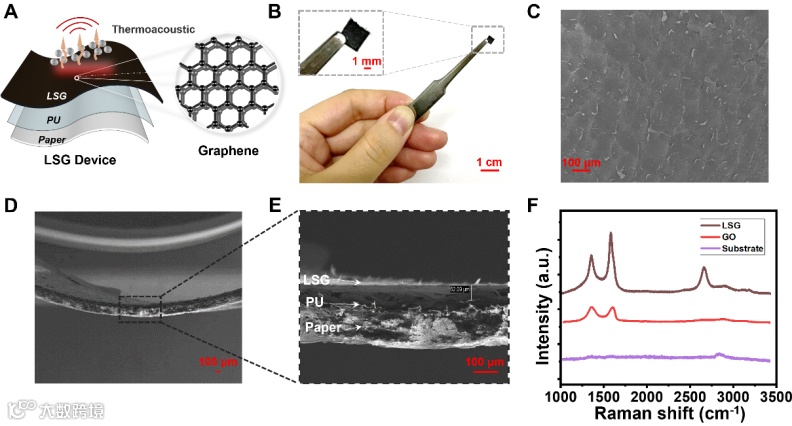
图2
如图2A所示为基于石墨烯的多层声源器件结构。该器件以激光直写石墨烯(LSG)为核心,中层为聚氨酯柔性膜,下层为透气纸纤维基底,形成独特的「三明治」结构。制备过程包括氧化石墨烯涂覆、激光还原及电极连接,其核心创新在于超薄PU-LSG复合体可贴附于任意曲面,器件尺寸仅3.5×3.5 mm(图2B)。扫描电镜显示LSG表面均匀平整(图2C),截面呈现50 μm厚三层柔性结构(图2D-E)。拉曼光谱表明激光处理后出现多层石墨烯特征峰(图2F)。
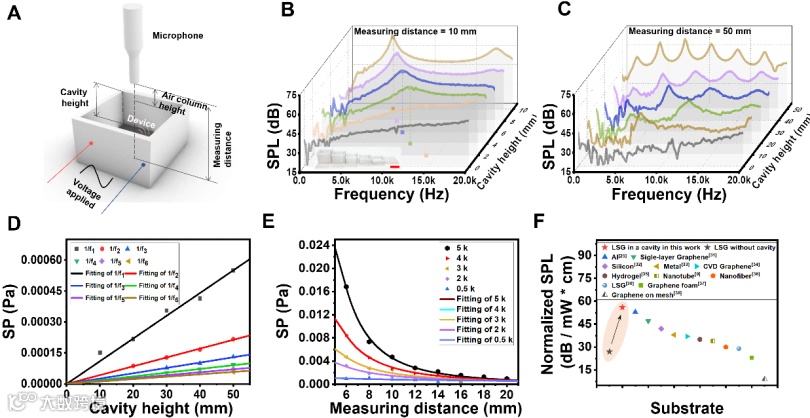
图3
石墨烯声学器件及仿生腔体的增效机制获实验验证(图3):研究团队搭建了标准化测试平台(图3A),首先采用3D打印制备了直腔体,底部集成LSG声源,顶部配置高灵敏麦克风。实验表明,当腔体高度从0增至10 mm时,5.4 kHz频率下的声压级实现39 dB到71 dB跨越式提升,并验证了声传播路径与谐振频率成反比(图3B)。随着腔体高度增至50 mm,可听域范围内谐振峰数量增至六个,基础频率f1由17.2 kHz降至1.8 kHz(图3C-D)。研究证实了腔体高度,即声波传播距离,是影响谐振频率的核心参数。性能对比显示(图3F),该器件在5.4 kHz处达56 dB·mW⁻¹·cm⁻¹,较无腔体状态提升107%。
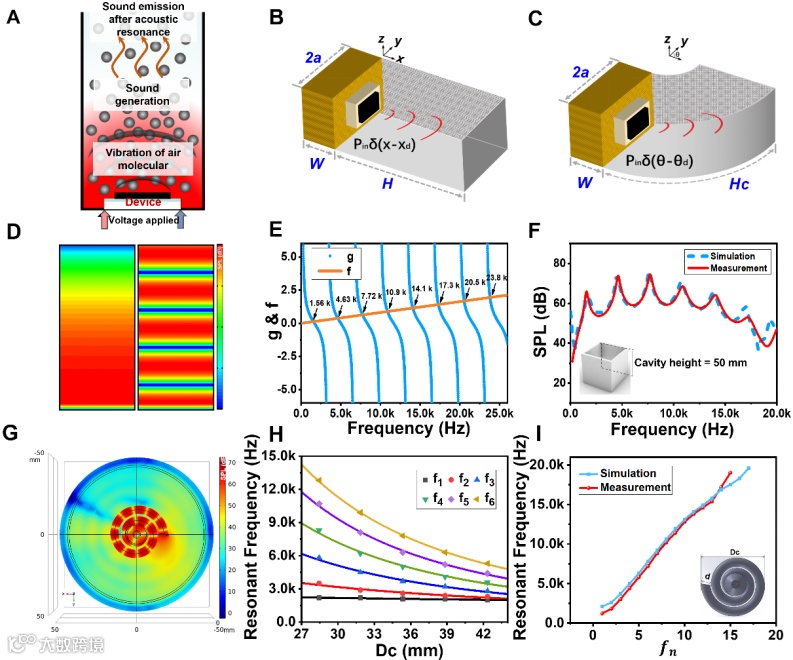
研究团队创新性提出了热声共振的物理模型(图4):区别于传统扬声器的机械振膜发声原理,石墨烯器件通过焦耳热激发空气振动(图4A),实现100%空间利用率。实验测试表明螺旋腔体中的声传播路径等效于直腔高度(图4B、C),其谐振频率随腔体总尺寸增大而降低,当总尺寸从28 mm增至42 mm时,谐振峰f6从12.8 kHz降至5.3 kHz(图4H)。通过构建声场分布模型(图4D、G),实现了声压级仿真与实测数据的高度吻合(图4F、I),验证了该理论模型的适用性。
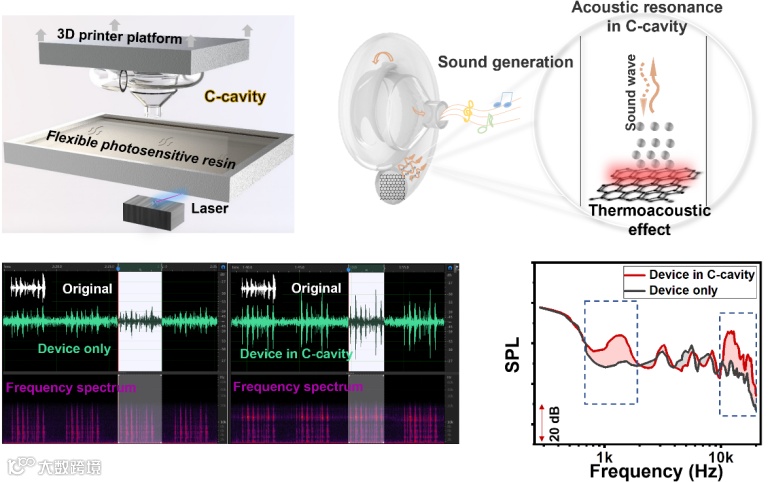
图5
如图5所示,研究团队采用光固化3D打印技术,制造出类海螺的腔体耳机。通过调节螺旋腔体高度精准控制谐振频率,实测表明,该器件在1 kHz和10 kHz频段附近实现明显的共振增强,整体声压较开放环境传统提升显著,为智能助听设备产业化提供了可能性。
Frequency-tunable sound amplification in a conch-like cavity with graphene thermoacoustic resonance
The 2D thermoacoustic emitter excels in producing a flat sound spectrum above 5 kilohertz but struggles with reduced sound pressure at lower frequencies. To address this, we designed a wearable acoustic device that combines graphene with a 3D-printed cavity, enabling tunable resonant frequency and enhanced sound amplification based on thermoacoustic resonance. The design features laser-scribed graphene as a 2D flexible thermoacoustic source attached onto the cavity, with a specialized chamber above to facilitate air vibration through Joule heat release. The inversely proportional relationship between the operating resonant frequency and the path distance of sound propagation is verified, the sound pressure level increases from 32 to 71 decibels at 5.4 kilohertz when the cavity height increases from 0 to 10 millimeters. Last, a wearable conch-like spiral cavity with graphene is tested under a commercial artificial ear system, demonstrating an effective amplification at approximately 1 and 10 kilohertz, offering insights for developing flexible loudspeakers.
参考文献
1. S. Bae, h. Kim, Y. lee, X. Xu, J. S. Park, Y. Zheng, J. Balakrishnan, t. lei, h. Ri Kim, Y. il Song, Y.- J. Kim, K. S. Kim, B. Özyilmaz, J.- h. Ahn, B. h. hong, S. iijima, Roll- to- roll production of 30- inch graphene films for transparent electrodes. Nat. Nanotechnol. 5, 574-578 (2010).
2. Tao L. Q., Tian H., Liu Y., Ju Z. Y., Pang Y., Chen Y. Q., Wang D. Y., Tian X. G., Yan J. C., Deng N. Q., Yang Y. & Ren T. L. An intelligent artificial throat with sound-sensing ability based on laser induced graphene. Nature communications, 8(1), 14579 (2017).
3. Q. Yang, W. Jin, Q. Zhang, Y. Wei, Z. Guo, X. li, Y. Yang, Q. Luo, H. Tian, T.- L. Ren, Mixed-modality speech recognition and interaction using a wearable artificial throat. Nat. Mach. Intell. 5, 169-180 (2023).
论文链接:
https://www.science.org/doi/full/10.1126/sciadv.adv2801
作者简介
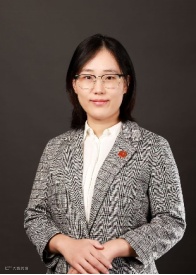
韦雨宏,博士毕业于清华大学集成电路学院,现任华东师范大学通信与电子工程学院副教授。研究方向:柔性电子器件、声学传感器、声学信号识别及分类、柔性可穿戴健康监测传感器及系统。以第一或共一作者身份发表SCI期刊论文7篇,会议论文1篇,授权专利2项。曾获清华大学优秀博士毕业生、北京市优秀毕业生等荣誉。
Yu-Hong Wei, a Ph.D. graduate from the School of Integrated Circuits at Tsinghua University, is currently an associate professor at the School of Communication and Electronic Engineering at East China Normal University. Research direction: Flexible electronic devices, acoustic sensors, acoustic signal recognition and classification, flexible wearable health monitoring sensors and systems. Published 7 SCI journal papers, 1 conference paper, and 2 authorized patents as the first or co-author. Has won honors such as Outstanding PhD Graduate from Tsinghua University and Outstanding Graduate from Beijing.

郭展锋,清华大学集成电路学院在读博士生,研究方向主要为二维材料、柔性电子及相关系统级应用。
Zhan-Feng Guo is currently a Ph.D. student at the School of Integrated Circuit Science and Engineering, Tsinghua University, specializing in two-dimensional materials, flexible electronics, and their system-level applications.
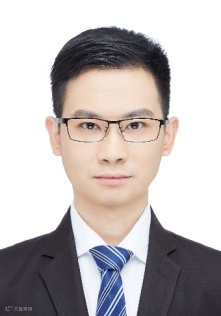
林涛,清华大学材料学院实验教学中心工程师。负责国家级材料科学与工程虚拟仿真实验教学中心建设,负责校级/市级3D打印大赛及增材制造平台运维,主讲《增材制造之材》《材料科学与工程实验四》等四门实验课程。主持教育部协同育人项目2项、校级创新基金2项,发表SCI论文8篇,获软件著作权20项、专利11项。获清华大学实验技术成果一等奖(第十八届)、二等奖(第十七届),指导学生获第三十五届学生实验室贡献奖一等奖。
Lin Tao, Engineer at Tsinghua University's Materials Science Experimental Teaching Center. Leads the National Virtual Simulation Center for Materials Science and Engineering, directs Tsinghua's 3D Printing Competitions (university/city level), and manages the center's additive manufacturing platform. Teaches experimental courses including 「Additive Manufacturing Materials」 and 「Principles of 3D Printing」. Holds 2 Ministry of Education collaborative projects, 2 Tsinghua innovation funds, 8 SCI papers, 20 software copyrights, and 11 patents. Awarded First Prize (18th) and Second Prize (17th) in Tsinghua Experimental Technology Achievement Awards, guided students to win First Prize in 35th Student Lab Contribution Award.
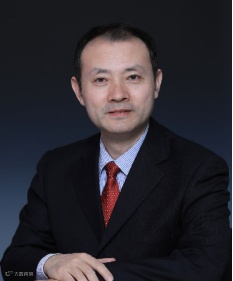
任天令,清华大学信息学院副院长,长江学者特聘教授,国家杰青。现任环境与健康传感技术研究中心副主任。主持国家自然科学重点基金、科技部重点研发计划等国家级项目十余项。主要研究智能微纳电子器件与系统,突破性成果包括世界最小栅极晶体管、智能人工喉、仿生突触器件等。在Nature系列、Advanced Materials等顶级期刊发表论文750余,入选Elsevier全球高被引学者。获授权发明专利70余项,引领柔性可穿戴器件与智能传感系统发展。
Tian-Ling Ren, Vice Dean of Tsinghua's School of Information Science and Technology, Chang Jiang Scholar, and National Distinguished Young Scientist. Serves as Deputy Director of the Center for Environmental and Health Sensing Technology. Leads over 10 national projects, including NSFC Key Fund and MOST Key R&D Program. Pioneers in intelligent micro/nano-electronics with breakthroughs: world's smallest-gate transistor, smart artificial throat, and bio-inspired synaptic devices. Published 750+ papers in Nature series, Advanced Materials, etc., named Elsevier Highly Cited Researcher (2018-2022). Holds 70+ invention patents, advancing flexible wearable devices and intelligent sensing systems.
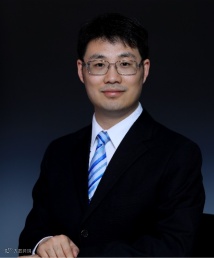
田禾,清华大学集成电路学院长聘副教授、党委委员、集成纳电子所副所长。2024年入选国家级科技创新领军人才,2020年获国家优青。主持科技部青年科学家项目、国家自然基金等10余项。在Nature、Science Advances、IEDM等顶刊发表SCI论文200余篇,他引超万次,h指数60。成果入选2022年中国十大科技新闻、半导体十大进展。获中国电子学会自然科学一等奖、MIT-TR35 China、教育部霍英东基金,入选中国科协青年人才托举工程。
He Tian, Tenured Associate Professor at Tsinghua University's School of Integrated Circuits, deputy Director of the Nanoelectronics Institute. Awarded National Leading Scientist in S&T Innovation (2024) and National Excellent Young Scientist (2020). Leads 10+ national projects including MOST Young Scientist Program. Published 200+ SCI papers (Nature, Science Advances; IEDM papers, etc) with 10,000+ citations (h-index 60). Research achievements selected as 「China's Top 10 S&T News」 (2022) and 「Semiconductor Top 10 Advances」 (2022). Honors include CEI Natural Science First Prize, MIT-TR35 China, and Ho Leung Ho Lee Foundation Grant.
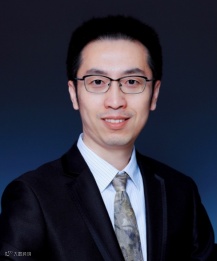
杨轶,清华大学集成电路学院副教授、博导、党委副书记。复旦大学电子工程系本科,清华大学博士。长期从事智能微纳器件与系统研究,在二维纳电子器件、纳米声学器件等领域取得突破,主持国家重大科技专项、重点研发计划等国家级项目10余项。发表Nature Communications、Science Advances等论文150余篇,获授权发明专利20余项。荣获中国电子学会自然科学一等奖、江苏省科技三等奖。现任IEEE电子器件学会北京分会主席,担任IEDM等国际会议技术委员,Sensors等期刊编委。
Yi Yang, Associate Professor and PhD Supervisor at Tsinghua University's School of Integrated Circuits. Serves as Deputy Party Secretary. B.S. from Fudan University, Ph.D. from Tsinghua. Pioneers in intelligent micro/nano-devices and systems with breakthroughs in 2D nanoelectronics and nanoacoustic devices. Leads 10+ national projects, including Major National S&T Projects. Published 150+ papers in Nature Communications, Science Advances, etc. Holds 20+ invention patents. Awarded CEI Natural Science First Prize and Jiangsu Provincial S&T Third Prize. Current Chair of IEEE EDS Beijing Chapter, Technical Committee Member for IEDM, and Editor for Sensors.
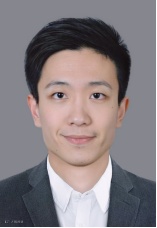
陶璐琪,清华大学信息国家研究中心副研究员,国家自然科学基金委评审专家。研究领域涉及可穿戴器件与系统、智能传感材料与器件、健康监测与人机交互系统。以第一或通讯作者发表SCI论文40余篇,包括Nature Communications, ACS Nano, Advanced Functional Materials, Infomat等,IEDM等EI论文4篇,授权发明专利10余项,主持国家自然科学基金等科研项目8项。智能石墨烯人工喉工作荣获2017年「中国十大重大技术进展」等,获「重庆英才」青年拔尖人才等荣誉。
Lu-Qi Tao, Associate Researcher at the National Center for Information Science and Technology at Tsinghua University, and Evaluation Expert at the National Natural Science Foundation of China. The research fields involve wearable devices and systems, intelligent sensing materials and devices, health monitoring and human-computer interaction systems. Published over 40 SCI papers as the first or corresponding author, including 4 EI papers in Nature Communications, ACS Nano, Advanced Functional Materials, Infomat, IEDM, etc., authorized over 10 invention patents, and led 8 research projects including the National Natural Science Foundation of China. The intelligent graphene artificial throat work has won honors such as the 「Top Ten Major Technological Advances in China」 in 2017 and the 「Chongqing Talents」 Young Top notch Talents.