


文章来源:FUTURE | 远见 Chip编辑部
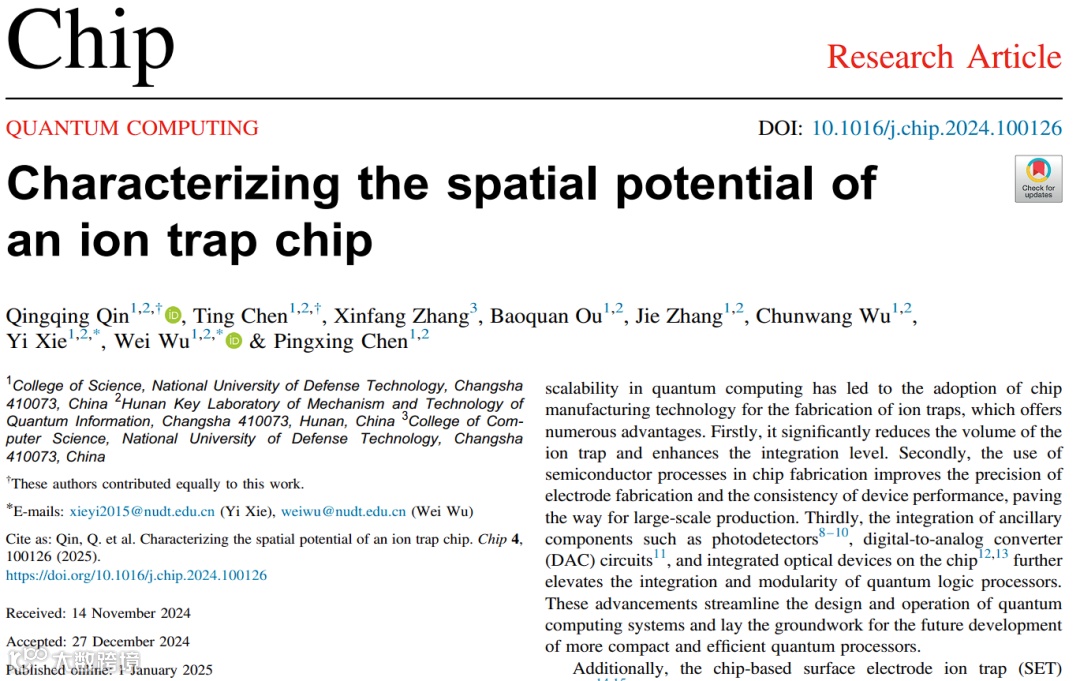
近日,国防科技大学陈平形团队以「Characterizing the spatial potential of an ion trap chip」¹为题在Chip上发表研究论文,提出了一种基于多类型数据优化方法的离子阱芯片空间电势表征技术。共同第一作者为秦青青、陈婷,通讯作者为谢艺、吴伟。本文被遴选为本期Featured in Chip编辑特选文章之一。Chip是全球唯一聚焦芯片类研究的综合性国际期刊,已入选「中国科技期刊卓越行动计划高起点新刊项目」、「中国科技期刊卓越行动计划二期项目-英文梯队期刊」,为科技部鼓励发表「三类高质量论文」期刊之一。
Characterizing the spatial potential of an ion trap chip¹
Surface-electrode ion traps are key devices for realizing scalable ion-trap quantum computing². Precisely characterizing³ and controlling the potential distribution of each electrode in the trapping space is one of the essential technologies for achieving certain ion chain spatial arrangement⁴, precise transport control⁵, and is crucial for the scalability of ion qubits. A research team led by Professor Pingxing Chen at the National University of Defense Technology has proposed a novel method for characterizing the spatial potentials of individual electrodes and the stray electric fields in ion-trap chips. By integrating various experimental data, including the equilibrium positions of ions in linear chains, single trapped ions, and trap frequencies, this method significantly reduces systematic errors and enhances the precision of potential characterization. The results show that the trap potential model established using this method outperforms existing techniques in predicting ion positions and trap frequencies, providing important technical support for the scalability of ion-trap quantum computing.
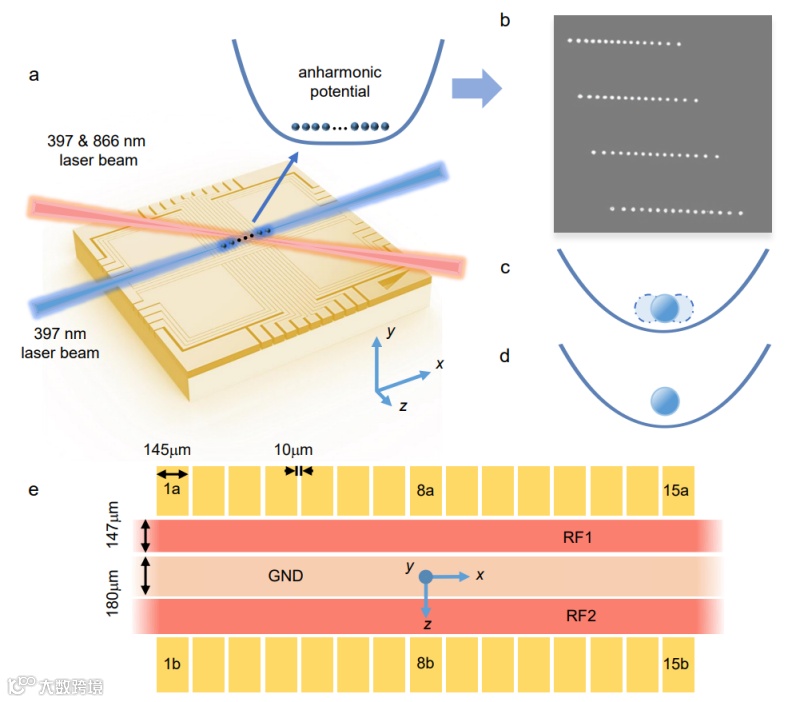
The potential characterization scheme proposed in this paper is illustrated in Fig. 1. Ions trapped in an anharmonic potential are illuminated by lasers for Doppler cooling and image acquisition. By varying the voltages applied to the electrodes, the ion chain (or single ion) moves along the trap axis. The equilibrium positions of the ions (or single ion) change with the electric field, and the trap frequencies of single ions also vary accordingly. By introducing a single-electrode potential distribution function that includes free parameters and is consistent with the results of boundary element analysis, these diverse experimental results under different trapping voltage settings are determined by the free parameters. Conversely, when sufficient data of various types are used as input, the optimal estimates of the free parameters describing the potentials of each electrode can be obtained through a multi-objective optimization method. This method seamlessly integrates these data, effectively reducing errors caused by magnification in the imaging system and providing a spatially smooth potential that facilitates the establishment of a potential distribution model for the ion trap. Moreover, this method allows for significant flexibility in voltage settings, enabling potential characterization while maintaining a constant trap height, thereby suppressing systematic errors introduced by changes in trap height due to voltage variations.
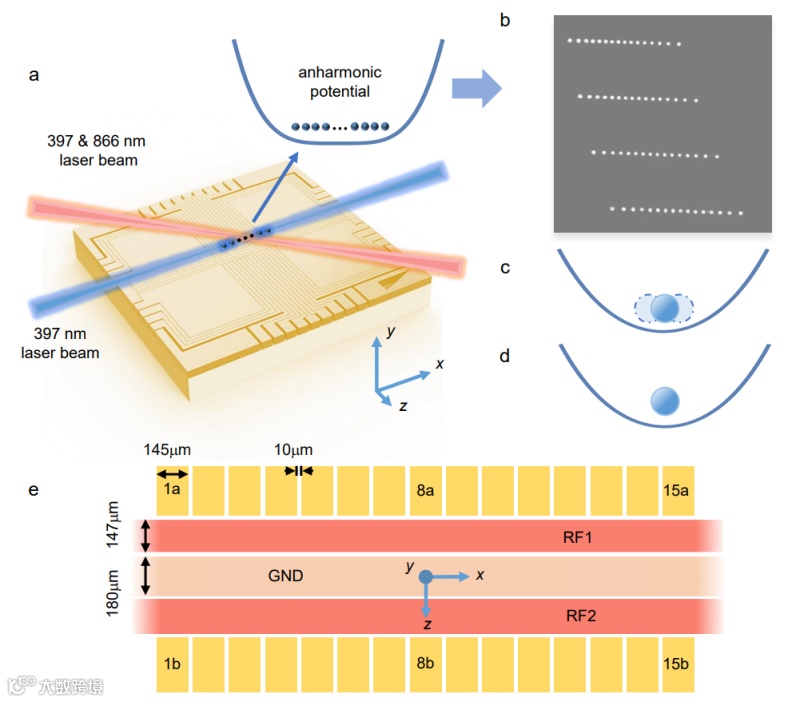
Fig. 1 | Scheme for spatial potential characterization of an ion trap. a, A linear ion chain is trapped above a surface electrode trap (SET) and Doppler-cooled by 397 nm and 866 nm lasers. b, When the control voltages are changed, the ion chain (containing 6–19 ions) moves to a new equilibrium position, and these changes are recorded. c, Vibrational frequencies are measured at different trapping voltages. d, The equilibrium position of a single ion is also recorded simultaneously. e, Schematic diagram of the "five-wire" linear ion trap. The DC electrodes located on the y = 0 plane are labeled from 1a(b) to 15a(b).
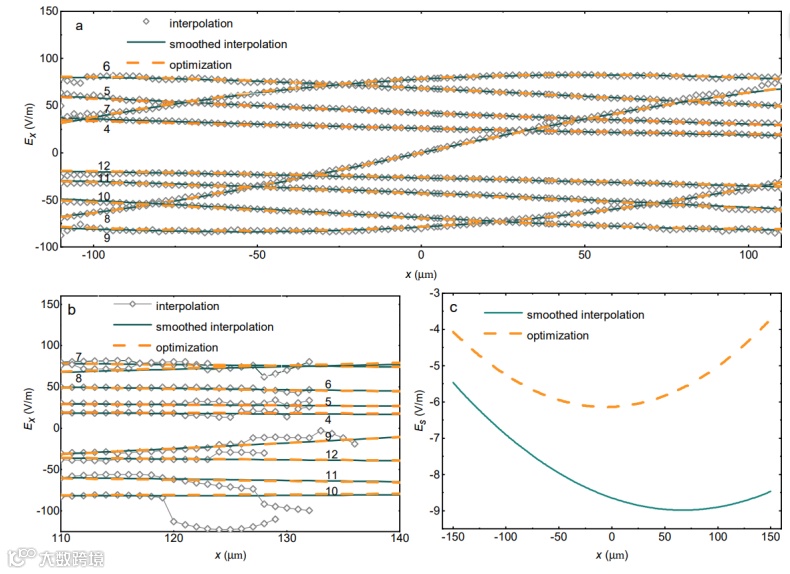
In this study, the electric field distributions of electrodes 4 to 12 were characterized in a surface-electrode ion trap with 15 pairs of electrodes. This method was compared with the interpolation method that relies solely on the position data of the moving ion chain³, with the results shown in Fig. 2. Since the original interpolation method yielded discretized and highly fluctuating electric field strengths, a model with free parameters was used to fit the central region of the electric field data obtained by interpolation, where the fluctuations were smaller. The smoothed interpolation model generally agrees with the results obtained from the optimization method for the electrode potentials. However, there are certain differences between the two methods in the characterization of stray fields.
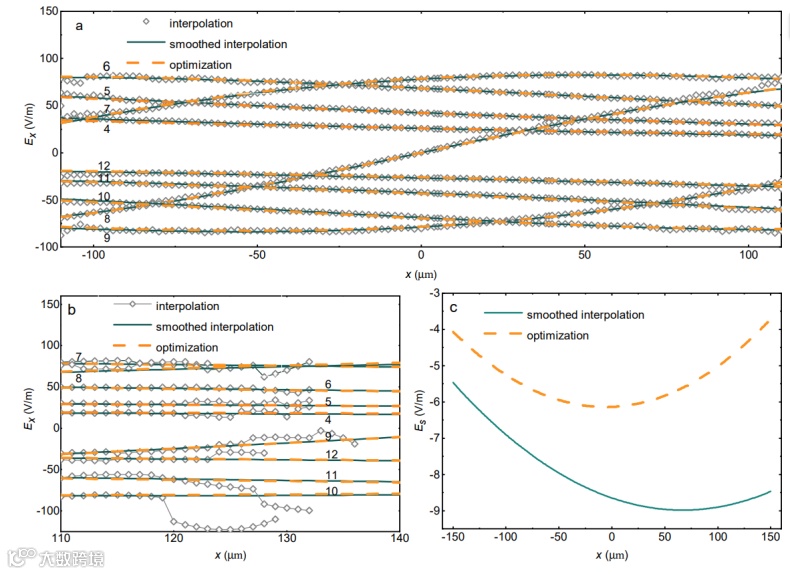
Fig. 2 | Comparison of spatial distributions of single-electrode electric fields and stray fields among different models. a, Comparison of electric field models in the central trapping region. b, Comparison of models in the right-end region, where significant fluctuations occur in the interpolation method due to insufficient overlapping samples. c, Spatial distribution of the stray electric field.
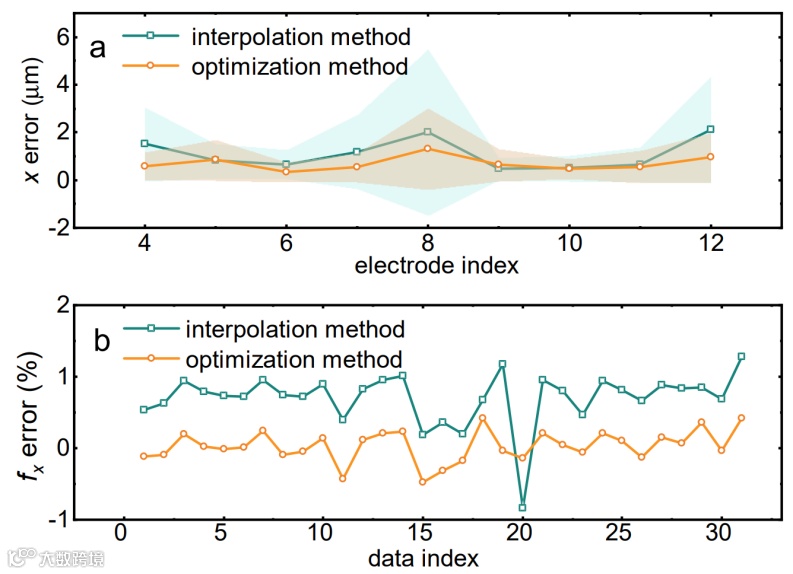
To compare the accuracy of the smoothed interpolation model and the multi-data optimization model, this paper used both models to predict the coordinates of ion chains (ions) and the trap frequencies of single ions under different voltages. These predictions were then compared with the actual measured values, with the results shown in Fig. 3. In Fig. 3a, The equilibrium coordinates of ions in the ion chain were obtained through molecular dynamics simulations, using the velocity-Verlet algorithm with significant damping to accelerate the equilibrium process. For each electrode k, five distinct voltage settings were selected from the experimental data (including the maximum and minimum voltage values, with intermediate values as evenly distributed as possible) for simulation and comparison. In Fig. 3b, the trap frequencies of the first 20 data points were used for optimization, while the last 11 data points were reserved for later validation. The comparison results show that the optimization model outperforms the smoothed interpolation method in predicting both ion positions and trap frequencies.
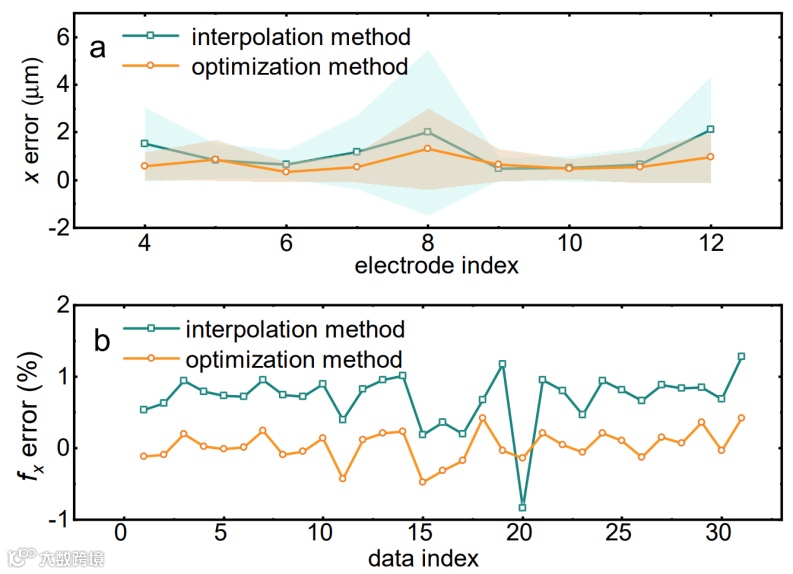
Fig. 3 | Comparison of prediction results between two potential models. a, The position errors of ions in the ion chain related to a voltage-varying electrode are averaged. The mean errors are represented by data points, and the standard deviations are shown by shaded areas. b, Percentage errors in trap frequency predictions by the two potential models.
In summary, the researchers have proposed an optimization method based on a simple yet highly precise parametric expression that integrates diverse experimental data. This method enables accurate modeling of the spatial distribution of electrode electric fields and stray fields in chip-based ion traps. It effectively reduces systematic errors and achieves a better match between model predictions and experimental observations than existing methods. This research provides a practical tool for precise control of trapping potentials, with applications in creating uniformly spaced linear ion chains, generating trapping wells of specific shapes, and accurately managing ion shuttling voltages for scalable quantum computing.
参考文献
1. Qin, Q. et al. Characterizing the spatial potential of an ion trap chip. Chip 4, 100126 (2024).
2. Kielpinski, D. et al. Architecture for a large-scale ion-trap quantum computer. Nature 417, 709 (2022).
3. Brownnutt M. et al. Spatially-resolved potential measurement with ion crystals. Appl. Phys. B 107, 1125 (2012).
4. Creating equally spaced linear ion string in a surface-electrode trap by feedback control. Phys. Rev. A 95, 032341 (2017).
5. Kaushal V. et al. Shuttling-based trapped-ion quantum information processing. AVS Quantum Sci. 2, 014101 (2020).
论文链接:
https://www.sciencedirect.com/science/article/pii/S2709472324000443
作者简介

秦青青,目前在国防科技大学攻读物理学博士学位,研究方向为囚禁离子量子计算。
Qingqing Qin is currently a Ph.D. candidate of physics in National University of Defense Technology. His research interest focuses on trapped ion quantum computing.
陈婷,国防科技大学助理研究员。研究兴趣为芯片离子阱量子计算,主持和参加自然科学基金项目、国家重点研发计划课题、科技创新2030重大项目课题等多项课题。在Chip, Nature communications, Science China Physics, Mechanics & Astronomy, Physical Review Applied等知名期刊上发表论文20余篇。授权中国发明专利6项,美国发明专利1项。
Ting Chen is an Assistant Researcher at the National University of Defense Technology. Her research interest is quantum information technology based on ion trap chips. She has led or participated in numerous projects, including National Natural Science Foundation projects, topics in the National Key Research and Development Program, and major projects in the Science and Technology Innovation 2030 initiative. She has published over 20 SCI papers in important international and domestic academic journals, such as Chip, Nature Communications, Science China Physics, Mechanics & Astronomy, Physical Review Applied, and others. She holds six Chinese invention patents and one U.S. patent.
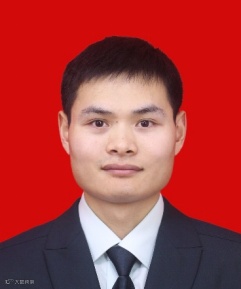
谢艺,国防科技大学副研究员。研究兴趣为离子阱量子计算,主持和参加自然科学基金项目、国家重点研发计划课题、科技创新2030重大项目课题等多项课题。在Chip, Nature communications, npj quantum information, Science China Physics, Mechanics & Astronomy, Physical Review Applied等知名期刊上发表论文40余篇。授权中国发明专利6项,美国发明专利1项。
Yi Xie is an Associate Researcher at the National University of Defense Technology. His research interest is quantum information technology based on trapped ion. He has led or participated in numerous projects, including National Natural Science Foundation projects, topics in the National Key Research and Development Program, and major projects in the Science and Technology Innovation 2030 initiative. He has published over 40 SCI papers in important international and domestic academic journals, such as Chip, Nature Communications, Science China Physics, Mechanics & Astronomy, Physical Review Applied, and others. He holds six Chinese invention patents and one U.S. patent.
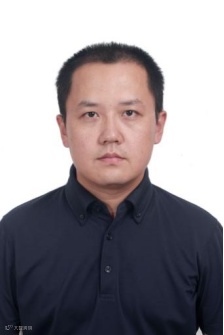
吴伟,国防科技大学副教授。研究兴趣包括基于囚禁离子的量子信息技术、高性能离子量子计算芯片的研发等。主持国家重点研发计划课题、自然科学基金项目等科研项目10余项。在Chip, Fumdamental Research,Nature communications, npj quantum information, Science China Physics, Mechanics & Astronomy等国际和国内重要学术期刊发表SCI学术论文60余篇,获湖南省自然科学奖一等奖1项。参编《量子计算机研究》和《量子信息学基础》等书,授权中国发明专利7项,美国发明专利1项。
Wei Wu is an associate professor at the National University of Defense Technology. His research interests include quantum information technology based on trapped ions and the development of high-performance ion quantum computing chips. He has led more than 10 scientific research projects, including topics in the National Key Research and Development Program and the National Natural Science Foundation. He has published over 60 SCI papers in important international and domestic academic journals, such as Chip, Fundamental Research, Nature Communications, npj Quantum Information, Science China Physics, Mechanics & Astronomy, and others. He has received the first prize of the Hunan Provincial Natural Science Award. He has also contributed to the editing of books such as 「Research on Quantum Computers」 and 「Fundamentals of Quantum Information」. He holds 7 Chinese invention patents and 1 US invention patent.
免责声明:本文旨在传递更多科研资讯及分享,所有其他媒、网来源均注明出处,如涉及版权问题,请作者第一时间后台联系,我们将协调进行处理,所有来稿文责自负,两江仅作分享平台。转载请注明出处,如原创内容转载需授权,请联系下方微信号。