

近日,南方科技大学王恺团队和深圳技术大学吴丹团队以「Integrated colloidal quantum dot devices for on-chip light sources」¹为题在Chip上发表长篇综述论文,对胶体量子点光源在集成光子器件上的发展进行了总结,并围绕朝向电泵浦胶体量子点激光器的最终应用做出了展望。共同第一作者为周禄为、谭扬志和田大地,通讯作者为王恺和吴丹。
为应对信息时代对高速数据传输、宽带能力提升与低功耗运行的迫切需求,光子集成电路(photonic integrated circuits, PICs)已成为支撑未来芯片发展的关键技术之一,而片上光源在其中发挥着核心作用。与在硅基芯片上通过外延生长或键合工艺集成III-V族半导体光源的经典路径相比,胶体量子点(colloidal quantum dots, CQDs)凭借其发光波长精确可调、易于异质集成以及制备成本低等优势,为片上光源的实现提供了一条兼具低成本与易于集成特性的新途径。
本文从CQDs的结构演进切入,首先概述了其由早期非连续变化核壳结构向合金化梯度渐变核壳结构发展的历程2。非连续变化核壳结构因存在较多界面缺陷及快速的载流子俄歇复合过程,限制了其光学性能的进一步提升;而合金化梯度渐变核壳结构的引入,则显著抑制了CQDs中由缺陷和俄歇复合导致的非辐射复合,从而大幅提升了其自发辐射与受激辐射性能,并推动了CQD发光二极管和激光器性能的显著进步。在材料性能不断优化的基础上,本文系统回顾了CQDs在集成光子器件中的关键应用(图1),主要包括:波导耦合型CQD光源;与超表面集成的CQD激光器;与光学腔集成的CQD单光子源以及面向电泵浦CQD激光器的器件。
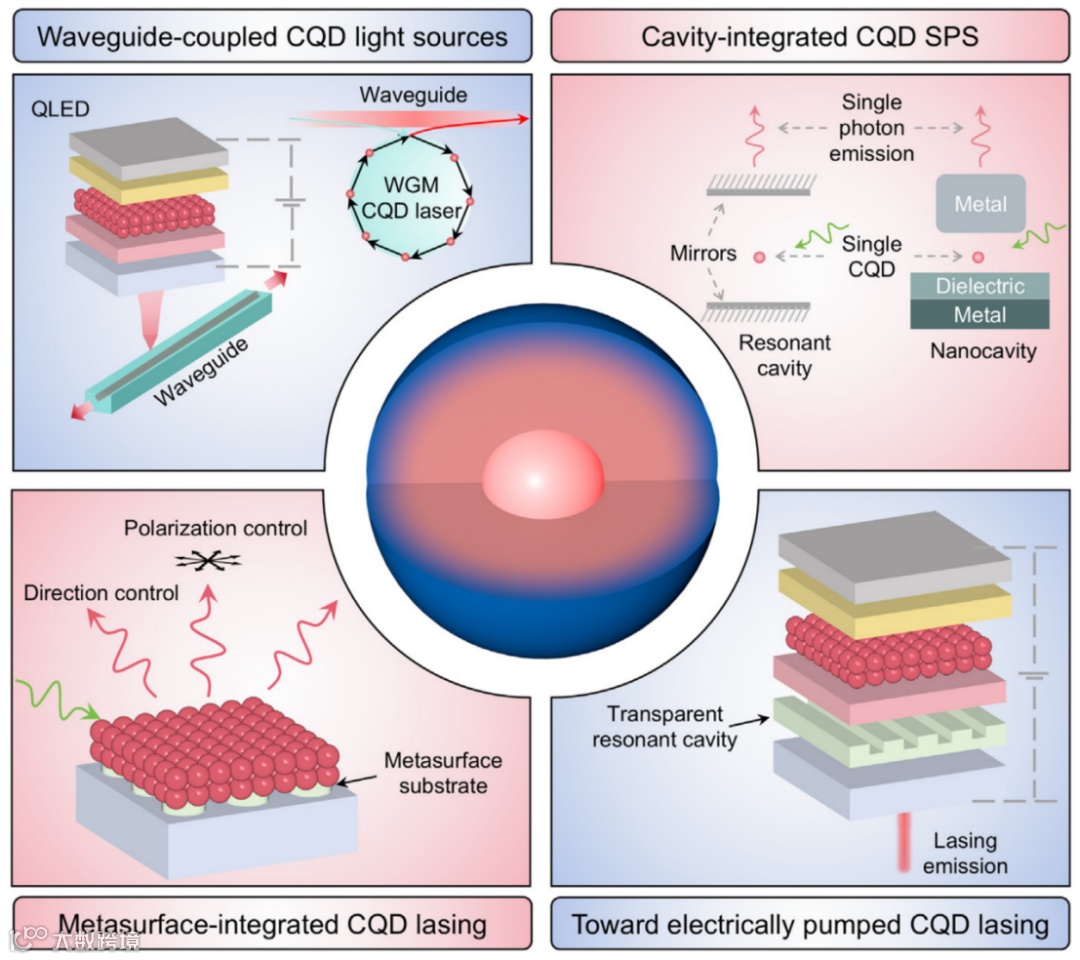
图1 | CQDs与不同光电器件集成示意图。
得益于其易于异质集成的特性,CQD发光二极管和激光器已成功实现与氮化硅波导的高效耦合,并展现出未来片上光源的潜力;与光学超表面的集成,可优化局域光能量分布,有效降低CQD激光的激发阈值,并进一步能够精确调控CQD激光的发射特性(偏振态、方向等);而与微/纳光学谐振腔的结合,则为开发适用于量子信息技术的高性能CQD单光子源开辟了前景。尽管上述CQD集成式光源已取得显著进展,然而面向片上光源的最终应用,仍依赖于电泵浦CQD激光器的突破。尽管这一目标尚未完全实现,但近年来从材料设计、器件结构、谐振腔优化以及波导集成的多项研究进展,已为其可行性提供了有力支持。
本文重点梳理了相关关键工作3-6,主要包括:无效率滚降的CQDs结构设计;基于电流聚焦结构实现的电泵浦CQDs光学增益;利用脉冲电流注入诱发的双能带CQDs光学增益;通过集成光学谐振腔实现的电泵浦CQDs放大自发辐射;以及兼具电注入发光和光泵浦激光的双功能器件设计。这些研究为最终实现室温工作的电泵浦CQD激光器奠定了重要基础。
最后,本文系统总结了当前发展CQD片上光源所面临的关键挑战,并对未来研究方向作出展望。主要挑战包括:降低CQDs的散射损耗并进一步提升其俄歇寿命;优化集成工艺以增强光耦合效率;以及改善CQD光电器件的长期运行稳定性和环境耐受性。文末进一步指出,将CQD与光学超表面、光子晶体等光子技术结合,为增强光与物质的相互作用以及实现新型CQD激光器提供了重要途径;同时,通过与高能量发光二极管集成,构建电驱动(或间接电泵浦)CQD激光器,有望成为迈向最终实现电泵浦CQD激光器的关键下一步。
Integrated colloidal quantum dot devices for on-chip light sources¹
To address the urgent demands of the information age for high-speed data transmission, enhanced broadband capabilities, and low-power operation, photonic integrated circuits (PICs) have emerged as one of the key technologies supporting the future development of chips, with on-chip light sources playing a core role. In contrast to conventional methods that rely on epitaxial growth or bonding to integrate III-V semiconductor light sources onto silicon platforms, colloidal quantum dots (CQDs) present a promising alternative for on-chip light source integration. Owing to their precisely tunable emission wavelengths, compatibility with heterogeneous integration processes, and cost-effective solution-based fabrication, CQDs offer a compelling combination of scalability, flexibility, and economic feasibility.
This review begins with the structural evolution of CQDs, outlining their development from early discrete core–shell structures to alloyed gradient structures2. While discrete core–shell structures suffer from numerous interfacial defects and rapid carrier Auger recombination, which limit their optical performance, the introduction of compositionally graded alloy structures has effectively suppressed non-radiative recombination caused by defects and Auger processes in CQDs. This advancement has significantly enhanced both spontaneous and stimulated emission performance of CQDs, leading to notable improvements in CQD light-emitting diodes (QLEDs) and laser devices. Building on these material advances, this article systematically reviews key applications of CQDs in integrated photonic devices (Fig. 1), including: (1) waveguide-coupled CQD light sources; (2) metasurface-integrated CQD lasers; (3) optical cavity-integrated CQD single-photon sources; and (4) integrated device designs toward electrically pumped CQD lasers.
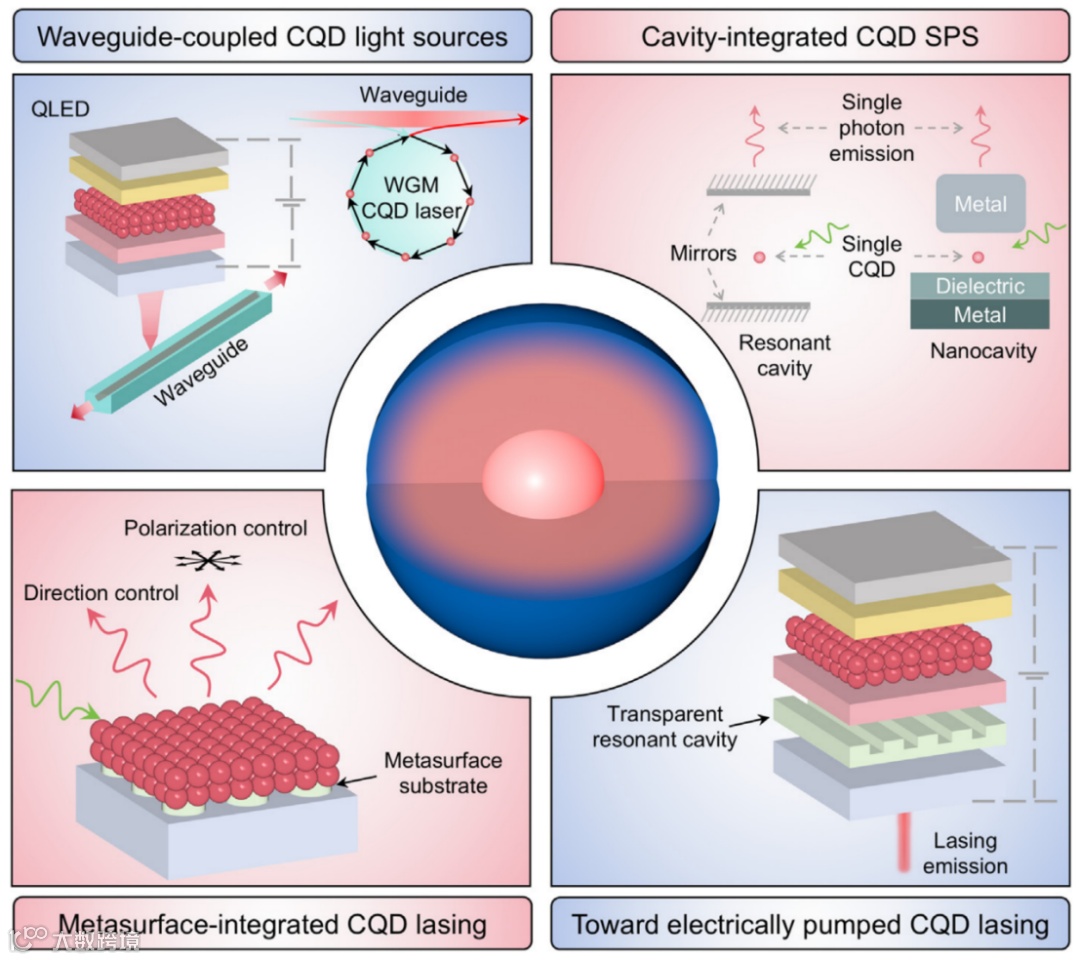
Fig. 1 | Schematic summary of CQDs’ integration with various optoelectronic device.
Benefiting from their favorable characteristics for heterogeneous integration, colloidal quantum dot (CQD) light-emitting diodes and lasers have been successfully and efficiently coupled with silicon nitride waveguides, thereby showcasing the potential of future on-chip light sources. The integration of CQDs with optical metasurfaces enables the optimization of the local optical energy distribution. This not only effectively reduces the excitation threshold of CQD lasers but also further allows for the precise manipulation of the emission characteristics of CQD lasers, such as polarization state and direction. Moreover, the combination of CQDs with micro/nano optical resonators paves the way for the development of high-performance CQD single-photon sources that are suitable for quantum information technology. Although significant progress has been made in these CQD integrated devices, the ultimate application of on-chip light sources still depends on the realization of electrically pumped CQD lasers. While this goal has not yet been fully achieved, recent optimizations in materials, device architectures, and cavity integration have provided strong evidence of its feasibility.
This review highlights key related works3-6, including: efficiency droop-free CQD structures; electrically pumped optical gain in CQDs achieved via current-focusing device architecture; two-band optical gain in CQDs under pulsed current injection; electrically pumped amplified spontaneous emission from CQDs in QLEDs integrated with cavities; and dual-function devices capable of both electroluminescence and optically pumped lasing. These studies lay an important foundation for the eventual realization of room-temperature electrically pumped CQD lasers.
Finally, this review summarizes the key challenges in developing CQD-based on-chip light sources and offers a prospect. Major challenges include reducing scattering losses and further increasing the Auger lifetime in CQDs; optimizing integration processes to improve light coupling efficiency; and enhancing the long-term operational and environmental stability of CQD devices. It is also pointed out that integrating CQDs with photonic technologies, including optical metasurfaces and photonic crystals, offers a crucial avenue for strengthening light-matter interactions and enabling the development of novel CQD lasers. Moreover, integrating CQDs with high-power LEDs to construct electrically driven (or indirectly electrically pumped) CQD lasers may represent the critical next step toward fully electrically pumped CQD lasers.
参考文献
1. Wang, K. et al. Integrated colloidal quantum dot devices for on-chip light sources. Chip 4, 100152 (2025).
2. Lee, M. et al. Stability of quantum dots, quantum dot films, and quantum dot light-emitting diodes for display applications. Adv. Mater. 31, 1804294 (2019).
3. Park, L. et al. Optical gain in colloidal quantum dots achieved with direct-current electrical pumping. Nat. Mater. 17, 42–49 (2018).
4. Jung, H. et al. Two-band optical gain and ultrabright electroluminescence from colloidal quantum dots at 1000 A cm-2. Nat. Commun. 13, 3734 (2022).
5. Ahn, N. et al. Electrically driven amplified spontaneous emission from colloidal quantum dots. Nature 617, 79–85 (2023).
6. Park, R. et al. Optically pumped colloidal-quantum-dot lasing in LED-like devices with an integrated optical cavity. Nat. Commun. 11, 271 (2020).
论文链接:
https://doi.org/10.1016/j.chip.2025.100152

扫码阅读原文
作者简介

吴丹,深圳技术大学光源与照明系副系主任副教授(长聘), 入选广东省特支计划青年拔尖人才、深圳市海外高层次人才等。面向先进光子集成、光互联应用等开展高亮度的新型电致发光器件研究,包括高亮度量子点圆偏振电致发光器件、低缺陷态密度单晶薄膜原位异质可控生长技术、器件光子高效耦合输出技术等。在Nature、Advanced Materials、Light: Science & Applications等国际高水平学术期刊共发表SCI收录论文93篇,申请/授权中国发明专利20余项。
Dan WU is an Associate Dean and Tenured Associate Professor in the Department of Light Sources and Illumination at Shenzhen Technology University. She has been selected into the Young Top Talents Program of Guangdong Special Support Plan and Shenzhen Overseas High-Level Talents, etc. Her research focuses on the development of high-brightness new electroluminescent devices for advanced photonic integration and optical interconnection applications, including high-brightness quantum dot circularly polarized electroluminescent devices, in-situ heterogeneous controllable growth technology of single-crystal thin films with low defect state density, and efficient photon coupling and output technology of devices. She has published over 93 SCI-indexed papers in high-level international academic journals such asNature, Advanced Materials, and Light: Science & Applications, and has applied for/been granted more than 20 Chinese invention patents.

王恺,南方科技大学,长聘教授,博导,国家优青,广东省杰青。研究方向为量子点光电器件及其在新型显示、光电混合芯片、光电探测等领域的应用。主持国家重点研发计划项目/课题,发表SCI论文200余篇,被引12000余次,H指数61;授权中国发明专利64项。研究成果获得国家技术发明奖二等奖、国家教育部技术发明奖一等奖、湖北省自然科学奖一等奖、广东省自然科学奖二等奖。连续5年入选美国斯坦福大学全球前2%顶尖科学家榜单。
Kai WANG is currently a full Professor of Southern University of Science and Technology (SUSTech). His research focuses on quantum dot optoelectronic devices, including quantum dot lasers for photonic chips, quantum dot light-emitting devices for displays, and quantum dot photodetectors for information sensing. He has published over 200 articles on academic journals with more than 12,000 citations and an H-index of 61. His research achievements are awarded the National Award for Technological Invention and the National Ministry of Education Award for Technological Innovation. He is the recipient of the National Outstanding Youth Scholar, Guangdong Province Distinguished Youth Scholar and also is selected as the World's Top 2% Scientists identified by Stanford University and Elsevier.