

传统肉类替代品——人造肉的
研究进展

目的:人造肉是科学家们为未来全球肉类可持续消费提出的一个新型概念,主要用于替代传统肉类的消费,以达到节约能源、保护环境和动物福利目的。尽管人造肉概念在国外早已被提出,但我国目前关于人造肉的研究尚处于初步阶段,并且消费者对人造肉的认知仍然较为模糊,因此本文对人造肉的生产技术和目前人们对人造肉的认识以及态度进行了综述,为人造肉行业的发展提供参考。
方法:综合运用文献收集、归纳总结与整理的方法,采用对比分析和举例分析的形式,针对人造肉概念和生产技术开展综述,并对未来的发展提出了建议。
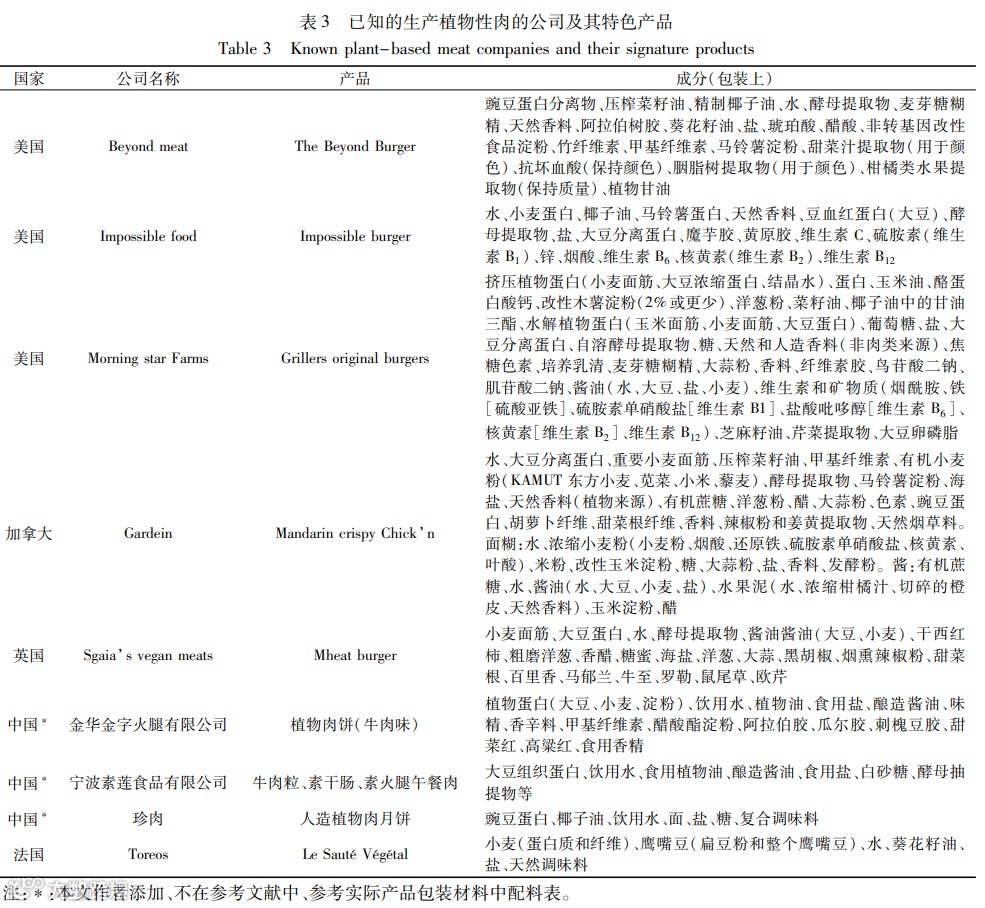
结果:人造肉主要分为细胞培养肉和植物性肉两种,其中细胞培养肉指的是通过提取动物干细胞并扩大培养而成的人造动物肉;而植物性肉通常指的是利用植物蛋白及其他植物性成分通过一定技术制备成具有类肉口感和风味的植物性食品。细胞培养肉由荷兰科学家马克·鲍斯特于2012年首次推出,其作为一种人工制造的肉主要制作步骤如下:①采集动物肌肉样本,并分离其中的干细胞;②然后在合适的培养环境下,给予合适的营养素和生长因子等诱导细胞(成肌细胞)生长和增殖;③进一步诱导细胞形成多核肌管并提供一定的支架,促进肌肉纤维形成;④最后通过催化蛋白质交联形成最终的培养肉。尽管通过一系列的生物技术手段能够获得培养肉,但其与传统的肉仍然有一定的差距,诸如一些神经、血液和脂肪细胞的缺失等,从而造成口感和风味上的差异。而另一方面,细胞培养过程中因遗传不稳定而引起的癌细胞和使用成份不明确的血清对消费者的可接受度造成了巨大挑战。目前的调查报告显示,大部分消费者暂时不能接受培养肉,但也存在一部分消费者坚信科学技术能够使得培养肉变得健康环保。植物性肉历史悠久,但传统的植物性肉类替代品缺乏肉类的口感、质地和风味,因此科学家们致力于利用具有纹理特征的植物性蛋白,开发一种具有肉类特征的新型植物肉。通常,植物性肉的原材料主要包含水(50%~80%),纹理植物蛋白(10%~25%),无纹理蛋白(4%~20%),脂肪(0%~15%),调味剂(3%~10%),结合剂(1%~5%)和着色剂(0%~0.5%)。其中植物蛋白是植物性肉的主要部分,提供了一定的结构特性,一般以豆类蛋白为主;脂肪则主要赋予植物性肉的多汁、柔软和浓度风味,主要有椰子油、葵花籽油、玉米油和棕榈油等;调味剂在赋予类肉风味方面至关重要,主要包含一些还原糖、呈味氨基酸和核苷酸等;结合剂主要用于水或脂肪与蛋白质的粘合,通常有大豆分离蛋白、小麦面筋和一些多糖胶组成;着色剂主要给产品上色,良好的色泽可使人激发食欲。植物性肉的制作主要有挤压、剪切和纺丝等技术。国内外已经有部分企业成功研发并生产出了植物性肉产品,如植物基汉堡、植物肉饼、植物性午餐肉和植物肉月饼等。得益于传统素食产品的消费,国内消费者比国外消费者更易于接受植物性肉,但目前仍然难以撼动传统素食产品的市场。
结论:人造肉是近些年提出的一种新型可持续蛋白供应方案,主要分为细胞培养肉和植物性肉两种。尽管在科学家们的努利下,无论培养肉还是植物性肉均已经有相应的产品出现,但在未来的生产消费中仍然存在巨大的挑战。对于培养肉,批量生产并实现低成本商业化是目前最大的难题;其次研究安全无害的培养肉,并通过宣传提高消费者的可接受度也是一项挑战;而对植物性肉而言,完善植物性肉的口感与质地,提高产品与传统肉类的相似性是首要任务;其次安全性也是重要考虑因素。
图片来源于图司机
Objective: Artificial meat is a new concept proposed by scientists for future global sustainable meat consumption, mainly for replacing traditional meat consumption to achieve energy saving, environmental protection and animal welfare purposes.Although the concept of artificial meat has long been proposed abroad, the research on artificial meat in China is at a preliminary stage, and the perception of consumers about artificial meat is still relatively vague.Therefore, this paper provided a review of the production technology of artificial meat and the current understanding and attitude of people towards artificial meat, to provide a reference for the development of the artificial meat industry.
Methods: Based on literature analyzing, summarization and reorganization, a review of the concept and production technology of artificial meat was conducted in the form of comparative analysis and example analysis.Suggestions for future development are also provided.
Results: Artificial meat is mainly divided into cell culture meat and plant-based meat, where culture meat refers to artificial animal meat made by extracting animal stem cells and expanded; while plant-based meat usually refers to application of plant protein and other plant-based ingredients through some techniques to prepare plant-based food with meat-like taste and flavor. Culture meat was first introduced in 2012 by Dutch scientist Mark Post, and the main productionsteps are as follows: (i) collect animal muscle samples and isolate the stem cells; (ii) then induce the cells (myogenic cells) to grow and proliferate by giving suitable nutrients and growth factorsin a suitable culture environment; (iii) further induce the cells to form multinucleated myotubes and provide scaffolds to promote muscle fiber formation; (iv) finally producethe final cultured meat by catalyzing protein cross-linking. Although cultured meat can be obtained through a range of biotechnological techniques, there are still some gaps compared to conventional meat, such as the absence of some nerve, blood and fat cells, resulting in differences in taste and flavor.On the other hand, cancer cells caused by genetic instability during the cell culture process and the use of serum with unclear composition pose a great challenge to consumer acceptability. The current survey reports that most consumers cannot accept cultured meat now, but there are some consumers who believe that science and technology can make cultured meat healthy and environmental friendly.Plant-based meat have a long history, but traditional plant-based substitutes are lack full taste, texture and flavor of meat, and thusscientists areworking to develop a novel plant-based meat with meat characteristics usingtextural plant proteins.Generally, the raw material of plant-based meat contains water (50% ~ 80%), textured plantprotein (10% ~ 25%), untextured plant protein (4% ~ 20%), fat (0% ~ 15%), flavoring agents (3% ~ 10%), binding agents (1% ~ 5%) and coloring agents (0% ~ 0.5%).Among them, plant protein is the main part of plant-based meat, providing certain structural characteristics, generally based on soy protein; fat is to give plant-based meat juicy, soft and concentrated flavor, and mainly includescoconut oil, sunflower oil, corn oil and palm oil, etc.; flavoring agents are essential in giving meat-like flavor, mainly containing some reducing sugars, flavoring amino acids and nucleotides, etc.; binding agents are mainly used for water or fat and protein bonding, usually composed of soybean isolate protein, wheat gluten and some polysaccharide gum; coloring agents are to color the product, in order to make people stimulate appetite.Plant-based meat is mainly produced by extrusion, shearing and spinning technologies. Some companies have successfully developed and produced plant-based meat products, such as plant-based burgers, plant-based meat patties, plant-based lunch meat and plant-based meat mooncakes. Owing to the consumption of traditional vegetarian products, domestic consumers are more receptive to plant-based meat than foreign consumers, but it is still difficult to influence the market of traditional vegetarian products.
Conclusion: Artificial meat is a new sustainable protein supply solution that has been proposed in recent years, mainly in the form of cell-cultured meat and plant-based meat. Although both cultured meat and plant-based meat have been produced, there are still challenges in the future production and consumption habit. For cultured meat, mass production and low-cost commercialization arethe biggest challenges; researching safe and harmless cultured meat and improving consumer acceptability through publicity is also a challenge.While for plant-based meat, perfecting the taste and texture and improving the similarity between the product and traditional meat are thepriority targets, and safety is also an important consideration.
《食品工业科技》特邀主编专栏征稿

版权声明
《食品工业科技》具有以上论文在全世界范围内的复制权、发行权、翻译权、汇编权、广播权、表演权、信息网络传播权、转许可权及以上权利的邻接权,且作者已授权期刊同论文著作权保护期。如需转载,可联系《食品工业科技》编辑部010-87244116,或直接在文末撰写转载来源。