
响应面法优化黑果枸杞中原花青素提取工艺
目的:黑果枸杞有极强的抗旱、抗寒和耐盐碱特性,其果实中含有大量的原花青素、花青素、多糖等成分,是理想的原花青素来源。原花青素是一种由黄烷-3-醇单体缩合而成的聚多酚类物质,本研究以新疆产黑果枸杞为原料,利用响应面设计优化原花青素的提取工艺,以获得更高的原花青素得率。
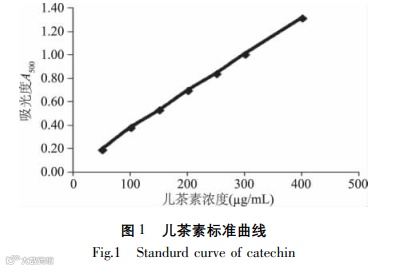
方法:选取乙醇浓度、提取温度、提取时间、料液比4个参数,通过单因素实验探究其对原花青素得率的影响规律,并选择参数范围。在单因素实验的基础上,使用Minitab 17软件设计Box-Behnken中心组合实验,考察乙醇浓度(A)、提取温度(B)、提取时间(C)三个因素及其交互作用对原花青素得率的影响,建立数学模型,绘制响应面图,并对结果进行统计分析、平行验证实验,优化原花青素的提取工艺。以儿茶素为标准品,使用浓盐酸-香草醛法绘制标准曲线并测定原花青素的含量、计算得率。
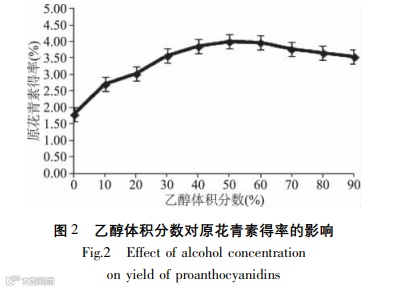
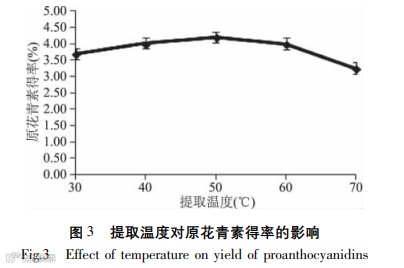
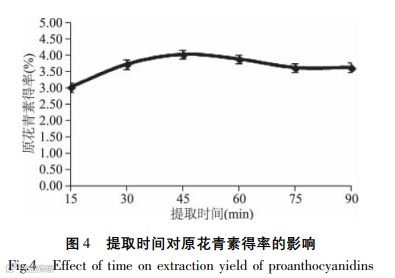
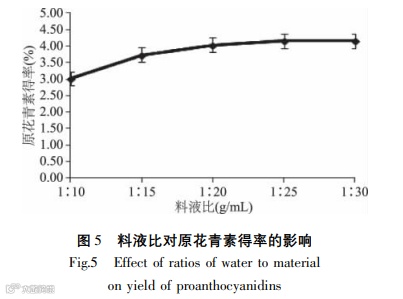
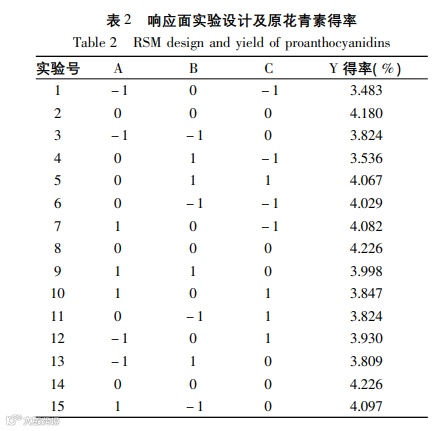
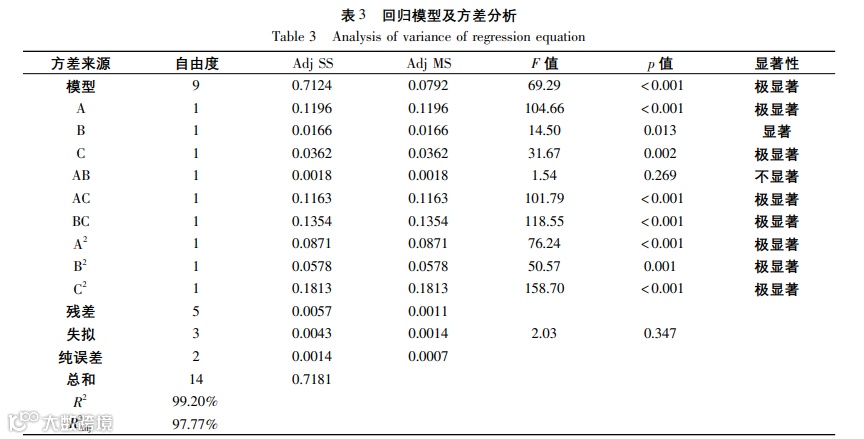
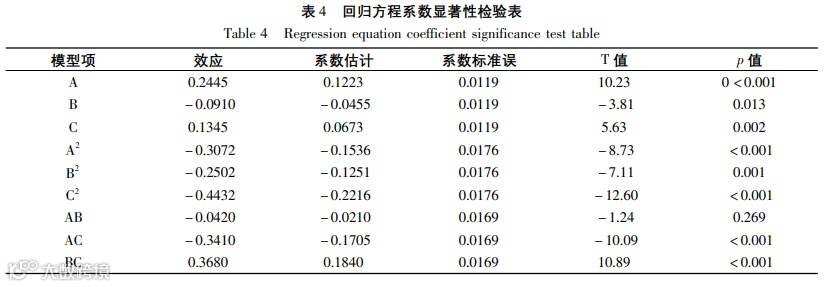
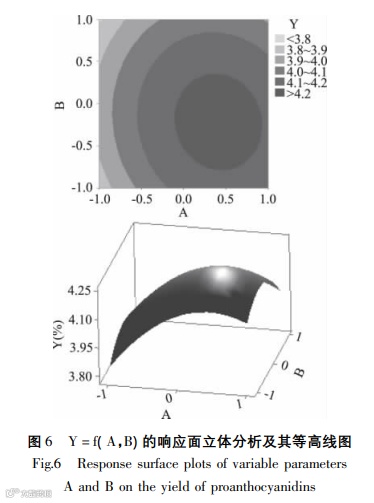
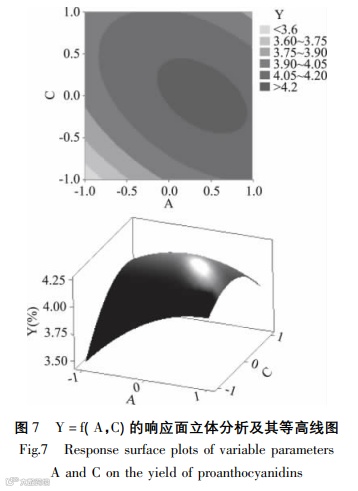
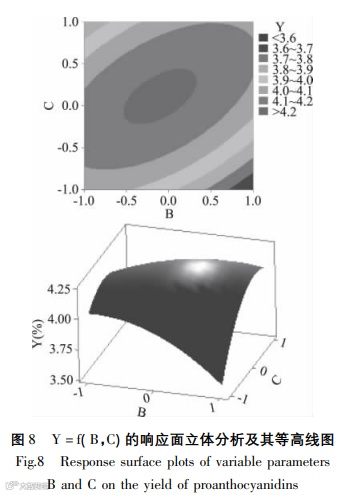
结果:单因素实验中,原花青素得率最高时的乙醇体积分数为50%;高温虽然能促进原花青素的溶出,但同时也会使其失活,温度在50 ℃以下时,原花青素得率呈现上升的趋势,随着温度的增加得率逐渐下降;提取时间为40~60 min时原花青素得率随时间的延长而增加,但当得率达到最高水平时,继续延长提取时间得率趋于平稳;原花青素得率先随着料液比的增加而升高,料液比达到1:20 g/mL时,原花青素得率趋于平稳。基于以上结果,在Box-Behnken中心组合实验中,选取乙醇体积分数40%、50%、60%,提取温度40、50、60 ℃,提取时间40、50、60 min,分别设定为-1、0、1三个水平的因素值,借助Minitab 17设计实验方案,将实验结果进行回归分析,对各因素拟合后得到回归方程:Y=4.2107+0.1223A-0.0455B+0.0673C-0.1536A2-0.1251B2-0.2216C2-0.0210AB-0.1705AC+0.1840BC,该回归模型的R2=99.20%,与实际拟合良好,可代替实验真实点对实验结果进行分析。该回归方程的一次项和二次项的影响显著,结合响应面图判定各因素对响应值显著性的排序为A>C>B;交互项AC和BC对响应值影响也极显著,但A和B二者交互对响应值的影响不显著。对回归方程求解,即得率达到最大值时的提取条件为乙醇浓度为55.60%, 提取温度为45.77 ℃,提取时间为47.612 min,此时原花青素得率为4.250%。结合实际操作可行性,在乙醇浓度56%,提取温度46 ℃,提取时间48 min条件下,取三等份黑果枸杞进行原花青素提取的平行验证实验,得率分别为4.308%、4.312%、4.325%,平均得率为4.315%,与预测值相对误差为1.5%,经过响应回归方程拟合出的理论值与实际值偏差小。
结论:采用单因素-响应面法建立了原花青素得率的二次多项拟合方程及三维响应面图,由该模型优化的原花青素提取条件为乙醇浓度56%,提取温度46 ℃,提取时间48 min,此时原花青素得率可达4.315%,高于前人提取工艺优化后2.990%的得率。
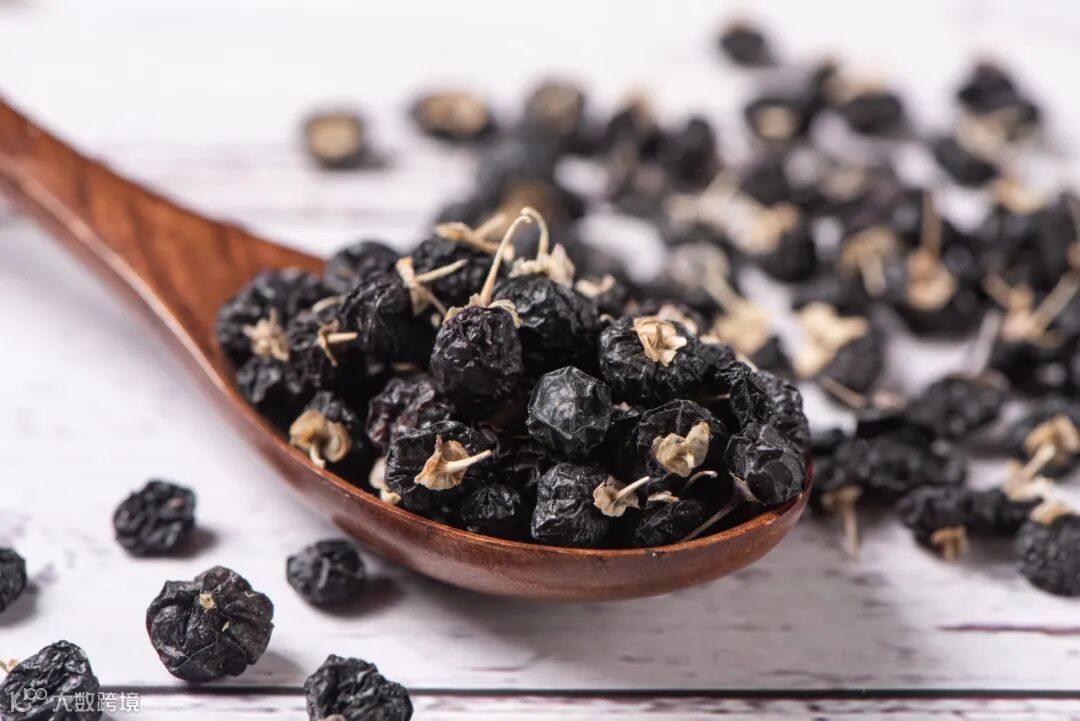
图片购买于壹图网。
Objectives: Lycium ruthenicum Murr. has strong characteristics of drought-resistance, cold-resistance and salinity-alkalinity resistance. Its fruits are rich of proanthocyanidins, anthocyanins, polysaccharides and other components, and are regarded as ideal source of proanthocyanidins. Proanthocyanidins are polyphenols condensed from flavan-3-ol monomers. In this study, Lycium ruthenicum Murr. from Xinjiang were used in the extraction process of proanthocyanidins in order to improving its yield by RSM design.
Methods: In single-factor experiments, parameters of ethanol concentration, extraction temperature, extraction time and material liquid ratio were selected to explore their influence on yield of proanthocyanidins and to select parameters scope. On the basis of single-factor experiments, Minitab 17 statistical analysis software was used to design the Box-Behnken center combination experiments in which parameters of ethanol concentration (A), extraction temperature (B), extraction time (C) and their interaction effects on yield of proanthocyanidins were investigated. During this statistical analysis, a mathematical model would be established, several response surface diagrams would be drawn and three parallel verification experiments would be carried out to optimize the extraction process of proanthocyanidins. The catechin standards and HCl-vanillin detection method were used to draw the standard curve and determine the concentration of proanthocyanidins.
Results: In single-factor experiments, the maximum yield of proanthocyanidins was got at ethanol concentration of 50%. Although higher temperature could promote the dissolution of proanthocyanidins, it could also inactivate it. With the increasing of temperature, the yield decreased gradually. In range of 40~60 min, yield increased along with prolongation of time, and then kept stable after the maximum. Accompanied with the improving of solid to liquid ratio, yield of proanthocyanidins increased, and then became stable at the ratio of 1:20 g/mL. Based on the above results, in the Box-Behnken center combination experiment, ethanol concentration of 40%, 50% and 60%, extraction temperature of 40, 50 and 60 °C, extraction time of 40, 50 and 60 min were separately selected as parameter level of -1, 0 and 1. Experiments were designed and analyzed by Minitab 17 software, the regression equation was Y=4.2107+0.1223A-0.0455B+0.0673C-0.1536A2-0.1251B2-0.2216C2-0.0210AB-0.1705AC+0.1840BC, R2=99.20%. This equation fitted well with the actual situation, and could be used to analyze the experimental results instead of actual point of experiment. The linear and quadratic terms of the regression equation had significant influences on yield. Combined with the response surface diagrams, the significance order of three parameters on response value was A>C>B, the interaction terms AC and BC had significant effects on response value, while the interaction terms AB had no significant. The maximum yield of proanthocyanidins was 4.250%, which was reached at ethanol concentration of 55.60%, extraction temperature of 45.77 °C, and extraction time of 47.612 min. Considering the practical feasibility, three parallel verification experiments were carried out under ethanol concentration of 56%, extraction temperature of 46 °C, and extraction time of 48 min, for which the yields were seperately 4.308%, 4.312% and 4.325%, average of 4.315%. Its relative error with predicted value was 1.5%, and the theoretical value fitted by the response regression equation had small deviation from the actual value.
Conclusions: The single-factor and RSM was used to establish the quadratic polynomial fitting equation and three-dimensional response surface diagram of proanthocyanidin yield. The conditions of proanthocyanidin extraction were optimized by this model, of which the ethanol concentration was 55.60%, extraction temperature was 45.77 °C and extraction time was 48 min. Finally the yield of proanthocyanidins could reach to 4.315% and was higher than recorded yield 2.990%.
作者简介



赵文娟 副教授

赵文娟,博士,滨州学院副教授,硕士研究生导师,被山东省啤酒工业协会聘任为山东省第八届啤酒评委,济南市青年学术技术带头人。先后主持滨州市农社领域科技创新政策引导计划项目、滨州学院博士基金、企业委托横向课题研究7项,指导学生开展山东省大学生创新训练项目2项,在《Journal of American Society of Brewing Chemistry》、《食品工业科技》等杂志发表论文多篇,以第一发明人获发明专利授权4项。主要研究方向为酿酒微生物资源开发与利用,发酵食品加工及品质提升等领域。
详细内容请点击文末“阅读原文”。

版权声明
《食品工业科技》具有以上论文在全世界范围内的复制权、发行权、翻译权、汇编权、广播权、表演权、信息网络传播权、转许可权及以上权利的邻接权,且作者已授权期刊同论文著作权保护期。如需转载,可联系《食品工业科技》编辑部010-87244116,或直接在文末撰写转载来源。