

来源: npj计算材料学
Editorial Summary
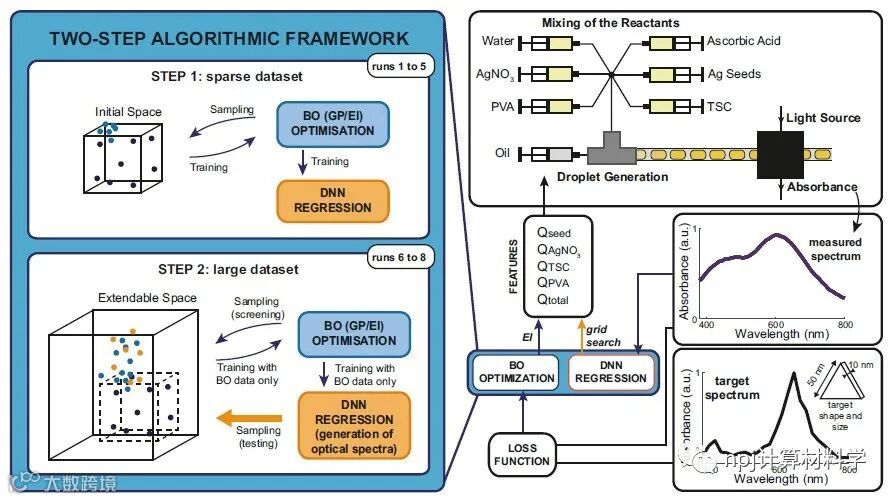
In recent years, machine learning (ML) methods have been applied to solve various problems in materials science, such as drug discovery, medical imaging, material synthesis, functional molecules generation, and materials degradation. Since ML algorithms have been mainly developed based on computational data or experimental datasets gathered from the literature, the material synthesis turns out to be difficult, or even impossible. In this work, a team led by Professor Xiaonan Wang from the Department of Chemical and Biomolecular Engineering, National University of Singapore, proposed a two-step framework for a machine learning-driven high-throughput microfluidic platform, in order to rapidly produce silver nanoparticles with the desired absorbance spectrum. By combing Bayesian optimization with deep neural network in a loop with a high-throughput experiment platform, the authors optimized the synthesis of silver nanoparticles. Moreover, the framework trains a transferable algorithm,and the final trained deep neural network can be used to optimize the synthesis of a different target. The developed methodology is generally applicable to the synthesis of other materials, and can be adapted to other types of high-throughput experiment platforms. This article was recently published in npj Computational Materials 7: 55 (2021).
原文Abstract及其翻译
Two-step machine learning enables optimized nanoparticle synthesis (两步式机器学习实现优化的纳米颗粒合成)
Flore Mekki-Berrada, Zekun Ren, Tan Huang, Wai Kuan Wong, Fang Zheng, Jiaxun Xie, Isaac Parker Siyu Tian, Senthilnath Jayavelu, Zackaria Mahfoud, Daniil Bash, Kedar Hippalgaonkar, Saif Khan, Tonio Buonassisi, Qianxiao Li & Xiaonan Wang
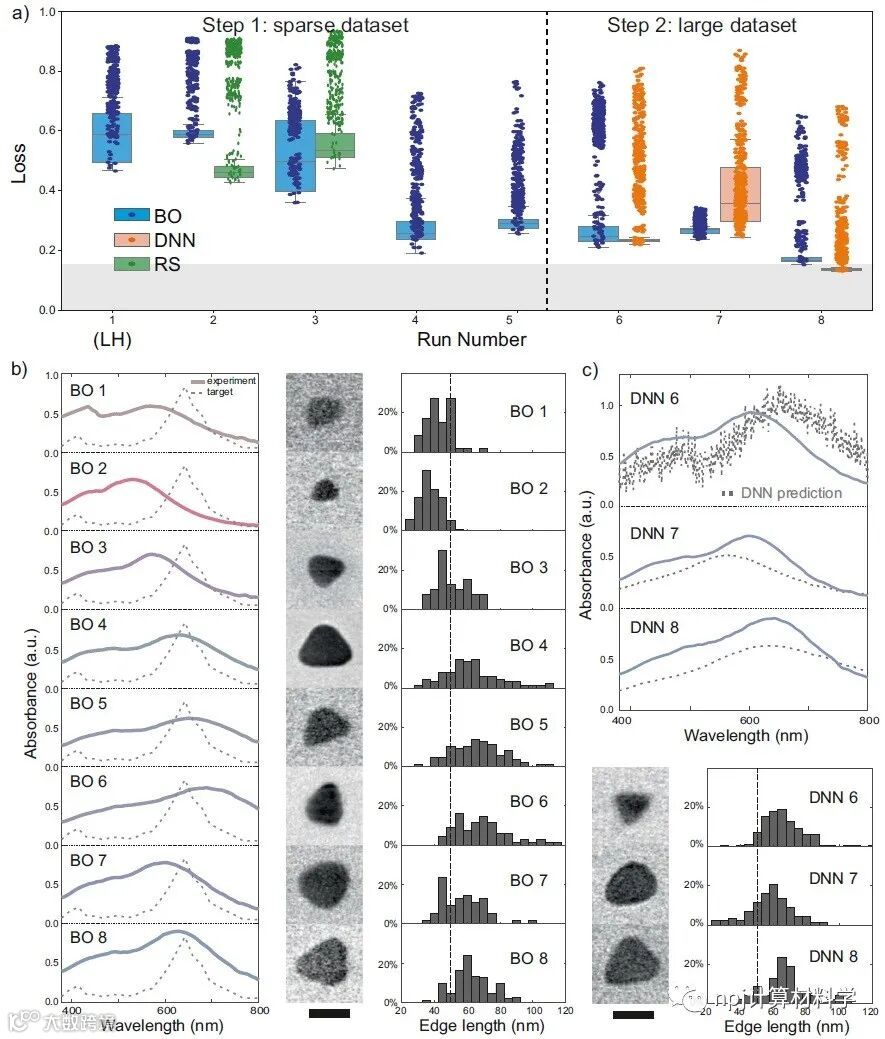
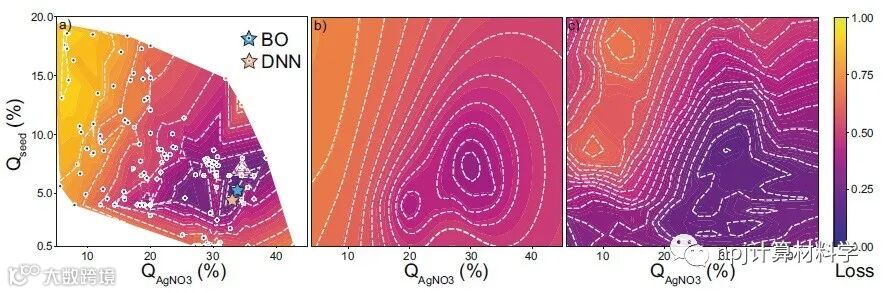
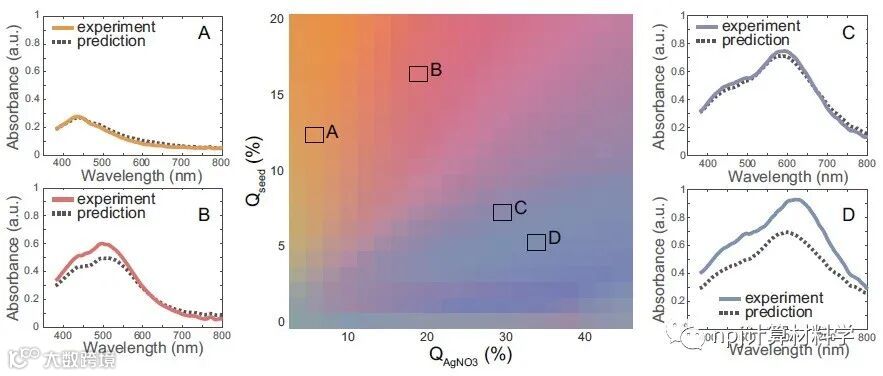
Abstract In materials science, the discovery of recipes that yield nanomaterials with defined optical properties is costly and time-consuming. In this study, we present a two-step framework for a machine learning-driven high-throughput microfluidic platform to rapidly produce silver nanoparticles with the desired absorbance spectrum. Combining a Gaussian process-based Bayesian optimization (BO) with a deep neural network (DNN), the algorithmic framework is able to converge towards the target spectrum after sampling 120 conditions. Once the dataset is large enough to train the DNN with sufficient accuracy in the region of the target spectrum, the DNN is used to predict the colour palette accessible with the reaction synthesis. While remaining interpretable by humans, the proposed framework efficiently optimizes the nanomaterial synthesis and can extract fundamental knowledge of the relationship between chemical composition and optical properties, such as the role of each reactant on the shape and amplitude of the absorbance spectrum.
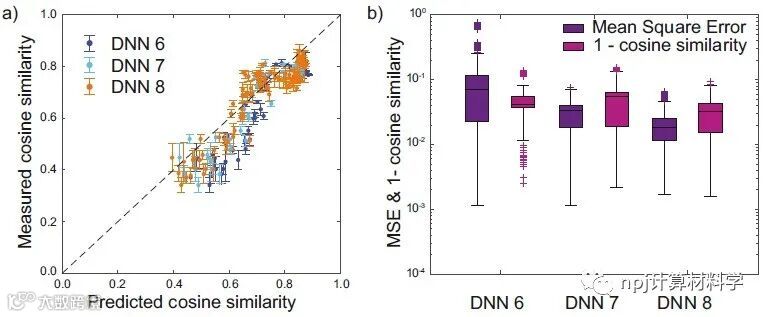
摘要 在材料科学领域,发掘可以生产具有特定光学性能纳米材料的方法既昂贵又耗时。在这项研究中,我们提出一个两步式框架,实现机器学习驱动的高通量微流控平台,用于快速生产具有特定吸收光谱的银纳米颗粒。该算法框架将基于高斯过程的贝叶斯优化算法与深度神经网络结合,在进行120个条件采样后,算法收敛到目标频谱。当数据库足够大时,可以在目标谱区域内以高精度地进行深度神经网络训练,并将其用于预测反应合成的调色板。该框架可人为解释,可有效地优化纳米材料的合成,并能提取化学成分和光学性质之间的基本信息,例如每个反应物在吸收谱的形状和振幅中扮演的角色。
免责声明:本文旨在传递更多科研资讯及分享,所有其他媒、网来源均注明出处,如涉及版权问题,请作者第一时间后台联系,我们将协调进行处理(按照法规支付稿费或立即删除),所有来稿文责自负,两江仅作分享平台。转载请注明出处,如原创内容转载需授权,请联系下方微信号。