


来源:npj计算科学
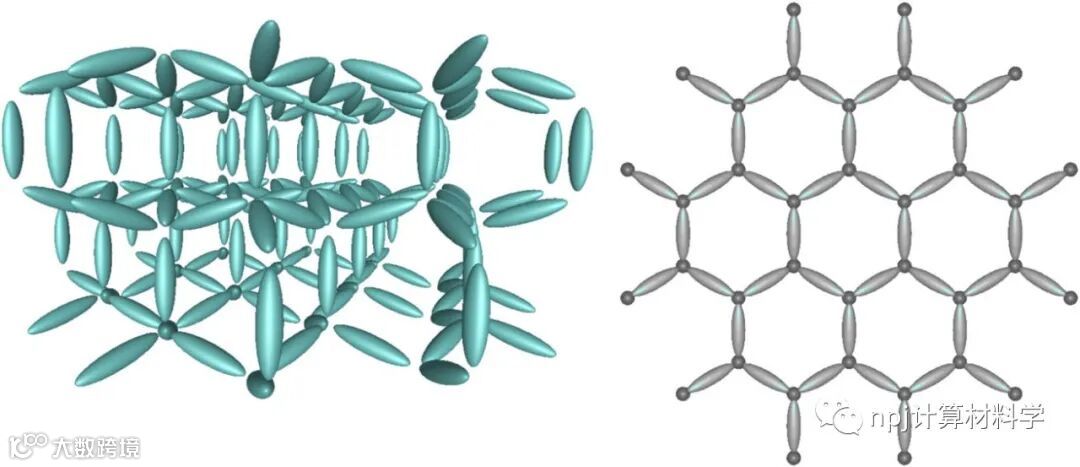
从硬盘驱动器到闪存,从CMOS 到自旋电子技术,数据存储和传输设备在当今的技术世界中至关重要。这些设备大都基于2D结构,而第三维没有被很好的利用。3D 纳米结构在现代凝聚态物理中提供了一种新范式,在光子学、生物医学和自旋电子学中有许多应用。它们有望实现用于超快速和低能量数据存储的 3D 磁性纳米网络。这些系统中的阻挫会导致磁荷或磁单极子,可以作为移动的二进制信息载体。作为一种3D结构,自旋冰近年来得到了广泛研究。然而,2D 人造自旋冰中的狄拉克弦会结合磁荷,而对应的3D 偶极系统需要低温才能保持稳定性。
来自奥地利维也纳大学物理学院的Sabri Koraltan研究团队,结合偶极自旋冰和人造自旋冰的优点,设计了第一个 3D的人造自旋冰晶格。该晶格是一个 3D 纳米磁性顶点网络,由四个不连接的 3D 磁性椭球组成,具有完美的伊辛(Ising)行为,可实现无张力的狄拉克弦和未绑定的磁荷。研究发现,产生磁荷和传输磁荷所需的能量差异约为 2 eV,这使得未束缚磁电荷的传播具备可控性。鉴于磁单极子可作为移动信息的载体,该晶格能使电荷载流子在 3D 磁性纳米网络中进行可控运动。这些结果为用于数据传输和存储的 3D 磁网络铺平了道路。该文近期发布于npj Computational Materials 7: 125 (2021)。
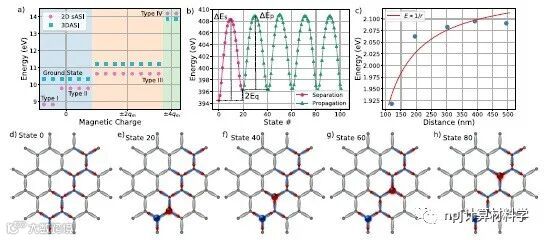
Fig. 2 Magnetostatic energies and minimum energy paths for propagation and separation of charges.
Editorial Summary
3D artificial spin ice: Controllable magnetic charges
Data storage and transport devices ranging from hard disk drives to flash memories, from CMOS to spintronic technologies are of crucial importance in our technological world. These devices are mainly based on 3D structures, while the third dimension has not been well utilized. In this regard, 3D nano-architectures presents a new paradigm in modern condensed matter physics with numerous applications in photonics, biomedicine, and spintronics. They are promising for the realization of 3D magnetic nano-networks for ultra-fast and low-energy data storage. Frustration in these systems can lead to magnetic charges or magnetic monopoles, which can function as mobile, binary information carriers. Over the past years, spin ices, a class of 3D materials, have been investigated in detail. However, Dirac strings in 2D artificial spin ices bind magnetic charges, while 3D dipolar counterparts require cryogenic temperatures for their stability.
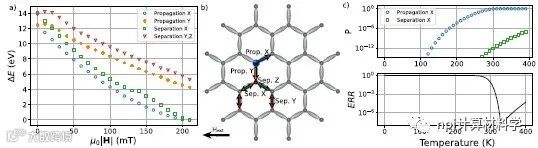
A team led by Sabri Koraltan from Faculty of Physics in University of Vienna, combined the advantages of both dipolar spin ices (DSI) and artificial spin ices (ASI), and designed the first 3D ASI lattice. The 3D ASI lattice is a 3D nano-magnetic network of vertices consisting of four disconnected 3D magnetic ellipsoids with perfect Ising behavior, enabling tension-free Dirac Strings and unbound magnetic charges. Results show that the difference in energy, required to create magnetic charges and their transport, is around 2 eV, which enables the controlled propagation of unbound charges. Considering the emergent magnetic monopoles as binary, mobile information carriers, the presented lattice demonstrates the steered motion of charge carriers in a 3D magnetic nano-network at room temperatures. The controllability of these charges paves the way toward a 3D magnetic network for data transport and storage. This article was recently published in npj Computational Materials 7: 125 (2021).
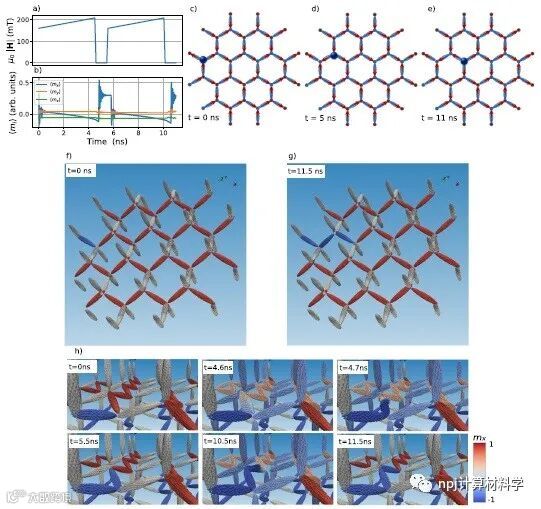
Fig. 4 Field-driven monopole propagation.
原文Abstract及其翻译
Tension-free Dirac strings and steered magnetic charges in 3D artificial spin ice (3D人造自旋冰中的无张力狄拉克弦和导向磁荷)
Sabri Koraltan, Florian Slanovc, Florian Bruckner, Cristiano Nisoli, Andrii V. Chumak, Oleksandr V. Dobrovolskiy, Claas Abert & Dieter Suess
Abstract 3D nano-architectures presents a new paradigm in modern condensed matter physics with numerous applications in photonics, biomedicine, and spintronics. They are promising for the realization of 3D magnetic nano-networks for ultra-fast and low-energy data storage. Frustration in these systems can lead to magnetic charges or magnetic monopoles, which can function as mobile, binary information carriers. However, Dirac strings in 2D artificial spin ices bind magnetic charges, while 3D dipolar counterparts require cryogenic temperatures for their stability. Here, we present a micromagnetic study of a highly frustrated 3D artificial spin ice harboring tension-free Dirac strings with unbound magnetic charges at room temperature. We use micromagnetic simulations to demonstrate that the mobility threshold for magnetic charges is by 2 eV lower than their unbinding energy. By applying global magnetic fields, we steer magnetic charges in a given direction omitting unintended switchings. The introduced system paves the way toward 3D magnetic networks for data transport and storage.
摘要 3D 纳米结构在现代凝聚态物理中提供了一种新范式,在光子学、生物医学和自旋电子学中有许多应用。它们有望实现用于超快速和低能量数据存储的 3D 磁性纳米网络。这些系统中的阻挫会导致磁荷或磁单极子,可以作为移动的二进制信息载体。然而,2D 人造自旋冰中的狄拉克弦会结合磁荷,而对应的3D 偶极系统需要低温才能保持稳定性。在本工作中,我们对高度受挫的 3D 人造自旋冰进行了微磁研究,该系统含有在室温下具有未束缚磁荷的无张力狄拉克弦。我们运用微磁模拟,证明了磁电荷的迁移率阈值比它们的结合能低 2 eV。通过应用全局磁场,我们可以在给定方向上引导磁荷并忽略意外切换。该工作引入的系统为用于数据传输和存储的 3D 磁网络奠定了基础。
微信分享

免责声明:本文旨在传递更多科研资讯及分享,所有其他媒、网来源均注明出处,如涉及版权问题,请作者第一时间后台联系,我们将协调进行处理,所有来稿文责自负,两江仅作分享平台。转载请注明出处,如原创内容转载需授权,请联系下方微信号。