


FUTURE | 远见 闵青云 文
近日,新加坡国立大学Yongxin Guo(郭永新)团队以「On large-signal modeling of GaN HEMTs: past, development and future」¹为题在Chip上发表长篇综述论文,回顾、梳理和展望了氮化镓高电子迁移率晶体管的大信号建模领域的研究进展。第一作者为Haorui Luo(罗皓瑞),通讯作者为Yongxin Guo。本文被遴选为本期Featured in Chip编辑特选文章之一。Chip是全球唯一聚焦芯片类研究的综合性国际期刊,是入选了国家高起点新刊计划的「三类高质量论文」期刊之一。
氮化镓高电子迁移率晶体管(gallium nitride high electron mobility transistor,GaN HEMT)以其高功率密度、高工作频率、高功率效率和高击穿电压等优异特性而被广泛应用在多种微波毫米波电路和系统中。如图1所示,相比于其他主要晶体管技术,GaN材料在高频段的输出功率方面有着明显的优势。GaN HEMT大信号模型在其中起到了关键的桥梁作用。它紧密地连接了器件与电路,确保了电路和系统设计的可靠性,也能为优化器件工艺提出指导。
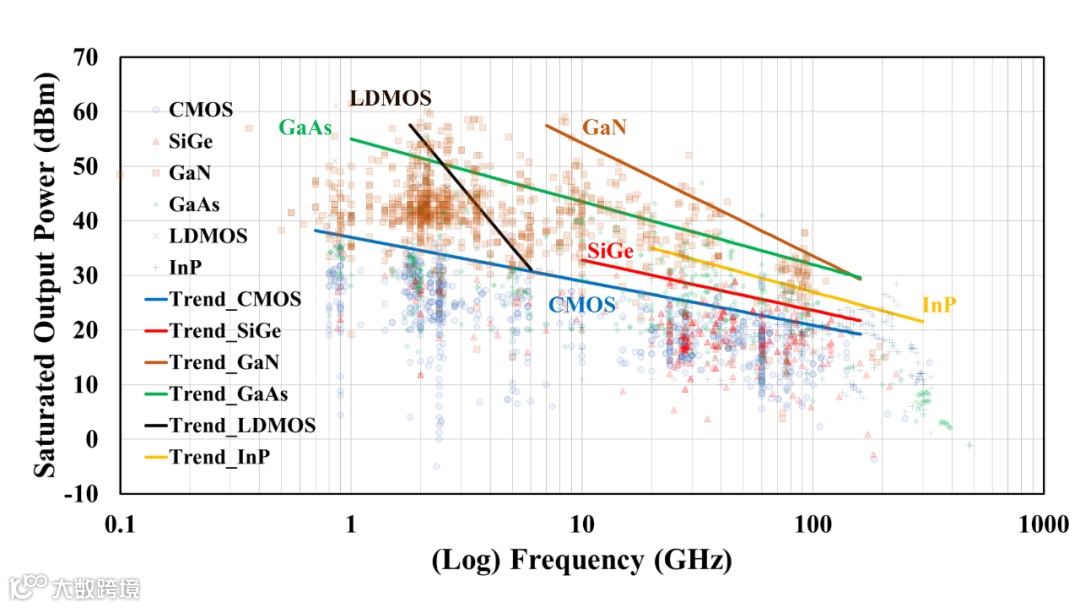
图1 | 基于不同晶体管技术的功率放大器的饱和输出功率与频率的关系。每一离散点代表现有文献中报道的设计性能,各条直线代表各项技术的极限性能的拟合趋势。
自GaN HEMT器件诞生以来,器件的工艺不断进步,电路和系统的设计要求不断提高。相应地,器件模型也有着显著的发展。一些典型的大信号模型发展时间线如图2所示。其中经验模型的出现最早,发展跨度也最广。即便现在,经验模型仍然被广泛的应用在科研和工业界一线。基于机器学习的建模想法最早于本世纪初提出,最近发展势头迅速。GaN HEMT的物理模型则提出于最近十年,并在这期间得到了飞速的发展,目前部分物理模型已有成熟的参数提取和建模流程。随着时间的发展,不同模型之间也逐渐产生了相互的交融,例如QPZD模型²,混合模型³,KBNN模型⁴等。尽管大信号模型的构建方法多样,但其等效电路的基本结构相似,如图3所示。
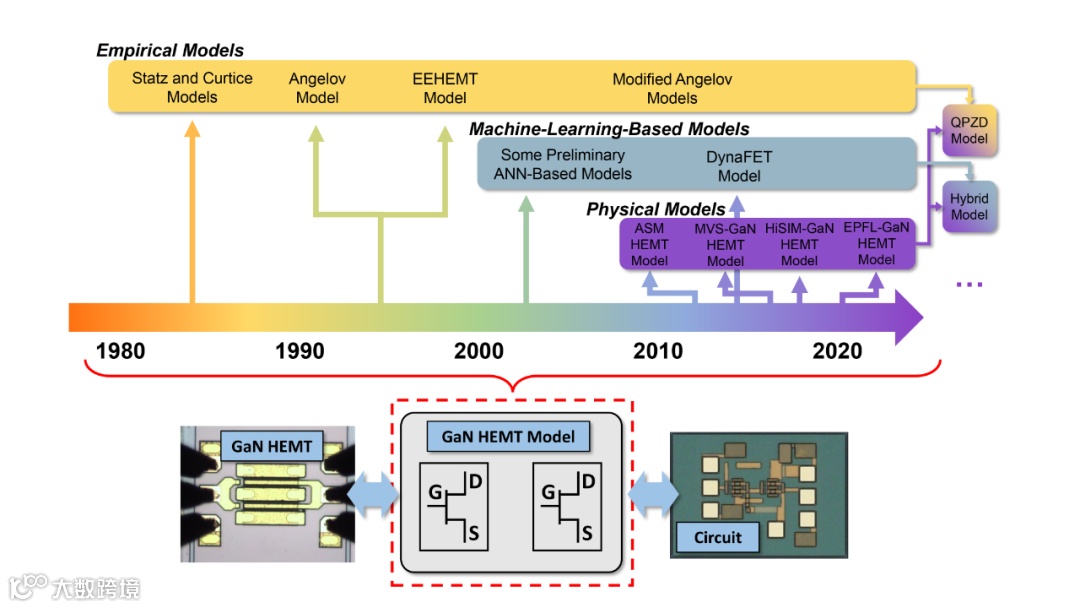
图2 | 一些典型的GaN HEMT大信号模型发展时间线。
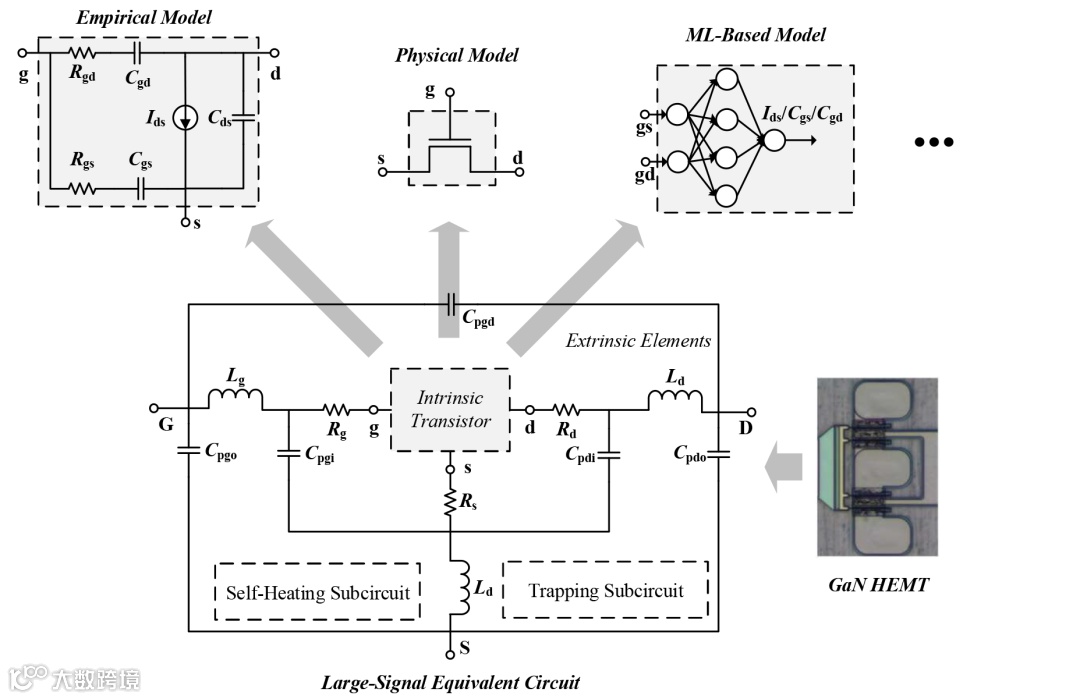
图3 | GaN HEMT大信号模型的等效电路图。
在未来,作者相信将会有更多新型的模型出现并应用至电路设计中。可能的创新之处包括现有本征模型建模公式的优化,非理想效应的建模优化和新建模方法的提出等。
On large-signal modeling of GaN HEMTs: past, development and future¹
Gallium nitride high electron mobility transistors (GaN HEMTs) are widely used in various microwave and millimeter wave circuits and systems due to their excellent characteristics such as high-power density, high operating frequency, high power efficiency, and high breakdown voltage. The GaN HEMT large-signal model plays a key role as a bridge. It closely connects devices and circuits, ensures the reliability of circuit and system design, and can also provide guidance for optimizing device processes.
Since the birth of GaN HEMT devices, device technology has continuously improved, and the design requirements of circuits and systems have also been continuously enhanced. Correspondingly, device models have seen significant development. Fig. 1 shows the timelines for the development of some typical large-signal models. Among them, empirical models appeared the earliest and have had the broadest development span. Even now, empirical models are still widely used on the frontiers of both scientific research and industry. The idea of machine learning-based modeling was first proposed in the early 2000s and has recently gained momentum. Physical models were proposed in the last decade and have developed rapidly during this period. Currently, some physical models have mature parameter extraction and modeling procedures. As time has passed, different models have gradually undergone mutual integration, examples of which include the QPZD model², the hybrid model³, the KBNN model⁴, etc. Although there are various formulation methods for the large-signal model, the basic architectures of their equivalent circuits are similar, as shown in Fig. 2. In the future, the authors believe that more new models will emerge and be applied to circuit designs. Possible innovations may include improvements to existing modeling formulas, optimization of modeling for non-ideal effects, proposal of new modeling methods, etc.
参考文献:
1. Luo, H., Hu, W. & Guo, Y. On large-signal modeling of GaN HEMTs: past, development and future. Chip 2, 100052 (2023).
2. Wen, Z. et al. A quasi-physical compact large-signal model for AlGaN/GaN HEMTs. IEEE Trans. Microw. Theory Tech. 65, 5113–5122 (2017).
3. Luo, H., Yan, X., Zhang, J. & Guo, Y. A neural network-based hybrid physical model for GaN HEMTs. IEEE Trans. Microw. Theory Tech. 70, 4816–4826 (2022).
4. Li, M. et al. A Scalable knowledge-based neural network model for GaN HEMTs with accurate trapping and self-heating effects characterization. IEEE Trans. Microw. Theory Tech. 1–14 (2023).
论文链接:
https://www.sciencedirect.com/science/article/pii/S2709472323000151
作者简介