


FUTURE | 远见 闵青云 选编
近日,北京大学王永锋团队最新研究成果以「Construction and electrical control of ultrahigh-density organic memory arrays at cryogenic temperature」¹为题在Chip上发表研究论文,报道了利用有机分子构筑超高密度磁存储阵列(~ 320 TB/sq.in)的相关工作。钟明俊和李杰为文章共同第一作者,通讯作者为王永锋、张亚杰以及张雪。本文为特刊(Cryogenic Chips)文章之一,此特刊为Chip发起的首个特刊。Chip是全球唯一聚焦芯片类研究的综合性国际期刊,是入选了国家高起点新刊计划的「三类高质量论文」期刊之一。
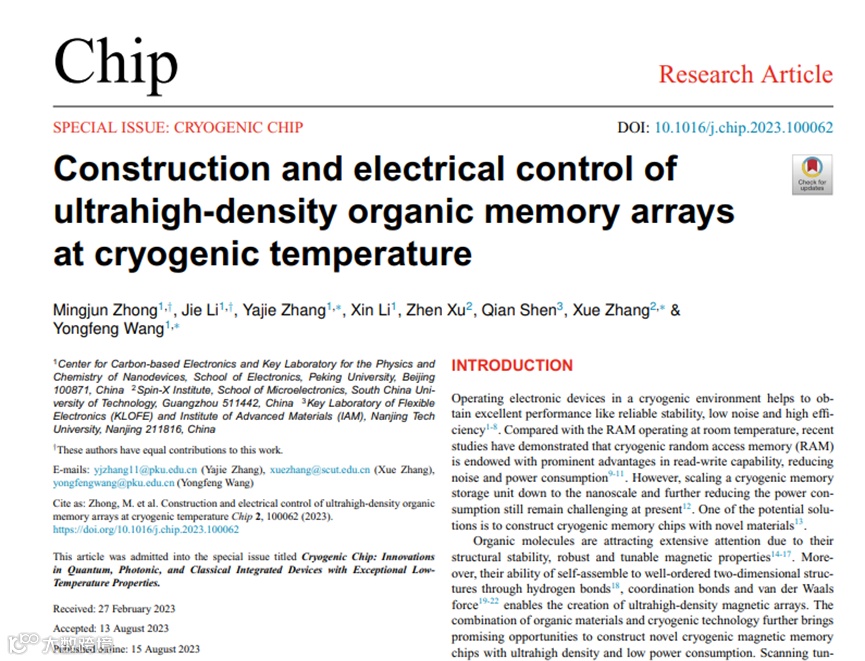
低温随机存储器在读写速度、噪音和功耗方面表现出优越的性能。然而,将低温存储单元缩小到纳米尺度并进一步降低功耗仍极具挑战性。利用有机分子自组装形成的超高密度二维阵列构筑纳米级存储芯片有望解决这一难题。
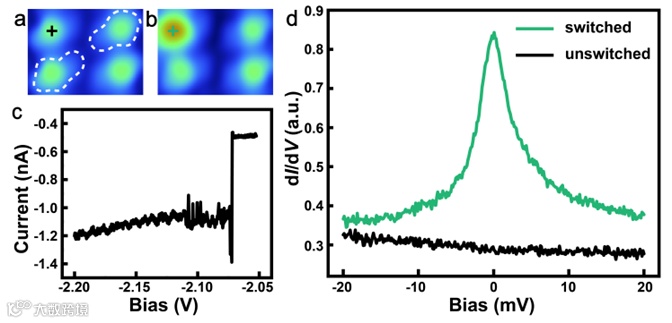
研究团队进而利用电压脉冲成功实现了对分子自旋态的电学操纵,将分子从非磁性态转变为磁性态⁴。图2展示了分子自旋态转变前后的形貌变化和谱学演化,可以发现分子被操纵至磁性态后亮度变高,且其微分电导谱出现明显的近藤共振峰。
Operating random access memory (RAM) in a cryogenic environment helps to obtain excellent performance like exceptional read-write capability, low noise and less power consumption. However, scaling of a cryogenic memory storage unit down to nanoscale and further reducing the power consumption remain challenging at present. One of the potential solutions is to construct the cryogenic memory chips with organic molecules which have the ability of self-assembling to well-ordered two-dimensional structures and constructing ultrahigh-density magnetic arrays.
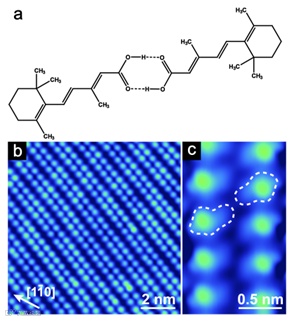
In this work, the organic molecule (2E,4E)-3-methyl-5-(2,6,6-trimethylcyclohex-1-enyl)penta-2,4-dienoic acid (denoted as DiA) with small molecular size was selected to construct close-packed molecular arrays through hydrogen bonds and van der Waals force. Cryogenic-temperature (4 K) scanning tunneling microscope (STM) experiments were performed to obtain topographic images of molecular arrays (Fig. 1). A single DiA molecule in the arrays occupies less than 0.25 nm², making it a potential candidate for constructing ultrahigh-density magnetic molecular arrays.
By applying voltage pulses, we can realize the electrical control of the molecular spin states. The DiA molecule could be converted from a nonmagnetic state to a spin-carrying state. The variations in molecular topography and the differential conductance spectroscopy would reflect the changes in the molecular spin state (Fig. 2).
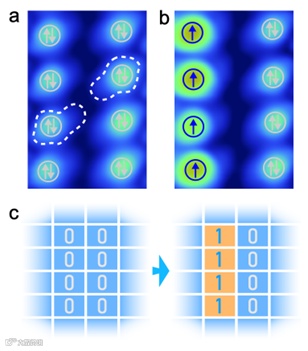
Utilizing logic numbers ‘0’ and ‘1’ to represent the nonmagnetic and magnetic state of the molecule, then eight molecules compose a byte of a memory chip. Each molecular bit can be converted from ‘0’ to ‘1’ by applying electrical voltage pulse to the bit sequentially (Fig. 3). Given that 2.6×10¹⁵ DiA molecules could adsorb in an area of one square inch, a memory chip constructed with DiA can reach an ultrahigh density of ~2600 terabits per square inch. The work sheds light on the potential of employing organic molecules to construct ultrahigh-density magnetic memory arrays and provides useful fundamental reference for future study of novel molecule-based spintronics and random-access memory devices in cryogenic environments.
参考文献:
1. Zhong, M. et al. Construction and electrical control of ultrahigh-density organic memory arrays at cryogenic temperature. Chip 2, 100062 (2023).
2.He, Y. et al. Observation of biradical spin coupling through hydrogen bonds. Phys. Rev. Lett. 128, 236401 (2022).
3. Karan, S. et al. Spin manipulation by creation of single-molecule radical cations. Phys. Rev. Lett. 116, 027201 (2016).
4. Bocquet, M. L., Lorente, N., Berndt, R. & Gruber, M. Spin in a closed‐shell organic molecule on a metal substrate generated by a sigmatropic reaction. Angew. Chem. Int. Ed. 58, 821-824 (2019).
论文链接:
https://www.sciencedirect.com/science/article/pii/S2709472323000254


Xue Zhang, an associate professor at South China University of Technology, focuses her research on the fabrication of surface nanostructures based on scanning tunneling microscopy and the manipulation and characterization of single molecular spin states. She has published over twenty research papers in famous journals such as Nature Chemistry, ACS Nano,Journal of the American Chemical Society, and Nano Letters, and has received financial support from national, provincial, and city-level scientific research projects.