


近年来,由于三维制造工艺和优化技术的进步,定制特性的机械材料设计引起了极大的兴趣。晶格结构因其高强度-重量比、出色的能量吸收能力和卓越的结构稳定性,在航空航天、汽车、生物医学和能源系统等领域扮演着不可或缺的角色。
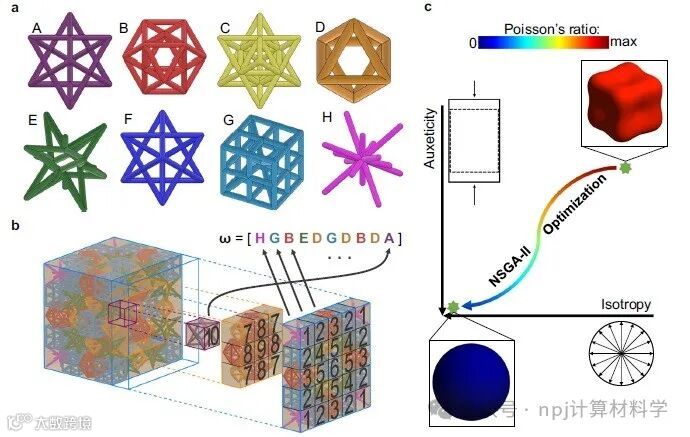
然而,实现具有多种期望力学性能的最优晶格结构的系统设计仍然是一项具有挑战性的任务。传统的设计方法依赖于试错或直觉,可能会耗时、昂贵,而且可能不能保证最佳性能。
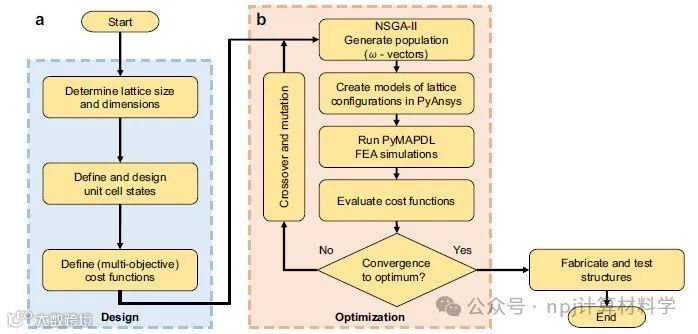
制造、有限元分析和优化技术的最新进展扩展了超材料设计的可能性,包括各向同性和拉胀结构,因其独特的变形机制和在不同载荷下的一致行为而被用于能量吸收等应用。然而,实现多个性质的同时控制,如最佳的各向同性和辅助特性等,仍然具有挑战性。
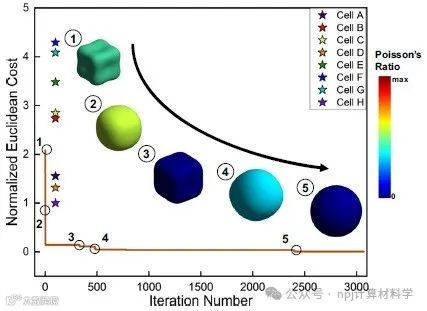
Fig. 3 Convergence of the multiobjective optimization process.
来自加州大学伯克利分校机械工程系激光热实验室的Timon Meier等,采用全自动多目标设计优化方法,利用遗传算法优化框架,设计出了具有定制弹性行为的晶格结构。
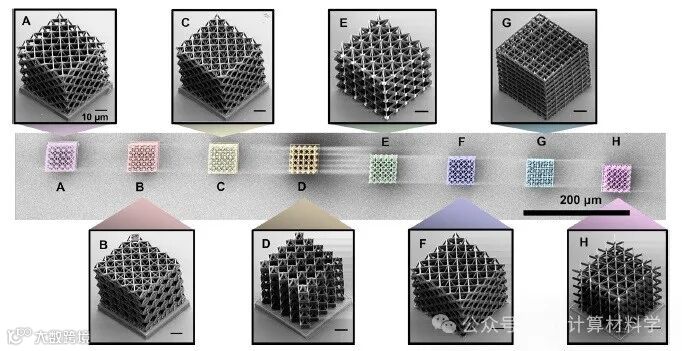
他们介绍了一种系统的设计方法,将模拟、有限元分析、遗传算法和优化结合起来,用于创建具有定制力学性能的晶格结构。通过战略性地排列8种明显不是各向同性也不是辅助的单位单元状态,控制了5×5×5立方对称晶格结构中的刚度张量。
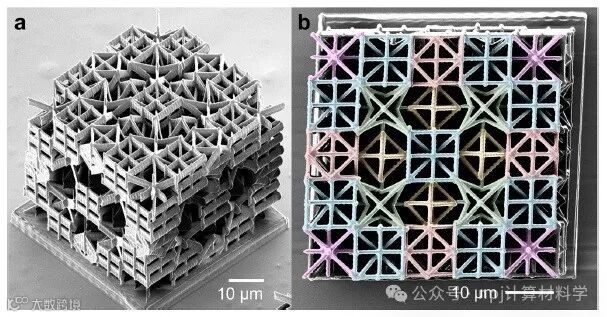
这种设计选择产生了一个大的违反直觉的组合设计空间,为实现所需的机械性能提供了灵活性。超材料的多光子光刻制造和实验表征突显了其现实应用,并证实了理论数据与实验数据之间的密切关联。
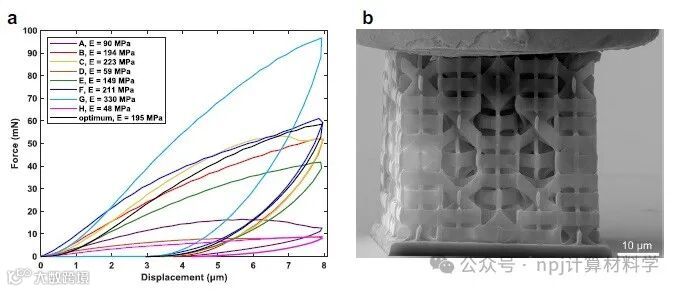
Fig. 6 Mechanical testing of structures.
作者的方法集成了自动化设计、有限元分析和优化与制造,以及实验表征,以验证最优结构,本方法为工程师和研究人员提供了一个有价值的工具,用于创建具有定制的力学性能的晶格结构。该文近期发布于npj Computational Materials 10: 3 (2023)。
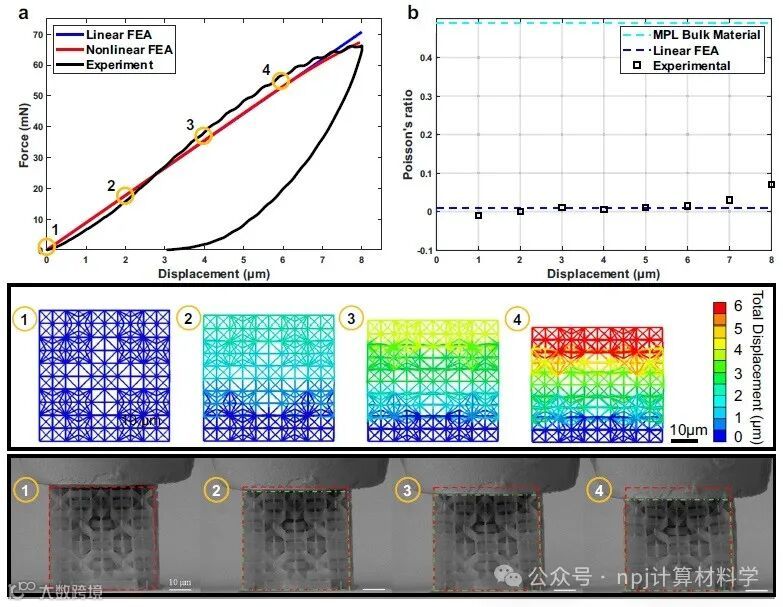
Fig. 7 Experimental compression test data of the optimal structure is presented, along with video captures and a comparison to theoretical FEA results.
反直觉设计空间中获得拉胀和各向同性超材料:一种自动优化方法和实验表征)
Timon Meier,
Runxuan Li, Stefanos Mavrikos, Brian Blankenship, Zacharias Vangelatos, M.
Erden Yildizdag & Costas P. Grigoropoulos
Abstract
Recent advancements in manufacturing, finite element analysis (FEA), and optimization techniques have expanded the design possibilities for metamaterials, including isotropic and auxetic structures, known for applications like energy absorption due to their unique deformation mechanism and consistent behavior under varying loads. However, achieving simultaneous control of multiple properties, such as optimal isotropic and auxetic characteristics, remains challenging. This paper introduces a systematic design approach that combines modeling, FEA, genetic algorithm, and optimization to create tailored mechanical behavior in metamaterials. Through strategically arranging 8 distinct neither isotropic nor auxetic unit cell states, the stiffness tensor in a 5 × 5 × 5 cubic symmetric lattice structure is controlled. Employing the NSGA-II genetic algorithm and automated modeling, we yield metamaterial lattice structures possessing both desired isotropic and auxetic properties. Multiphoton lithography fabrication and experimental characterization of the optimized metamaterial highlights a practical real-world use and confirms the close correlation between theoretical and
experimental data.
摘要 制造、有限元分析(FEA)和优化技术的最新进展扩展了超材料设计的可能性,包括各向同性和拉胀结构,其独特的变形机制和在不同载荷下的一致行为而被用于能量吸收等应用。然而,实现多个性质的同时调控,如最佳的各向同性和拉胀特性,仍然具有挑战性。本文介绍了一种系统的设计方法,将模拟、有限元分析、遗传算法和优化结合起来,以在超材料中创造定制的机械行为。通过战略性地排列8种明显不是各向同性也不是拉胀元胞态,控制了5×5×5立方对称晶格结构中的刚度张量。利用NSGA-II遗传算法和自动化模拟,我们得到了具有期望的各向同性和拉胀性能的超材料晶格结构。优秀超材料的多光子光刻制造和实验表征突显了其现实应用,并证实了理论数据与实验数据之间的密切关联。