文章来源:npj计算材料学
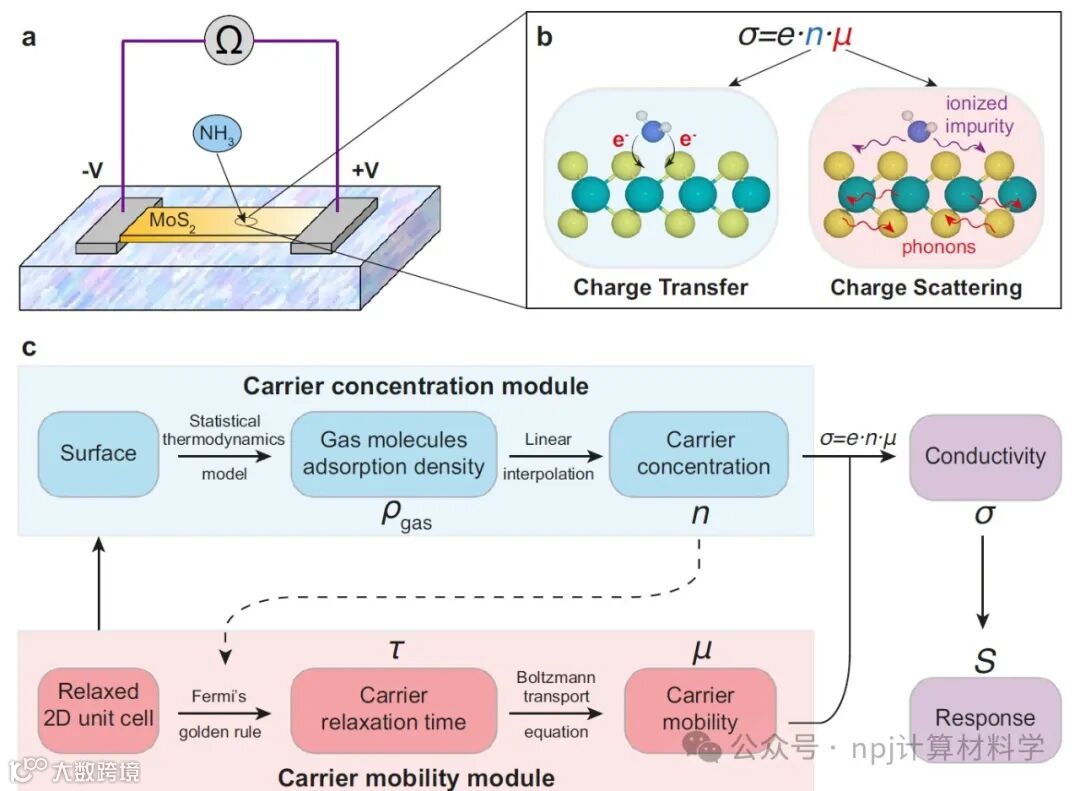
在二维化学电阻型气体传感器中,目标气体的检测依赖于监控传感材料电阻的变化。传感材料电阻的变化主要源于气体吸附对其载流子浓度和迁移率的影响。二维化学电阻型气体传感器响应的产生通常涉及多个过程,包括气体吸附、吸附气体与传感材料间的电荷转移、以及由此引起的传感材料载流子浓度和迁移率(电子-声子散射、电离杂质散射)的变化。然而,现有的理论研究方法,无论是半定量还是定量方法,仅通过计算电荷转移来考虑载流子浓度的变化,这带来了两个缺陷:1)忽略了载流子迁移率的变化;2)潜在地高估载流子浓度的变化。这使得我们无法准确捕捉这些相互交织的过程,也无法量化载流子浓度和迁移率分别对传感材料总响应的贡献,从而难以深入理解其本征传感机理。
Fig.1 | Schematics for calculating the response of 2D gas sensing materials.
来自清华大学燃烧能源中心和车辆学院的张亮副教授团队,提出了一套同时考虑载流子浓度和迁移率的第一性原理计算流程,来计算二维化学电阻型传感材料的吸附响应,并以二维MoS2为例验证了其准确性。
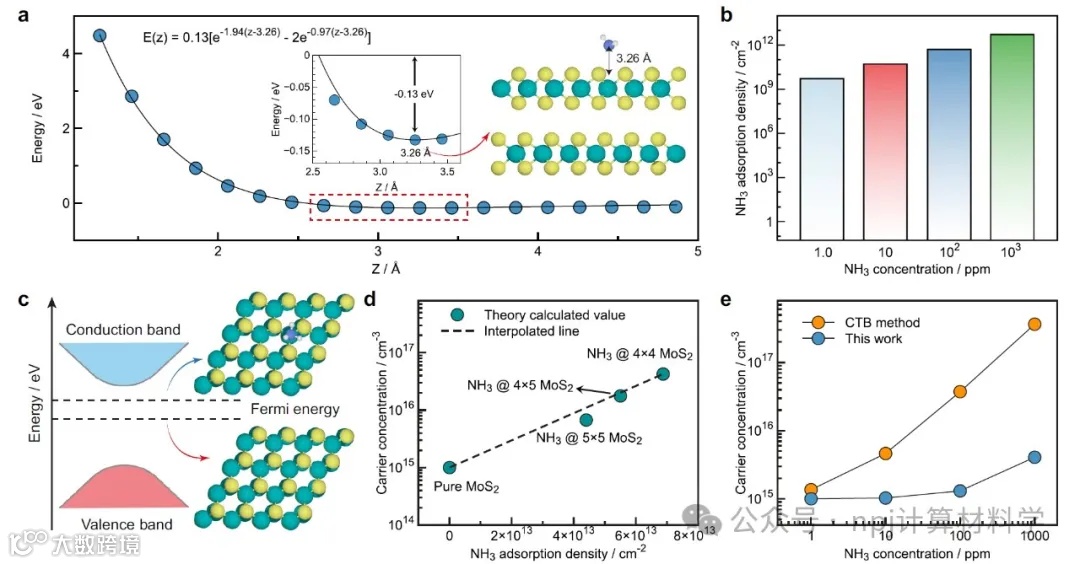
Fig. 2 | NH3 adsorption density on bilayer MoS2 and resultant carrier concentrations of MoS2 under varying NH3 concentrations.
理论与实验结果的对比表明,相较于电荷转移方法,该方法可提供更为准确的响应和检测极限(LOD)。此外,他们将载流子浓度和迁移率从电导率中解耦,量化了两者分别对气体总响应的贡献。结果表明,二维MoS2是一种载流子浓度占主导的气体传感材料,且导致电荷转移方法高估响应或低估LOD的主要原因为该方法通常会高估载流子浓度的变化。这是因为,通过计算得到的从气体分子转移到传感材材中的电荷通常不会全部转化为可自由移动的载流子。相反,它们可能会被界面上的一些特定位点吸收或与空穴重新结合。上述分析显示,尽管电荷转移方法能够对载流子浓度主导的气体传感材料吸附响应(如NH3@MoS2)提供一定程度的定性解释,但该方法并不适用于对这些材料响应的定量估计,尤其是对于那些载流子迁移率主导的材料。
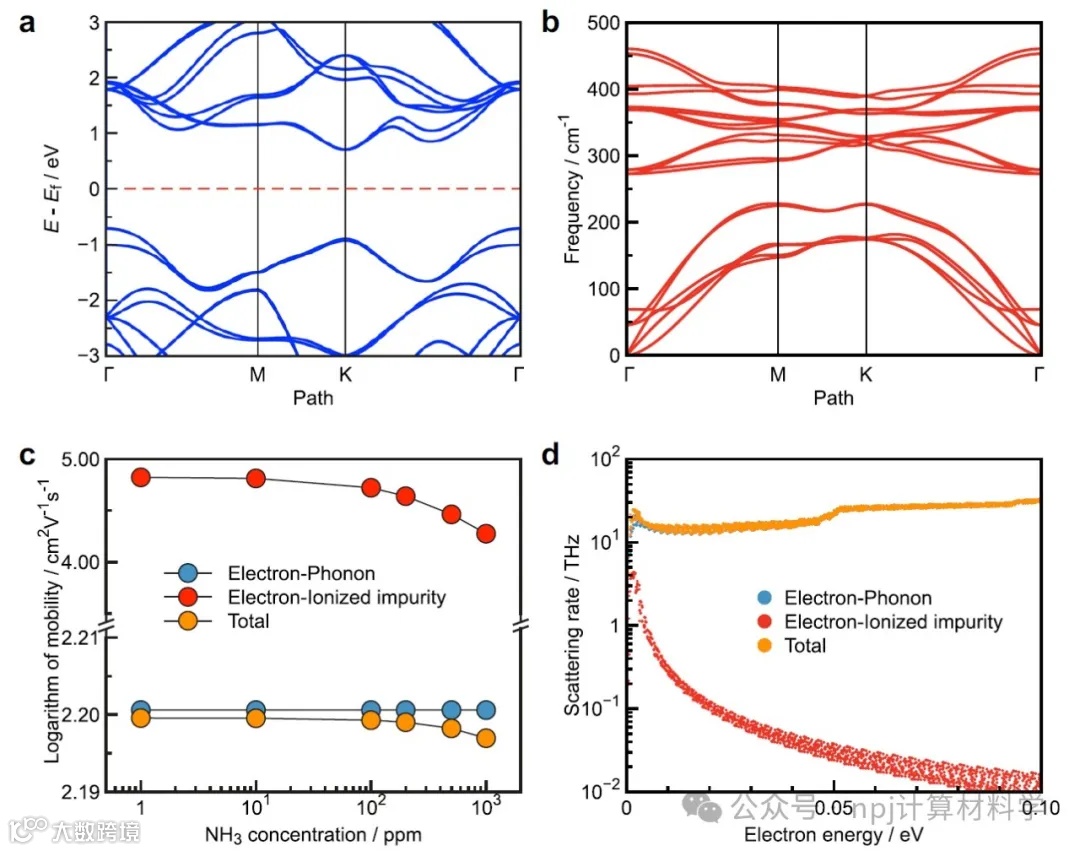
Fig. 3 | The carrier mobility and scattering rate of bilayer MoS2 under varying NH3 concentrations.
该研究为探索新型载流子迁移率主导的传感材料、筛选有前景的气体传感材料以及对传感机理的定量化理解提供了新的机遇。相关论文近期发布于npj Computational Materials 10: 138 (2024)。手机阅读原文,请点击本文底部左下角“阅读原文”,进入后亦可下载全文PDF文件。[这句请保留]
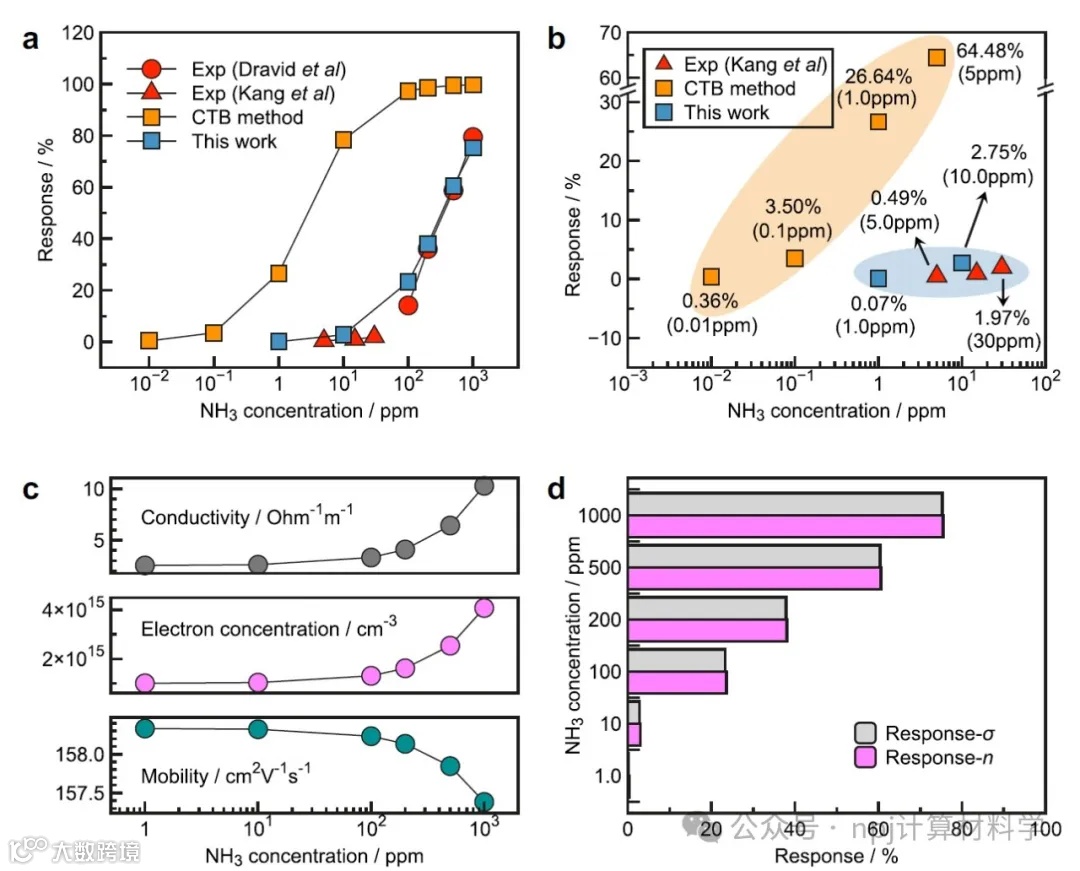
Fig. 4 | The comparison between experimental results and computational predictions.
Diamond anvil cell: Stress−strain fields, large elastoplasticity and friction
Within 2D the chemiresistive gas sensors, the detection of target gases hinges on the monitoring of shifts in their electrical resistance. It is well accepted that the resistance variations stem from the impact of gas adsorption on the sensing material’s carrier concentration and mobility. The generation of response in 2D chemiresistive gas sensors involves a multitude of processes, including gas adsorption, modulation of material’s carrier concentration induced by the charge transfer between gas and sensing material, and carrier mobility influenced by factors like electron-phonon and ionized impurity scattering. However, current approaches, whether semi-quantitative or quantitative, solely based on charge transfer, leading to the following two major impediments: (1) the disregard for the impact of carrier mobility, and (2) the potential overestimation of carrier concentration changes, leading to the failure of comprehensively capturing these intertwined process or quantifying the contribution of carrier concentration and mobility to the total gas response of sensing materials, making a gap in understanding its intrinsic gas sensing mechanism.
A team led by Prof. Liang Zhang from the Center for Combustion Energy, and School of Vehicle and Mobility, Tsinghua University, China, presented a first-principles framework for calculating the response of 2D materials, incorporating both carrier concentration and mobility. They showcased their method by applying it to prototype NH3 sensing on 2D MoS2 and comparing the results with prior experiments in the literature. The comparative analysis with experimental results indicated that their method can provide an accurate prediction of response and LOD for 2D MoS2 to NH3, avoiding the overestimated response and underestimated LOD as encountered in charge-transfer-based method. Then, by decoupling carrier concentration and mobility from the conductivity of MoS2, the analysis provided a quantitative insight into their respective contributions to the overall response of 2D MoS2 to NH3, demonstrating that its gas sensing mechanism is primarily dominated by carrier concentration, and the overestimated response or underestimated LOD in charge-transfer-based method are attributed to overestimating the changes in carrier concentration of MoS2induced by NH3 adsorption. This overestimation arises from the fact that the calculated charges transferred from NH3 to MoS2may not fully become mobile-free carriers with MoS2. Instead, these transferred charges might either be trapped at specific sites near the interface or recombine with holes in MoS2. The above analysis demonstrates that charge transfer can serve as a valuable qualitative assessment of gas sensing performance, particularly for carrier concentration-dominated materials such as MoS2, but it cannot be suitable to carrier mobility-dominated materials.
Therefore, the first-principles method presented in this work opens exciting opportunities to explore carrier mobility-dominated sensing materials, facilities efficient screening of promising gas sensing materials, and quantitative understanding of the sensing mechanism. Thisarticle was recently published in npj Computational Materials 10: 138 (2024).
Accurate first-principles simulation for the response of 2D chemiresistive gas sensors (二维化学电阻型气体传感材料吸附响应的定量模拟)
Abstract The realm of chemiresistive gas sensors has witnessed a notable surge in interest in two-dimensional (2D) materials. The advancement of high-performance 2D gas sensing materials necessitates a quantitative theoretical method capable of accurately predicting their response. In this context, we present our first-principles framework for calculating the response of 2D materials, incorporating both carrier concentration and mobility. We showcase our method by applying it to prototype NH3 sensing on 2D MoS2 and comparing the results with prior experiments in the literature. Our approach offers a thorough solution for carrier concentration, taking into account the electronic structure around the Fermi level. In conjunction with the mobility calculation, this enables us to provide a quantitative prediction of the response profile and limit of detection (LOD), yielding a notably improved alignment with prior experimental findings. Further analysis quantifies the contributions of carrier concentration and mobility to the overall response of 2D MoS2 to NH3. We identify that discrepancies in the charge-transfer-based method primarily stem from overestimating carrier concentrations. Our method opens exciting opportunities to explore carrier mobility-dominated sensing materials, facilitates efficient screening of promising gas sensing materials, and quantitative understanding of the sensing mechanism.
摘要:在过去的几年里,化学电阻型气体传感领域对二维(2D)材料的研究兴趣日益浓厚。开发能够准确预测二维传感材料气体吸附响应的定量计算方法,是推动高性能二维气体传感材料发展的关键。我们提出了一种基于第一性原理的计算流程,通过对载流子的浓度和迁移率的计算,实现对二维材料的气体响应进行定量模拟。我们将这种方法应用于二维MoS2表面上的NH3传感,并与现有实验数据进行了比较。通过考虑费米能级附近的电子结构,我们的方法提供了更精确的载流子浓度计算。结合载流子迁移率计算,我们的方法能够定量预测响应曲线和检测限(LOD),与实验结果一致。我们进一步分析了载流子浓度和迁移率对总体响应的单独贡献,揭示了电荷转移方法的主要预测偏差来自对载流子浓度变化的高估。我们的方法为探索以载流子迁移率为主导的传感材料、筛选有前景的气体传感材料以及实现传感机制的定量理解提供了新的机遇。
免责声明:本文旨在传递更多科研资讯及分享,所有其他媒、网来源均注明出处,如涉及版权问题,请作者第一时间后台联系,我们将协调进行处理,所有来稿文责自负,两江仅作分享平台。转载请注明出处,如原创内容转载需授权,请联系下方微信号。