

文章来源:npj计算材料学
在传统铁电材料中,电场可以诱导无序的自发极化沿外场方向排列,伴随温度升高,极化熵降低;撤去电场后温度下降,极化熵增大。电卡制冷采用循环的方式实现对热量的“搬运”。但在PbZrO3等反铁电材料中,可以观测到施加电场温度降低的现象。这种与电卡效应相反的“负”电卡效应仍缺乏系统的理论研究。
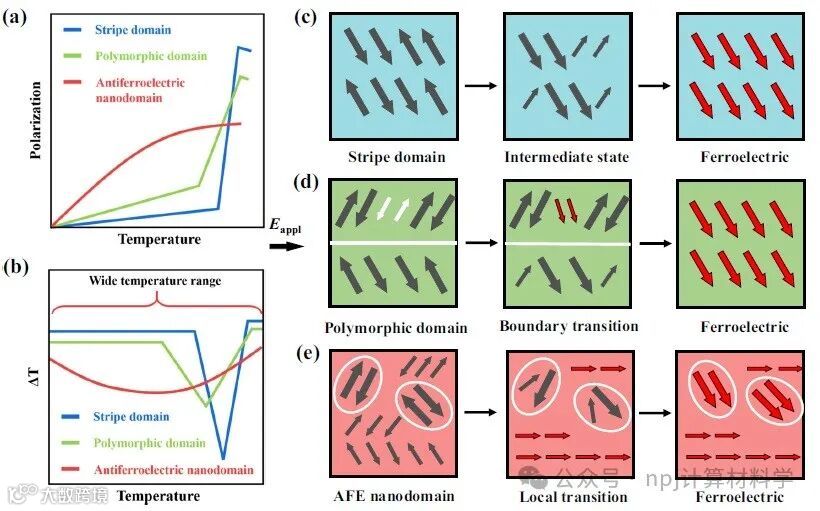
来自北京理工大学前沿交叉科学研究院的黄厚兵教授团队,采用相场法从畴尺度揭示了PbZrO3反铁电材料负电卡效应的产生机理。提出通过引入高密度极化界面的方式,提升负电卡效应的工作温区。
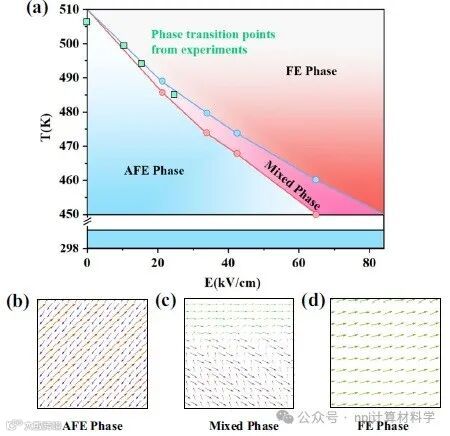
Fig. 2 | Temperature-electric field phase diagram of PZO polymorphic domain.
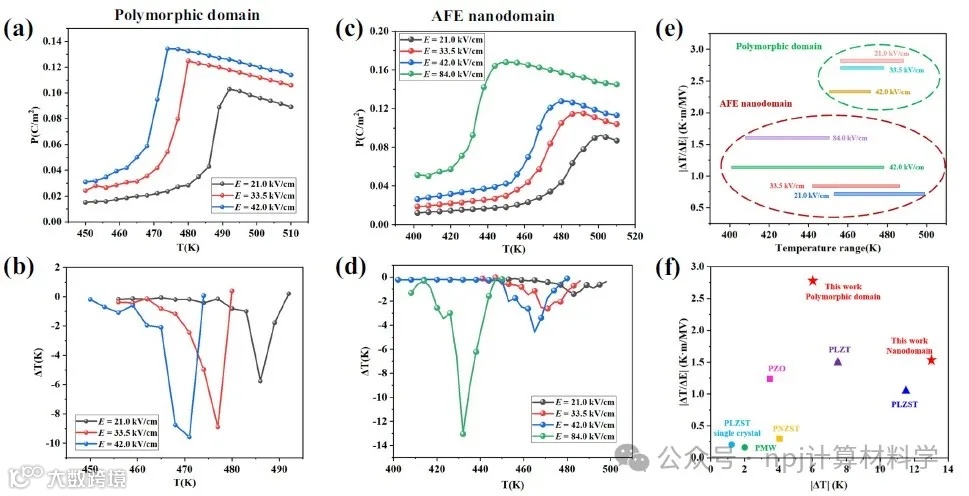
他们建立了原型PbZrO3的温度-电场相图,发现在反铁电和铁电相界处存在两相共存的区域。这种逐步相变而非瞬态相变的特征能够提升负电卡效应的工作温区。相场模拟表明,混合相形成的原因是反铁电→铁电和铁电→反铁电相变的形核位点均倾向于畴壁或局域非公度界面处。
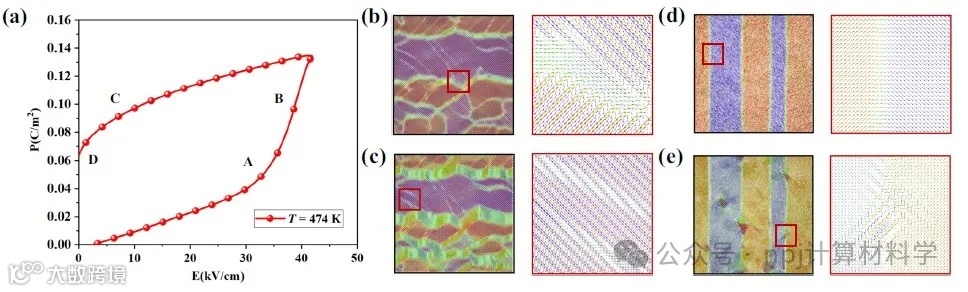
因此,通过朗道自由能的波动诱导出反铁电纳米畴,能够实现高密度极化界面的引入,进而将负电卡工作温区提升至75 K(电场强度42 kV/cm)。
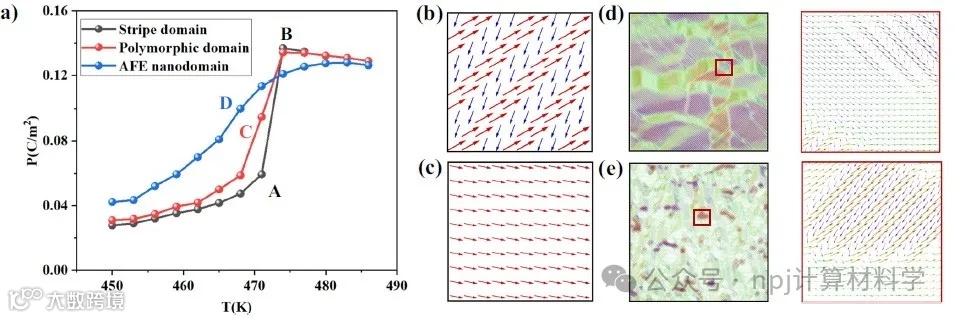
Fig. 4 | P-T curves and corresponding domain structures of PZO.
该研究表明,微观尺度下反铁电材料的负电卡强度与极化界面的形态和密度相关。相关论文近期发布于npj Computational Materials 10:150 2024. 手机阅读原文,请点击本文底部左下角“阅读原文”,进入后亦可下载全文PDF文件。
Editorial Summary
Polar boundaries - the key factor in enhancing the negative electrocaloric effect
In conventional ferroelectric (FE) materials, electric field induces disordered spontaneous polarizations along the external field, which is accompanied by a decrease in polarization entropy with an increase in temperature, and an increase in polarization entropy with a decrease in temperature after the electric field is removed. Electrocaloric refrigeration adopts a cyclic approach to realize the “transport” of heat. However, in antiferroelectric (AFE) materials such as PbZrO3, the phenomenon of decreasing temperature with an external electric field can be observed. There is still a lack of systematic mechanistic research on this “negative” electrocaloric effect (ECE), which is the opposite of positive ECE.
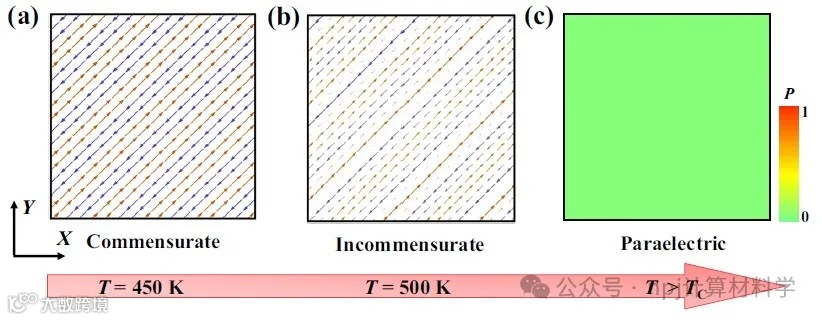
Fig. 6 | Temperature-induced phase transition of prototype PZO domain structures by phase-field simulations.
Prof. Houbing Huang's group from the Advanced Research Institute of Multidisciplinary Science, Beijing Institute of Technology, uses the phase-field methods to reveal the mechanism of the negative ECE in PbZrO3 AFE materials at domain scale. It is proposed to enhance the working temperature range of the negative ECE by introducing high-density polar boundaries.
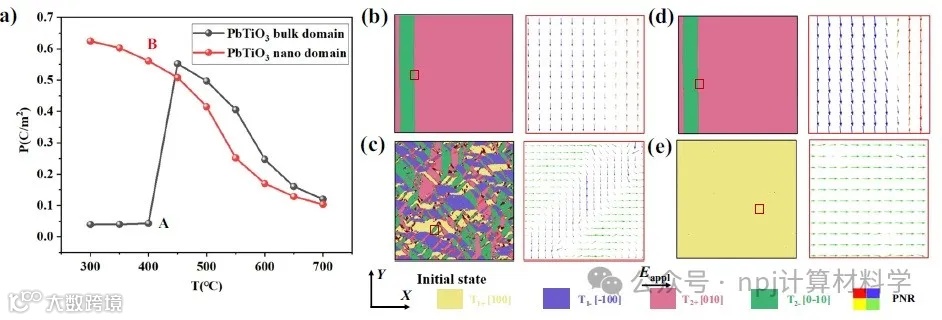
They establish the temperature-electric field phase diagram of the prototype PbZrO3 and find there is a mixed phase at the AFE - FE phase boundary. The gradual rather than transient phase transition characterizes the ability to enhance the working temperature range of the negative ECE. Phase-field simulations show that the nucleation sites for both the AFE → FE and FE → AFE phase transitions are inclined to be at the domain walls and local incommensurate interfaces. Therefore, the introduction of AFE nanodomains induced by the fluctuation of the Landau free energy can lead to high-density polar boundaries. Finally, negative ECE working temperature range up to 75 K (electric field strength 42 kV/cm) can be achieved.
This study shows that the negative ECE strength of AFE materials at the microscopic scale is correlated with the type and density of the polar boundaries. the related article was recently published in npj Computational Materials 10:150 2024.
原文Abstract及其翻译
Design of polar boundaries enhancing negative electrocaloric performance by antiferroelectric phase-field simulations(相场模拟设计极化界面提高反铁电负电卡性能)
Ke Xu, Xiaoming Shi, Cancan Shao, Shouzhe Dong & Houbing Huang
Abstract Electrocaloric refrigeration which is environmentally benign has attracted considerable attention. In distinction to ferroelectric materials, which exhibit an extremely high positive electrocaloric effect near the Curie temperature, antiferroelectric materials represented by PbZrO3 have a specific negative electrocaloric effect, i.e., electric field decreases the temperature of the material. However, the explanation of the microscopic mechanism of the negative electrocaloric effect is still unclear, and further research is still needed to provide a theoretical basis for the negative electrocaloric effect enhancement. Herein, the antiferroelectric phase-field model was proposed to design polar boundaries enhancing antiferroelectric negative electrocaloric performance in PbZrO3-based materials. Based on this, we have simulated the polarization response and domain switching process of the temperature and electric field-induced antiferroelectric - ferroelectric phase transition. It is shown that the temperature range tends to increase as the density of polar boundaries increases from the antiferroelectric stripe domain, polymorphic domain to the nanodomain. Among them, the peak adiabatic temperature change of antiferroelectric nanodomains can reach -13.05 K at 84 kV/cm, and a wide temperature range of about 75 K can be realized at 42 kV/cm. We expect these discoveries to spur further interest in the potential applications of antiferroelectric materials for next-generation refrigeration devices.
摘要:对环境友好的新一代电卡制冷引起了广泛关注。与铁电材料在居里温度附近表现出极高的正电卡制冷效应不同,反铁电材料具有特殊的负电卡制冷效应,即电场会降低材料的温度。然而,负电卡效应的微观机理尚不清楚,还需要进一步的研究为提升制冷效应提供理论依据。在此,我们基于相场模拟提出了设计反铁电极化界面,以增强PbZrO3基材料的负电卡效应。我们模拟了温度和电场诱导的反铁电-铁电相变的极化响应和畴翻转过程。结果表明,随着极化界面密度的增加,从反铁电条纹畴、多态畴到纳米畴的负电卡工作温区呈提高趋势。其中,反铁电纳米畴的绝热温变峰值在84 kV/cm电场强度下可达到-13.05 K,在42 kV/cm时可实现约75 K的宽工作温区。