

本文来源:npj计算材料学
热电技术可以实现清洁发电和无流体冷却。热电材料研究的最终目标是设计或发现具有高热电优值zT的材料。实现高zT和高功率因子的一个主要挑战是电子输运性质由一组相互制约的物理量同时决定:σ和κe是正相关的,而σ和α是负相关的。直观理解热电材料的电输运行为通常采用单抛物线带(SPB)模型的方法。然而,该方法的理想化假设具有很大的局限性,进一步限制了该方法描述电子输运行为的准确性。
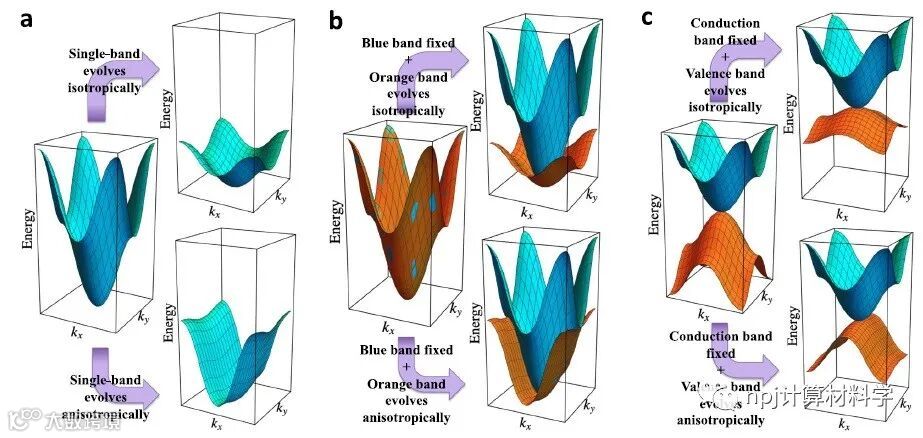
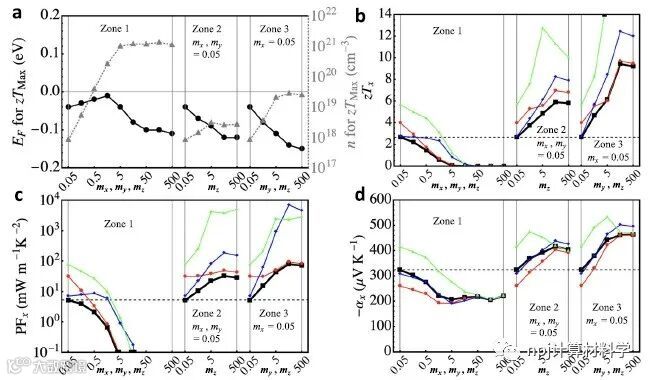
由美国劳伦斯伯克利国家实验室能源技术部的Junsoo Park教授和Anubhav Jain教授领导的团队,对更现实的能带结构(可反转为翻转抛物线的上抛物带)进行了更严格的散射处理,其中包括多能带情况。作者创建了更逼真的固体能带结构模型,更如实地模拟了多源载流子散射。他们的能带结构被适当地限制在有限的布里渊区中,在描述导(价)带时,将向上(向下)抛物线平滑地反转为向下(向上)抛物线,该描述是保留通用性、物理性和近似兼容既有散射方法论的关键。作者修改了已建立的几种散射机制的公式:如形变势散射(DPS)、极性光学散射(POS)和电离-杂质散射(IIS),以捕捉抛物带翻转、各向异性和多带性对载流子寿命的影响。作者跟踪了一个或多个能带结构改变对热电性能的影响。
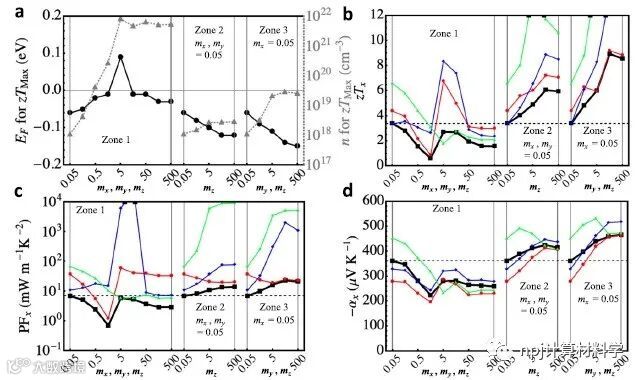
这项研究对从简单模型中得出的关于设计策略的结论进行了微调,如各向异性、能带简并度和共振能级。最后,作者以温度和晶格热导率为变量确定了最佳的带宽,从而提高了zT,超出了通常可获得的范围。该文近期发表于npj Computational Materials 7: 43 (2021).
Thermoelectricity enables clean electricity generation and fluid-free cooling. The ultimate goal of basic thermoelectric materials research is to design or discover materials with high figure of merit zT. A major challenge in achieving high zT and PF is that the electronic transport quantities are linked by a set of anti-complementary correlations: σ and κe are positively correlated whereas σ and α are negatively correlated. Equations based on the single parabolic band (SPB) model often underpin intuition about thermoelectric behavior. However, they tacitly assume that there is always enough (infinite) dispersion in all directions to cover the entire energy range relevant to thermoelectric phenomena, leading to one or more of the limitations.
A team led by Prof. Junsoo Park and Prof. Anubhav Jain from Energy Technologies Area, Lawrence Berkeley National Laboratory, USA, applied more rigorous scattering treatments to more realistic model band structures—upward-parabolic bands that inflect to an inverted-parabolic behavior—including cases of multiple bands. The authors create more realistic model solid-state band structures and more faithfully model carrier scattering due to multiple sources. Their band structures are properly confined to a finite BZ with smooth inversion of upward (downward) parabolicity to downward (upward) parabolicity for describing conduction (valence) states—a key for retaining generality, physicality, and approximate compatibility with established scattering formalism. The authors modify established formulae for various scattering mechanisms—deformation-potential scattering (DPS), polar-optical scattering (POS), and ionized-impurity scattering (IIS)—as to capture the effects of inverted parabolicity, anisotropy, and band multiplicity on carrier lifetimes. The authors monitor how thermoelectric properties of one or more bands respond to variations in band shapes.
This study fine-tunes conclusions drawn from simpler models on design strategies such as anisotropy, band multiplicity, and resonance levels. Finally, the authors determine the optimum bandwidths as a function of temperature and κ lat, which improves zT beyond what is normally accessible. This article was recently published in npj Computational Materials 7: 43 (2021).
原文Abstract及其翻译
Optimal band structure for thermoelectrics with realistic scattering and bands (具有真实散射和能带的热电材料的最佳能带结构)
Junsoo Park, Yi Xia, Vidvuds Ozoliņš & Anubhav Jain
Abstract Understanding how to optimize electronic band structures for thermoelectrics is a topic of long-standing interest in the community. Prior models have been limited to simplified bands and/or scattering models. In this study, we apply more rigorous scattering treatments to more realistic model band structures—upward-parabolic bands that inflect to an inverted-parabolic behavior—including cases of multiple bands. In contrast to common descriptors (e.g., quality factor and complexity factor), the degree to which multiple pockets improve thermoelectric performance is bounded by interband scattering and the relative shapes of the bands. We establish that extremely anisotropic “flat-and-dispersive” bands, although best-performing in theory, may not represent a promising design strategy in practice. Critically, we determine optimum bandwidth, dependent on temperature and lattice thermal conductivity, from perfect transport cutoffs that can in theory significantly boost zT beyond the values attainable through intrinsic band structures alone. Our analysis should be widely useful as the thermoelectric research community eyes zT > 3.
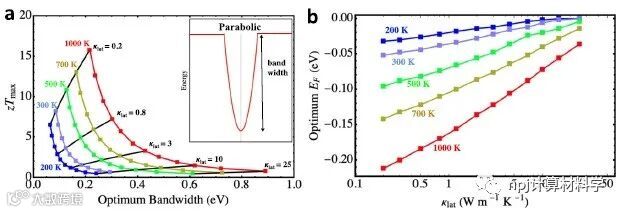
摘要 了解如何优化热电材料的电子能带结构是科学界长期关注的话题。现有的模型一直局限于简化的能带和/或散射模型。在这项研究中,我们对更现实的能带结构(可反转为翻转抛物线的上抛物带)进行了更严格的散射处理,其中包括多能带情况。与常见的描述符(如品质因子和复杂性因子)相反,多袋改善热电性能的程度受带间散射和能带的相对形状所限制。我们建立了极度各向异性的“平散”带,虽然在理论上性能表现最佳,但在实践中可能并不代表一个有前途的设计策略。关键的是,我们根据理想的输运截止条件确定了最佳带宽,具体取决于温度和晶格热导率,理论上可以显着提升zT,超过仅通过固有能带结构计算达到的值。随着热电研究界正在关注zT>3,我们的分析将广泛有用。
免责声明:本文旨在传递更多科研资讯及分享,所有其他媒、网来源均注明出处,如涉及版权问题,请作者第一时间后台联系,我们将协调进行处理(按照法规支付稿费或立即删除),所有来稿文责自负,两江仅作分享平台。转载请注明出处,如原创内容转载需授权,请联系下方微信号。