


论文
20
22
速递
Zihao Chen, Xuefan Yin, Jicheng Jin, Zhao Zheng, Zixuan Zhang, Feifan Wang, Li He, Bo Zhen, Chao Peng. Observation of miniaturized bound states in the continuum with ultra-high quality factors. Science Bulletin, 2022, 67(4): 359–366, doi: 10.1016/j.scib.2021.10.020
本文来源:ScienceBulletin

01
中文导读
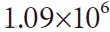 的品质因子, 其模式体积仅为
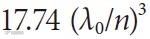 . 多个样品表征结果的统计分析表明, 该设计具有优秀的工艺鲁棒性. 本研究为在微小尺度上实现光束缚提供了一种新的设计范式, 在光子集成、非线性光学以及量子计算等领域具有可期的应用前景.

02
图文速览
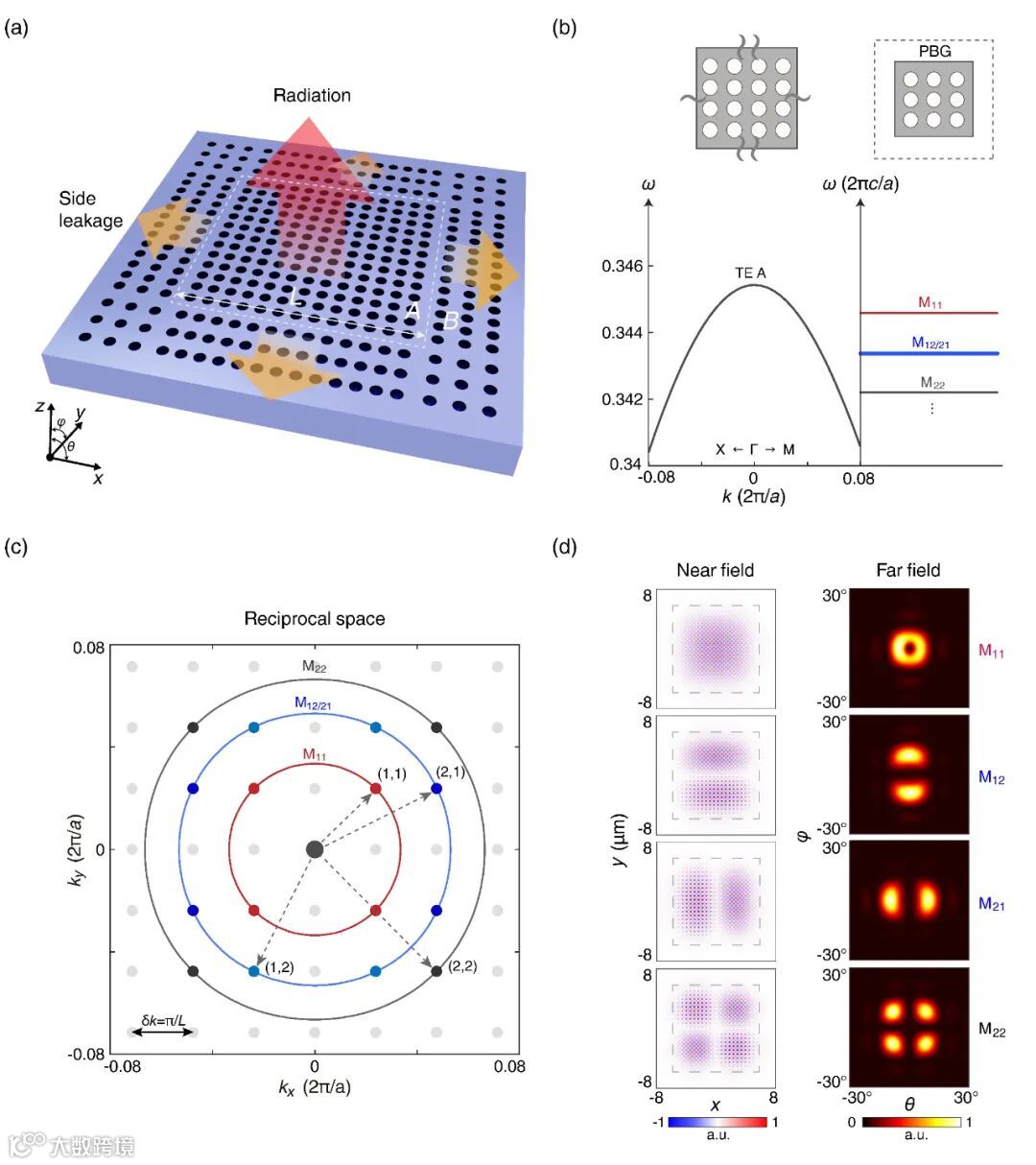
Fig. 1 Mini-BIC modes. (a) Schematic of a mini-BIC (region A) surrounded a photonic bandgap (PBG, region B). (b) A continuous band (TE-A) of an infinitely large PhC with periodic boundary condition (left) turns into a set of discrete modes under the PBG boundary condition (right). (c) The momentum distribution of each mode is highly localized to points that form a square lattice in the momentum space with a spacing of  . Modes are labeled as
  , according to their momentum peak positions in the first quadrant at
 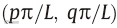 . (d) The near-field mode profiles of four modes
  through
  (left) and their far-field emission patterns (right).
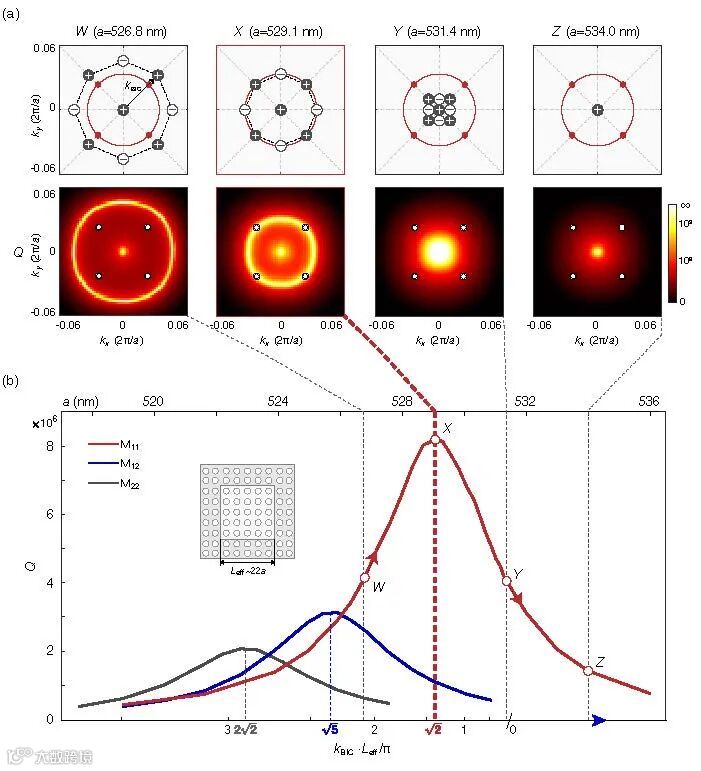
Fig. 2 Maximizing the Qs of mini-BICs by properly arranging topological charges in the momentum space. (a) Multiple BICs appear on bulk band TE-A in momentum space, in which  ones with
  topological charges compose an octagonal-shaped topological constellation, denoted by the radius
  . When unit cell periodicity a varies from 526.8 (W) to 534.0 nm (Z), the topological constellation shrinks, merges, and annihilates to a single topological charge (upper panel). The quality factor Q for each unit cell design is shown in the lower panel. (b) The quality factor Q of modes,
  through
  , as functions of periodicity a (upper axis) and topological constellation
  (lower axis). Q for
  (red line) maximizes when its quantized momentum
  matches the topological constellation
  , corresponding to case X (a=529.1 nm) in (a). Similar maxima are also observed for
  (blue) and
  (black) under other designs, when
  matches
  and
and  , respectively.
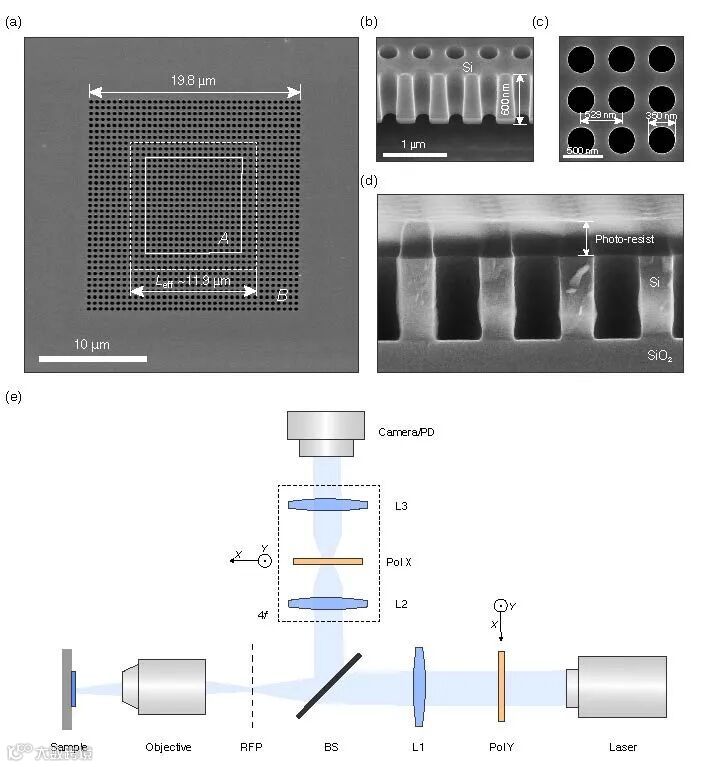
Fig. 3 Fabricated sample and experimental setup. (a–d) Scanning electron microscope images of the fabricated samples from top and side views. The photoresist and underlying  layer are removed before measurements. The chosen structural parameters correspond to case X in Fig. 2a to maximize Q for mode
  . (e) Schematic of the
experimental setup. L, lens; RFP, real focal plane; PD, photodiode; POL, polarizer; BS, beam-splitter; Lens L2 and L3 are confocal.
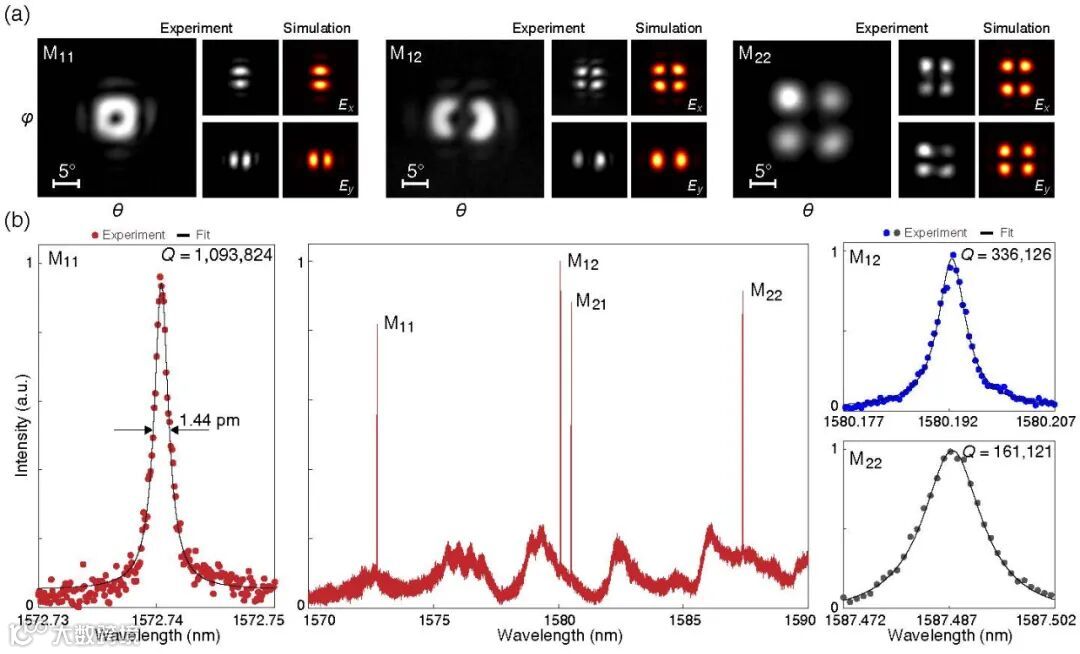
Fig. 4 Observation of mini-BIC modes. (a) The far-field emission patterns (x=y-polarized and overall) of modes  through
  , measured with a camera (gray color map), show good agreements with simulation results (hot color map). (b) Middle panel: measured scattered light intensity as the laser wavelength scans from 1570 to 1590 nm. Four clear peaks are observed and identified as
  through
  . The Q of
  reaches
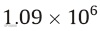 (left panel). In the same sample, the Qs of
  and
and  are measured as
  and
and 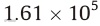 , respectively (right panel).
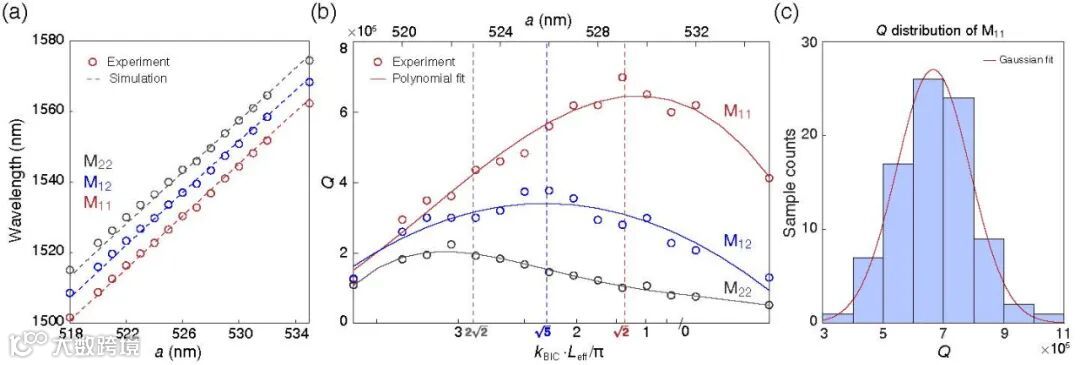
Fig. 5 Demonstration of mini-BIC robustness against fabrication errors. (a) Measured resonance wavelengths (circles) in samples with different periodicities a show good agreements with simulation results (dashed lines). (b) Measured Qs (circles) in samples with different periodicities a (upper axis) and therefore different topological constellation ( , lower axis). Polynomial fittings are shown in solid lines. Each curve reaches its maximum value when the matching condition is satisfied, as is shown on the dashed vertical line. (c) The statistical histogram of measured Qs of
  in 87 samples shows that our mini-BICs have good robustness.

03
本文通讯作者

彭超 长聘副教授 北京大学电子学院信息与通信研究所, 区域光纤通信网与新型光通信系统国家重点实验室, 主要研究领域为拓扑光子学与集成光子器件.
虎
封面
文章
年
2022年第4期
免责声明:本文旨在传递更多科研资讯及分享,所有其他媒、网来源均注明出处,如涉及版权问题,请作者第一时间后台联系,我们将协调进行处理,所有来稿文责自负,两江仅作分享平台。转载请注明出处,如原创内容转载需授权,请联系下方微信号