

文章来源:ChinesePhysicsLetters
EXPRESS LETTER
Magnetic Nonreciprocity in a Hybrid Device of Asymmetric Artificial Spin-Ice-Superconductors
Chong Li (李冲), Peiyuan Huang (黄培源), Chen-Guang Wang (王晨光), Haojie Li (李浩杰), Yang-Yang Lyu (吕阳阳), Wen-Cheng Yue (岳文诚), Zixiong Yuan (袁子雄), Tianyu Li (李甜雨), Xuecou Tu (涂学凑), Tao Tao (陶涛), Sining Dong (董思宁), Liang He (何亮), Xiaoqing Jia (贾小氢), Guozhu Sun (孙国柱), Lin Kang (康琳), Huabing Wang (王华兵), Peiheng Wu (吴培亨), and Yong-Lei Wang (王永磊)
Chin. Phys. Lett. 41 067402 (2024 )
DOI: 10.1088/0256-307X/41/6/067402
研究快讯
非对称人工自旋冰-超导器件中的磁非互易超导效应
设计了一种全新的人工自旋冰和超导异质结构器件,实现了奇特的单一磁场方向的超流输运效应,即磁非互易超导效应。该研究提出了磁场驱动的超导二极管概念,为设计低能耗的电子芯片提供了具有新功能的原型器件。
This work has been highlighted in a research update published in Physics World.
Spin-ice superconductors display magnetic nonreciprocity
Isabelle Dumé
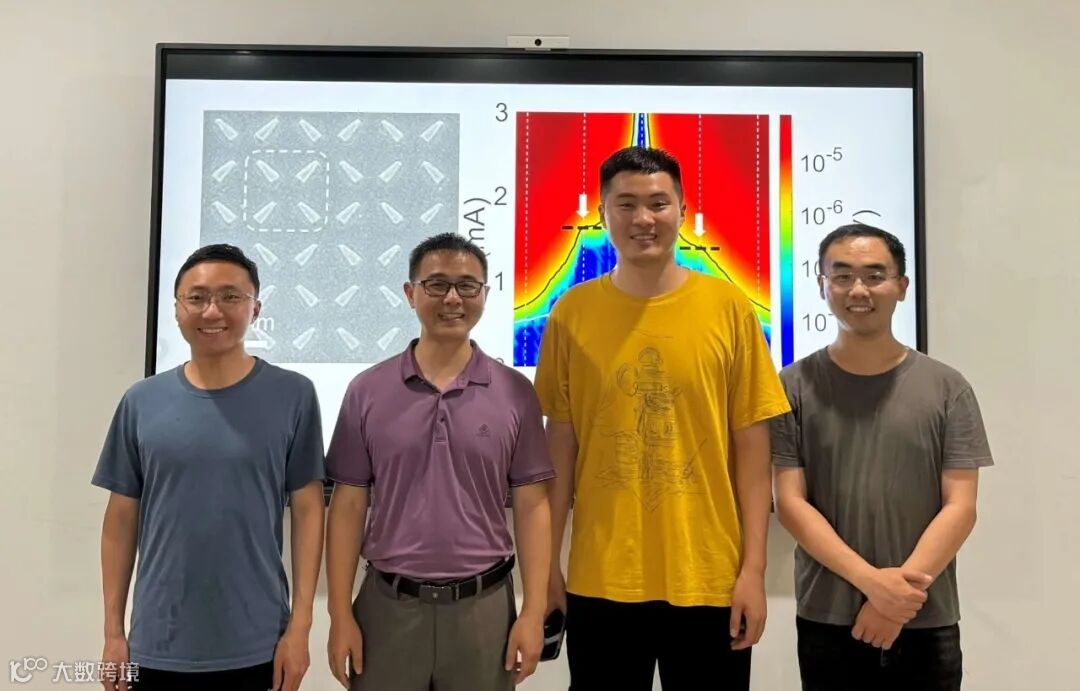
Device designers: Wen-Cheng Yue, Yong-Lei Wang, Chong Li and Yang-Yang Lyu are members of the Nanjing University superconducting and magnetic mesoscopic systems team. (Courtesy: Yong-Lei Wang)
Researchers in China have fabricated a new hybrid superconducting device from a special type of material known as an artificial spin ice (ASI). The innovative structure, which is made of asymmetric nanomagnets, could be used to build magnetic-field-driven superconducting diodes for use in energy-efficient electronics.
ASIs get their name from the fact that at low temperatures, their magnetic moments adopt the same disordered pattern typified by proton spins in water ice. They have a tetrahedral structure, with rare-earth ion moments occupying the corners in a way that obeys the so-called “ice rules”: two of the moments point into the tetrahedron, while two point out of it. In this configuration, the moments are unable to align, and the material is said to be geometrically frustrated.
The behaviour of the new ASI-based device is driven by a phenomenon known as the magnetic nonreciprocal effect, in which a material displays zero resistance along the direction of an applied magnetic field while continuing to have resistance in the opposite direction. “This is analogous to the behaviour of a superconducting diode and is a recently-discovered effect that is creating a flurry of interest in the field,” explains Yong-Lei Wang of Nanjing University, who led the research.
Asymmetric nanomagnets
To induce magnetic nonreciprocity, Wang and colleagues made their ASI from asymmetric nanomagnets. They created these nanomagnets by depositing a thin film of molybdenum germanium superconductor onto a silicon wafer using photolithography and magnetron sputtering techniques. They then fabricated the artificial spin ice on top of this structure, using electron beam lithography and evaporation to create an ASI with the nanomagnets arranged in a square lattice.
“Distinct from all previous ASIs, however, this structure contains asymmetric nanomagnets as opposed to symmetric ones,” explains Wang. “This leads to a novel superconducting pinning potential, resulting in the asymmetric motion of superconducting vortices when positive and negative magnetic fields are applied, thus allowing us to observe magnetic nonreciprocity.”
The Nanjing team has been working on ASI-superconductor heterostructures since 2018, when its members first reported on switchable geometric frustration and superconducting vortex diode effects. Two years later, the researchers made a switchable superconductor and programmable flux-quantum Hall effect device using another ASI-superconductor hybrid. Then, in 2021, they followed this by producing a superconducting diode in arrays of conformal-patterned nanoholes in superconducting thin films. “This last device works thanks to the spatial inversion symmetry breaking from the nanoholes and it allowed us to understand that the asymmetric nanomagnets in ASIs could induce unique symmetry breaking and lead to interesting superconducting effects,” Wang says.
The team’s findings could have implications for the development of advanced superconducting electronics, he tells Physics World. “Being able to control and reconfigure vortex dynamics in superconductors can lead to innovative devices such as magnetic field-driven superconducting diodes and rectifiers. These applications are particularly promising for low-power electronics, neuromorphic computing, and advanced sensing technologies.”
The researchers now plan to examine how temperature affects the magnetic nonreciprocal effects they observed. “We will also study the hysteresis behaviour of in-plane magnetic fields to enhance the nonreciprocal ratio of these effects,” reveals Wang. “We also plan to apply our method to other types of ASI structures, such as kagome-ASI and pinwheel-ASI, to explore a wider range of superconducting properties and functionalities.”
They detail their present work in Chinese Physics Letters.
© Copyright 2024 IOP Publishing Ltd