


文章来源:FUTURE远见
近日,天津大学胡小龙团队以「High-performance eight-channel system with fractal superconducting nanowire single-photon detectors」¹ 为题在Chip上发表研究论文,论文报道了工作在930–940 nm波段的高性能8通道分形SNSPD系统。第一作者为郝子繁、邹锴,通讯作者为胡小龙。本文被遴选为本期封面文章和本期Featured in Chip编辑特选文章之一。Chip是全球唯一聚焦芯片类研究的综合性国际期刊,是入选了国家高起点新刊计划的「三类高质量论文」期刊之一。
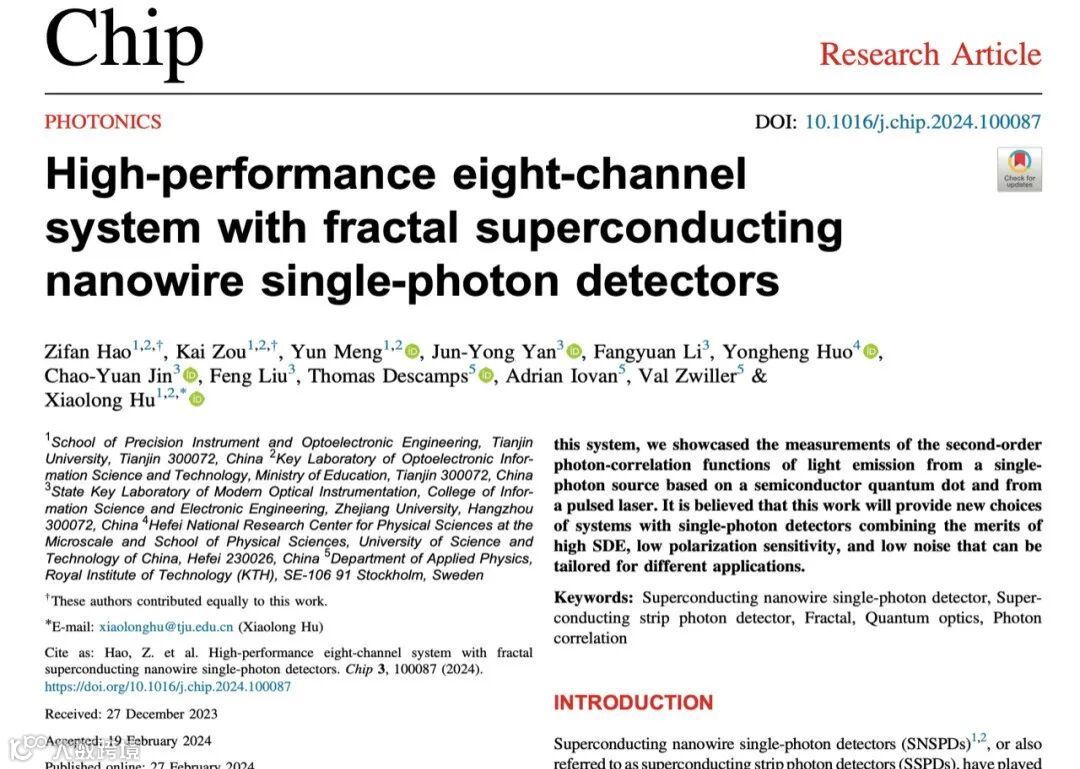
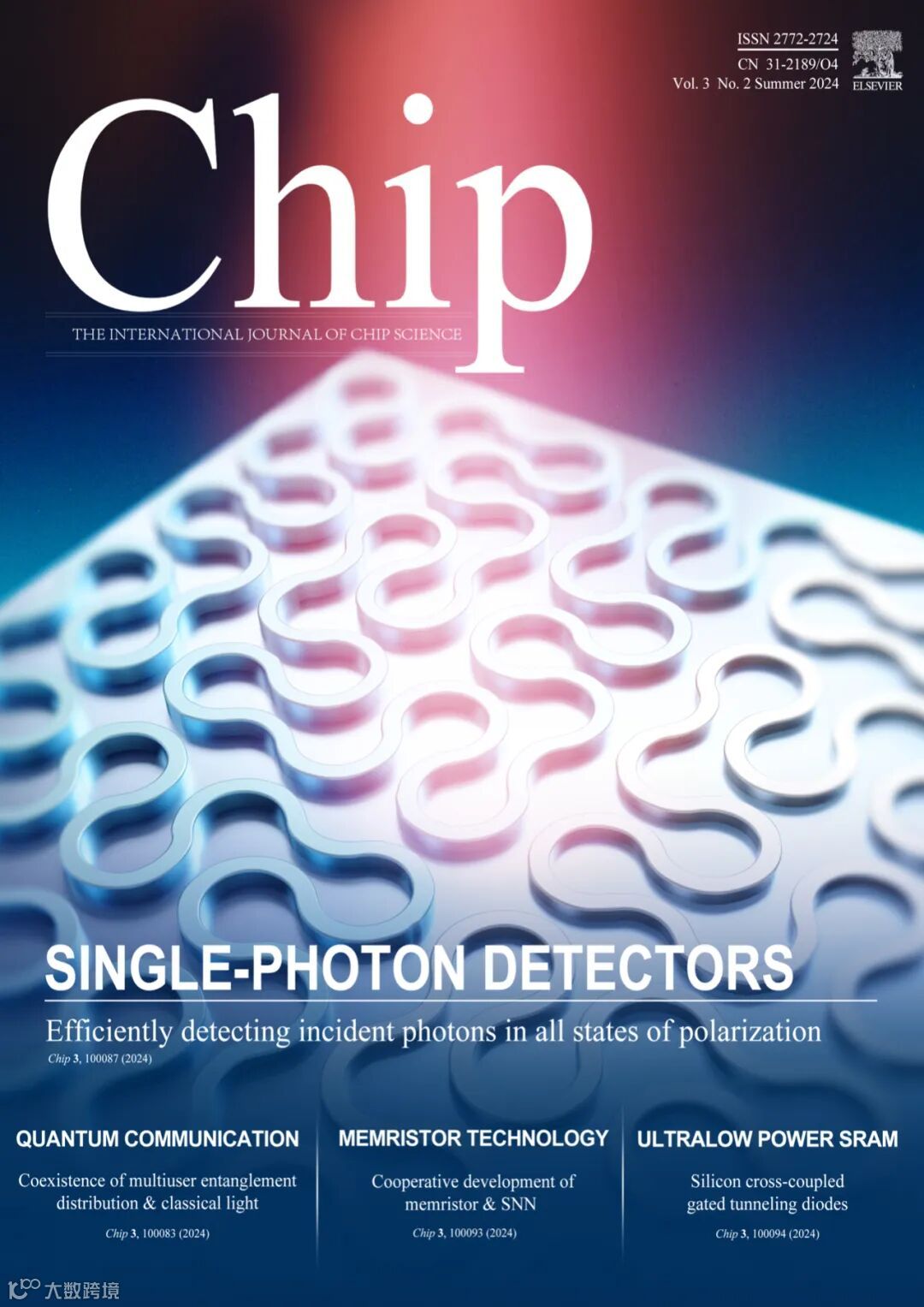
超导纳米线单光子探测器(Superconducting Nanowire Single-Photon Detectors, SNSPD),在许多经典和量子光学应用中发挥着至关重要的作用²。与最常用的回形(Meander) SNSPD不同,分形(Fractal)SNSPD的探测效率基本与入射光的偏振态无关³。目前,文献中报道的或商售的多通道SNSPD系统都是偏振敏感的⁴,而具有低偏振敏感度的多通道SNSPD系统未见报道。本论文报道了在930–940 nm波段具有高性能的8通道分形SNSPD系统,最高系统探测效率(System Detection Efficiency, SDE)为96%,8个通道对于所有偏振态的平均SDE为90%。作为该系统的一个直接应用,测量了基于半导体量子点的单光子源和脉冲激光器的二阶相关函数。
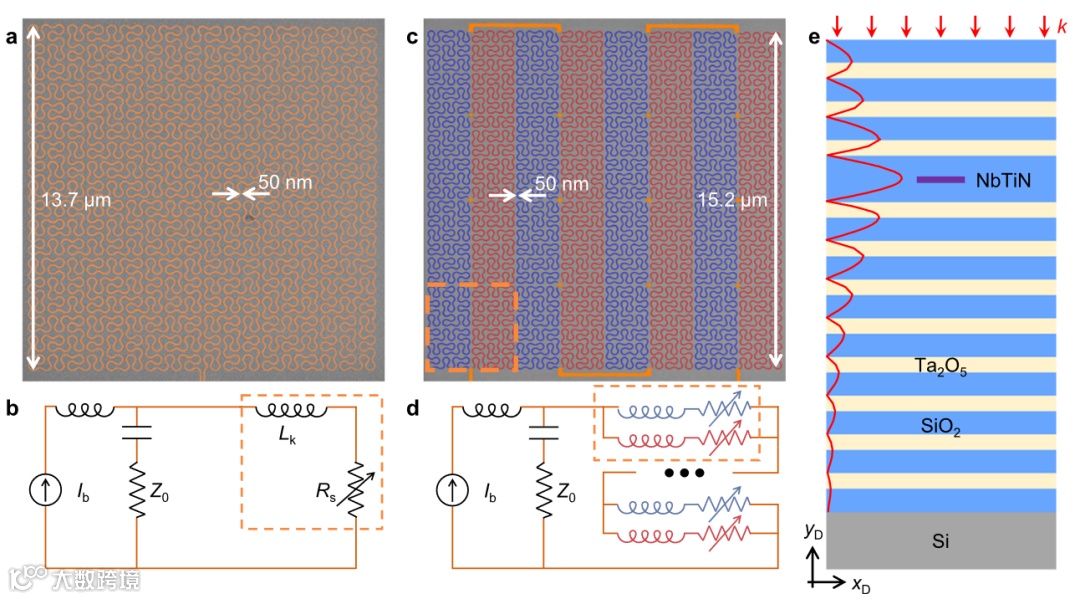
分形SNSPD通过将纳米线的几何结构设计为具有自相似性的分形图案来消除探测效率的偏振敏感性。系统中安装了两种类型的探测器,分别是由一根纳米线构成的SNSPD和两根纳米线并联构成的超导纳米线雪崩光电探测器(Superconducting Nanowire Avalanche Photodetector, SNAP)⁵,器件结构如图1所示。为了实现高探测效率,在设计和加工过程中扩大了探测器的光敏面以确保从光纤端面出射的光子与探测器光敏面之间接近100%的耦合效率并且将纳米线集成在基于分布式布拉格反射镜(Distributed Bragg Reflector, DBR)的光学腔体中以提高纳米线对入射光子的吸收效率。
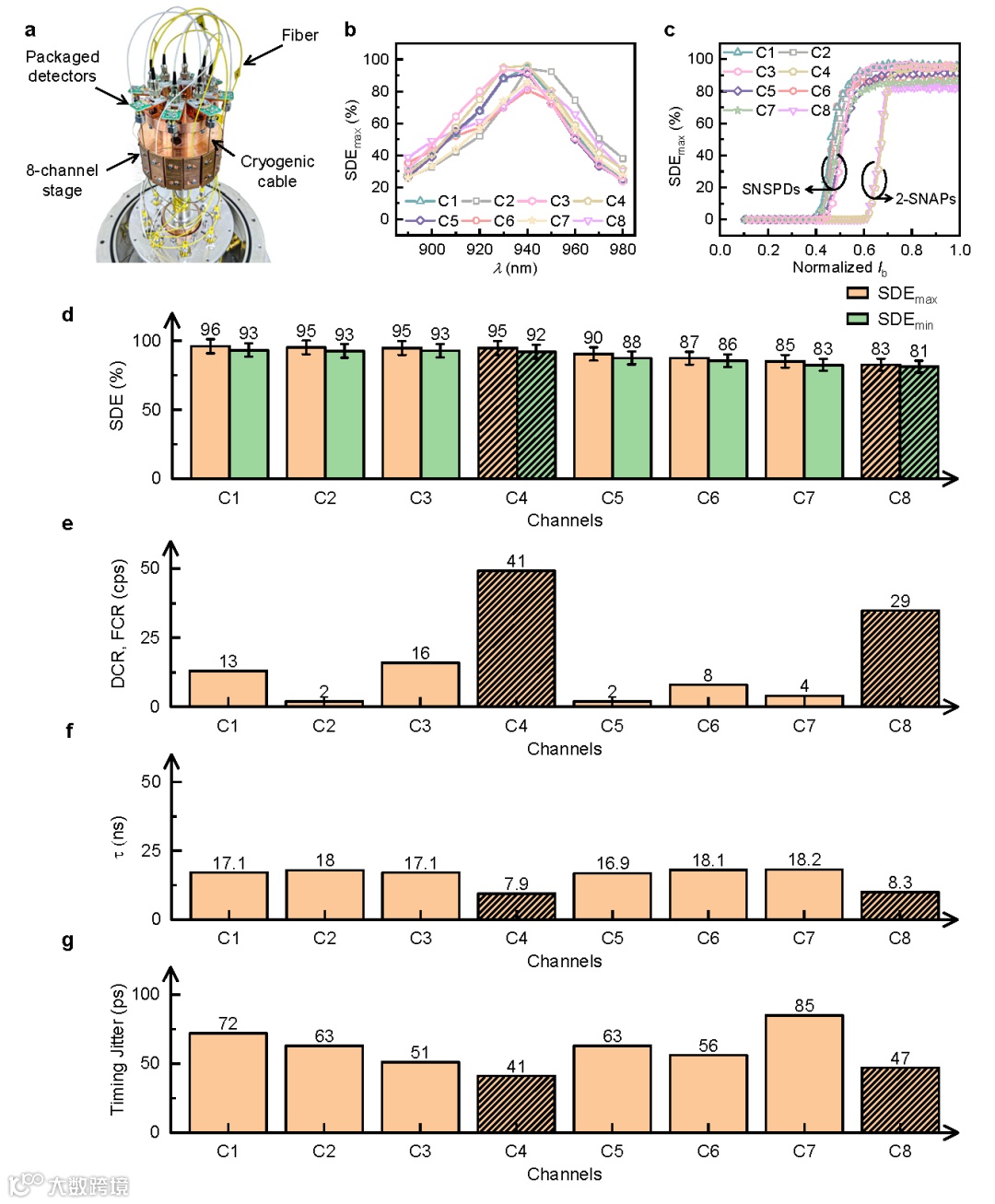
图2 | 8通道分形SNSPD系统及其主要性能。(a)安装了8个封装探测器的冷头照片;(b)8个通道的偏振最大系统探测效率(SDEₘₐₓ )作为波长λ的函数;(c)8个通道的SDEₘₐₓ作为归一化偏置电流的函数;(d)8个通道的SDEₘₐₓ和SDEₘᵢₙ;(e)八个通道在最低NEP下对应的DCR或FCR;(f)8个通道输出脉冲后沿的e⁻¹时间常数;(g)8个通道的最低时域抖动。
系统基于0.1瓦小型G-M闭循环制冷机,在自行设计的样品台上安装了8个光纤耦合封装探测器,经过降温后达到2.2 K的基础温度。在该温度下,测量了8个通道的偏振最大系统探测效率(SDEₘₐₓ)。如图2所示。所有通道的SDEₘₐₓ曲线都显示出饱和的平台,在8个通道中,最高SDEₘₐₓ达到96%,其中5个通道的SDEₘₐₓ超过90%,所有通道的SDEₘₐₓ超过80%。8个通道对于任意偏振态的平均SDE估计为90%。通过测量每个通道的各个性能指标可以看出,SNSPD器件和SNAP器件均能够实现较高的SDE,但前者具有较低的噪声水平,后者具有较短的响应恢复时间和较低的时域抖动。
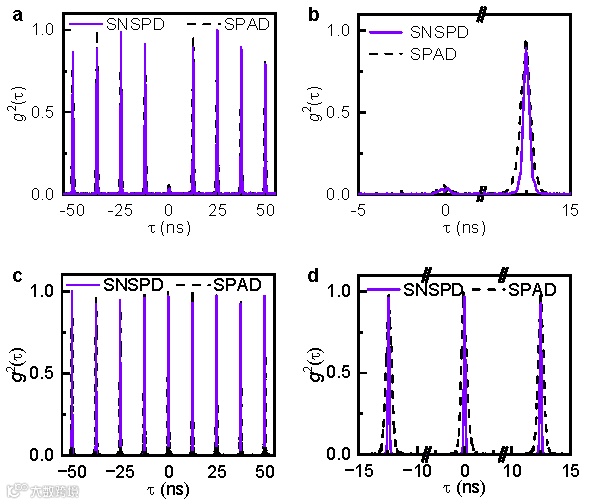
图3 | 使用两个分形SNSPD和两个硅SPAD测量的量子点单光子源和脉冲激光器的二阶相关函数g²(τ)。(a)测得的单光子源的g²(τ);(b)图a的局部放大;(c)测得的脉冲激光器的g²(τ);(d) 图c的局部放大。
作为一个应用演示,使用两个通道来测量In(Ga)As/GaAs量子点(QD)⁶和脉冲激光器的二阶相关函数g²(τ)并将测量结果与使用硅单光子雪崩二极管(SPAD)的测量结果进行对比。从结果可以看出使用分形SNSPD和SPAD测量的g²(τ)非常一致,但得益于更好的时间分辨率,使用SNSPD测得的g²(τ)的共计数峰具有更小的半高全宽。
High-performance eight-channel system with fractal superconducting nanowire single-photon detectors¹
Superconducting nanowire single-photon detectors (SNSPDs) have played vital roles in many classical and quantum photonic applications². Different than most, meandering SNSPDs, fractal SNSPDs feature low polarization dependence of their detection efficiency³. Up to now, multi-channel SNSPD systems, either reported in literature⁴ or been commercially available, are all polarization sensitive, and the multi-channel systems with SNSPDs that all feature low polarization-sensitivity remain unexplored. In this paper, researchers report on an eight-channel fractal SNSPD system in the wavelength range of 930–940 nm with the maximum system detection efficiency (SDE) reaching 96%. The average SDE for eight channels for all states of polarization is estimated to be 90%. As a direct application of this system, they measure the second-order correlation function of light emission from a single-photon source based on a semiconductor quantum dot and from a pulsed laser.
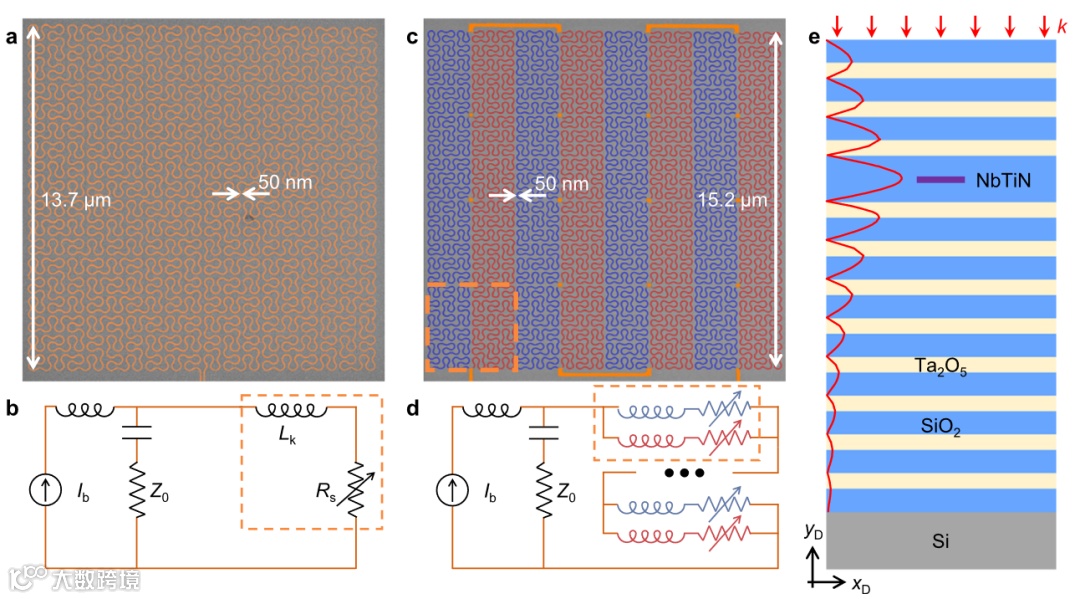
Fig. 1 | Device structures of the fractal superconducting nanowire single-photon detector (SNSPD) and the superconducting nanowire avalanche photodetector (SNAP). a, False-colored scanning-electron micrograph of the fabricated SNSPD. b, Equivalent circuitry of the SNSPD. c, False-colored scanning-electron micrograph of the fabricated SNAP. d, Equivalent circuitry of the SNAP. e, Schematics of the optical cavity structure, which is composed of the top distributed Bragg reflector (DBR) made of three pairs of alternating SiO₂ and Ta₂O₅ dielectric layers, the bottom DBR made of eight pairs of alternating dielectric layers, and the defect layer in between.
Fractal SNSPDs reduce polarization sensitivity. There are two types of detectors included in the system, namely, the SNSPD composed of one nanowire and superconducting nanowire avalanche photodetector (SNAP)⁵ composed of multiple nanowires in parallel. The device structure is shown in Fig. 1. In order to achieve high detection efficiency, the photosensitive region of the detector is expanded to ensure that the coupling efficiency between photons emitted from the fiber end facet and the photosensitive surface of the detector is close to 100%. And the nanowire is integrated into the optical cavity based on distributed Bragg reflector (DBR) to improve the absorptance of the nanowire for incident photons.
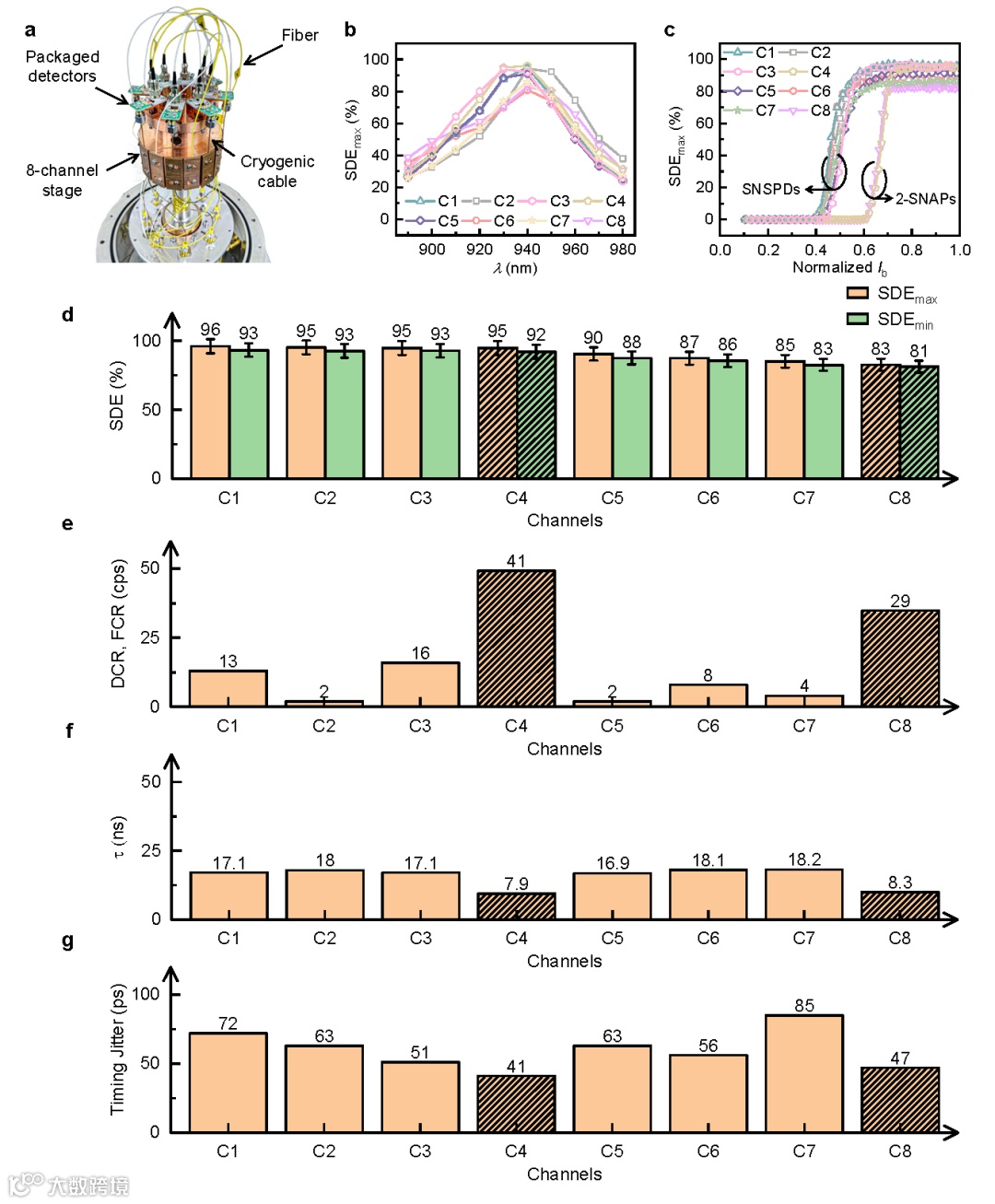
Fig. 5 | Eight-channel fractal SNSPD system and the performance metrics.a, Photograph of the cold-head with eight packaged detectors installed.b, Measured SDEₘₐₓ of eight channels as functions of the wavelength (λ). c, Measured SDEₘₐₓ of eight channels as functions of bias current normalized to each switching current. d, SDEₘₐₓ and SDEₘᵢₙ. e, DCR or FCR for each channel, corresponding to the lowest NEP of each detector. f, e⁻¹ time constant of the falling edges of each channel's output pulses. g, Measured lowest timing jitter using a femtosecond pulse laser with a central wavelength of 1560 nm.
The eight-channel system is based on the close-cycled G-M cryocooler, as shown in Fig. 2. Eight fiber-coupled packages are mounted on a self-designed sample stage on the cold-head of the cryocooler, achieving a base temperature of 2.2 K after cooling down. The SDEₘₐₓ and SDEₘᵢₙ of the eight channels are measured then. The SDE curves for all channels show saturated plateaus. Among the eight channels, the highest SDEₘₐₓ reached 96%. SDEₘₐₓ of five channels exceed 90%, and all the channels' SDEₘₐₓ exceed 80%. The average SDE for all states of polarization of the eight channels is estimated to be 90%, While both types of detectors show high SDE, the SNSPDs exceed in low dark-count rates (DCR) and therefore, low noise-equivalent power (NEP), whereas the SNAPs exhibit higher operating speed and better timing resolution.
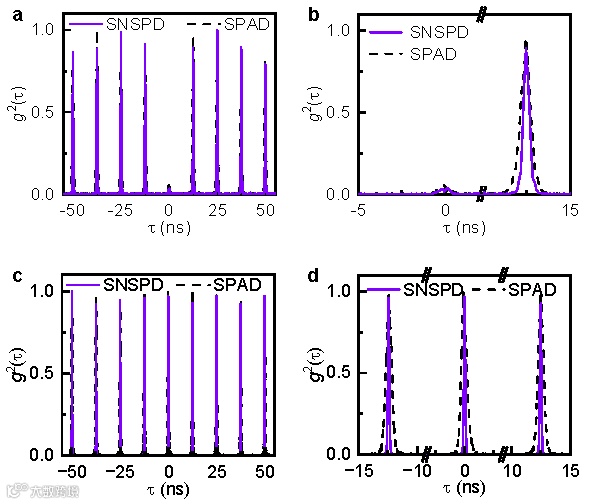
Fig. 7 | Second-order photon-correlation functions, g²(τ), of the light emission from a QD and a pulsed laser measured by two SNSPDs and two silicon SPADs. a, g²(τ) of light emission from of the single-photon source, showing clear anti-bunching. b, A zoom-in view of a. c, g²(τ) of light emission from of a pulsed laser with a FWHM of 6 ps. d, A zoom-in view of c.
As a demonstration of applications, researchers use two channels to measure the second-order correlation functions,g²(τ), of the emission from a In(Ga)As/GaAs quantum dot (QD)⁶ and from a pulsed laser. The measurement results are then compared with those obtained using silicon single-photon avalanche diodes (SPADs). While the measured g²(τ) are quite consistent by using the SNSPDs and by using the SPADs , better timing resolution of the SNSPDs than that of the SPADs results in sharper and narrower peaks.
作者简介

郝子繁,本科毕业于天津大学,获工学学士学位,专业为光电信息科学与工程。硕士毕业于天津大学精密仪器与光电子工程学院,专业为电子信息。攻读硕士期间的研究方向主要为超导纳米线单光子探测器。


Zifan Hao received his B. S. degree in Optoelectronic Information Science and Engineering from Tianjin University, and his M. S. degree in electronic information from School of Precision Instruments and Optoelectronic Engineering, Tianjin University. His research focused on superconducting nanowire single photon detectors.

邹锴,本科毕业于天津大学,获工学学士学位,专业为光电信息科学与工程。目前在天津大学精密仪器与光电子工程学院攻读博士学位,研究方向主要为超导纳米线单光子探测器与硅光器件。他是2020年硕士研究生国家奖学金获得者和2022年SPIE Optics and Photonics Education Scholarship获得者。
Kai Zou received his B. S. degree in Optoelectronic Information Science and Engineering from Tianjin University. Now he is a PhD student in School of Precision Instruments and Optoelectronic Engineering, Tianjin University. His current research focuses on superconducting nanowire single-photon detectors and silicon-photonic devices. He is an awardee of National Scholarship 2020 for Graduate Students and a recipient of 2022 SPIE Optics and Photonics Education Scholarship.

胡小龙博士是天津大学精密仪器与光电子工程学院教授,领导天津大学微纳光子学实验室。2011年从美国麻省理工学院电子工程与计算机科学系获得博士学位。目前的研究主要集中在微纳光电子器件。在超导纳米线单光子探测器(SNSPD)方面取得系列研究成果,提出并研制出具有高探测效率、低偏振敏感度、低时域抖动的分形SNSPD,并将所研制的分形SNSPD应用于全偏振激光雷达和非视域成像。发表论文80余篇,拥有20余项授权发明专利,出版英文书籍1部,在国内外学术会议作邀请报告40余次。研究工作被Nature Photonics、美国光学学会、IEEE Spectrum、Photonics Spectra等期刊或媒体撰文评述报道。曾入选国家海外高层次人才计划青年项目;是国家重点研发计划课题、科技创新2030课题、「慧眼行动」项目、国家自然科学基金面上项目的负责人。
Dr. Xiaolong Hu is a professor in the School of Precision Instrument and Optoelectronic Engineering at Tianjin University, where he heads the Nanophotonics Group. He obtained his Ph. D. degree from the Department of Electrical Engineering and Computer Sciences at the Massachusetts Institute of Technology (MIT) in 2011. His research focuses on nanophotonic devices, in particular, superconducting nanowire single-photon detectors (SNSPDs). He proposed and demonstrated fractal superconducting nanowire single-photon detectors with high detection efficiency, low polarization sensitivity, and low timing jitter, and applied the fractal SNSPDs in full-Stokes polarimetric LiDAR and non-line-of-sight imaging. He published more than 80 papers, and got more than 20 patents issued, published 1 book, and gave more than 40 invited talks at conferences. His research was reported and reviewed by journals or media including Nature Photonics (News & Views), Optica, IEEE Spectrum, and Photonics Spectra. He has ever been selected into the national oversea talent program for junior scholars and has been in responsible for some research programs.