
薰衣草残渣中黄酮的超声辅助提取工艺及其抗氧化活性

目的:薰衣草含有丰富的活性成分,是一种名贵而重要的天然香料植物,在新疆伊犁种植面积达3万多亩, 产量巨大。薰衣草花穗提制的精油芳香宜人,具有杀菌、松弛平滑肌、镇静、催眠等作用,因此广泛用于日用化妆品工业中。我国每年的薰衣草精油年产量己超过10万公斤,薰衣草精油仅占薰衣草干花含量的1.5%左右,工业上提取薰衣草花精油后剩余的残渣中仍含大量蛋白质、糖类、黄酮、微量元素等物质,若直接扔弃将造成极大的资源浪费。黄酮类化合物是一种存在于植物中的天然产物,属于天然抗氧化剂,药理学研究表明从植物茎叶、花卉中通过溶剂萃取、超临界流体萃取、微波提取等方法提取黄酮,如荞麦壳、银杏叶、蜜柚叶等,具有抗炎、抗菌、抗病毒、抗氧化等多种生物活性。本实验利用超声波的空化效应、热效应以及机械效应等作用,提取薰衣草残渣中的黄酮,挖掘薰衣草的潜在价值。
方法:本研究采用单因素和响应面法对薰衣草残渣中黄酮的超声辅助提取工艺进行优化,采用聚酰胺树脂吸附柱纯化黄酮,并通过总抗氧化能力、1,1-二苯基-2-三硝基苯肼(DPPH)自由基清除能力、铁离子螯合能力和总还原能力四个方面考察黄酮纯化物的抗氧化能力。
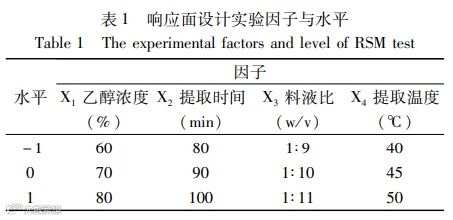
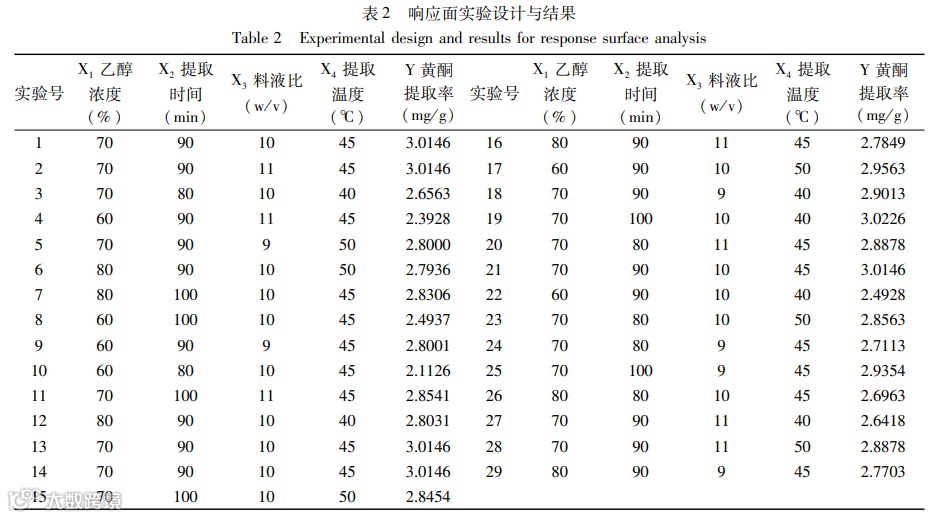
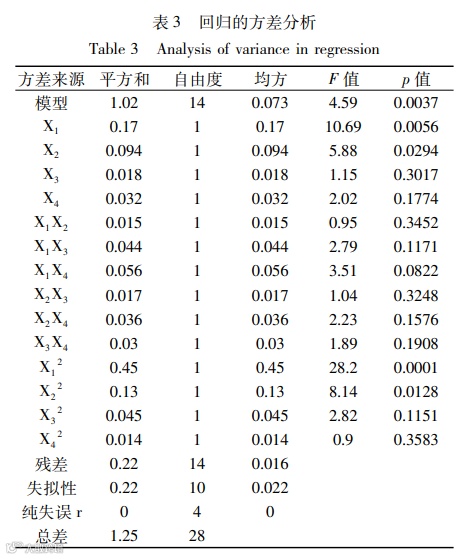
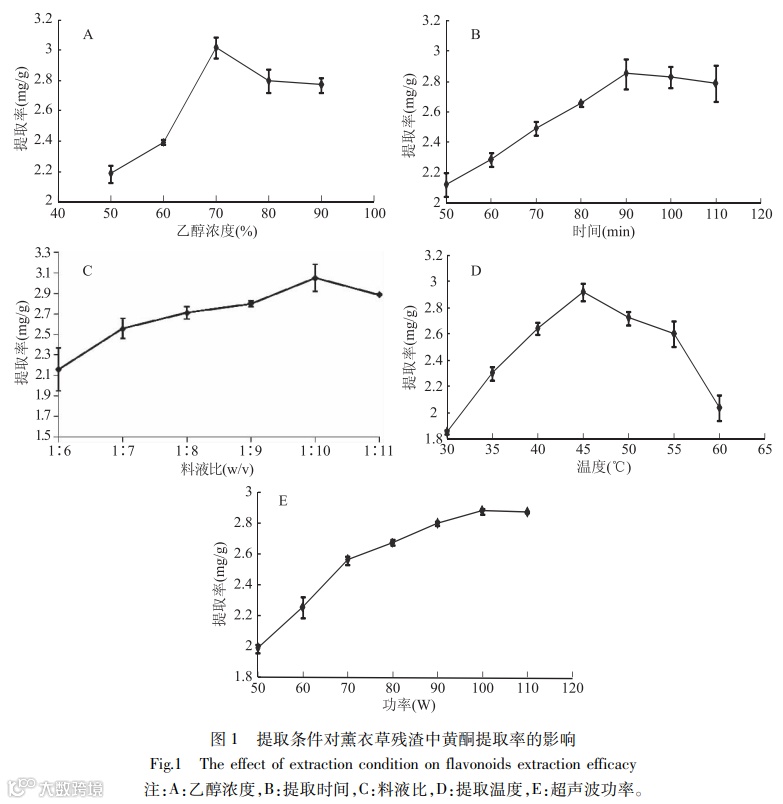
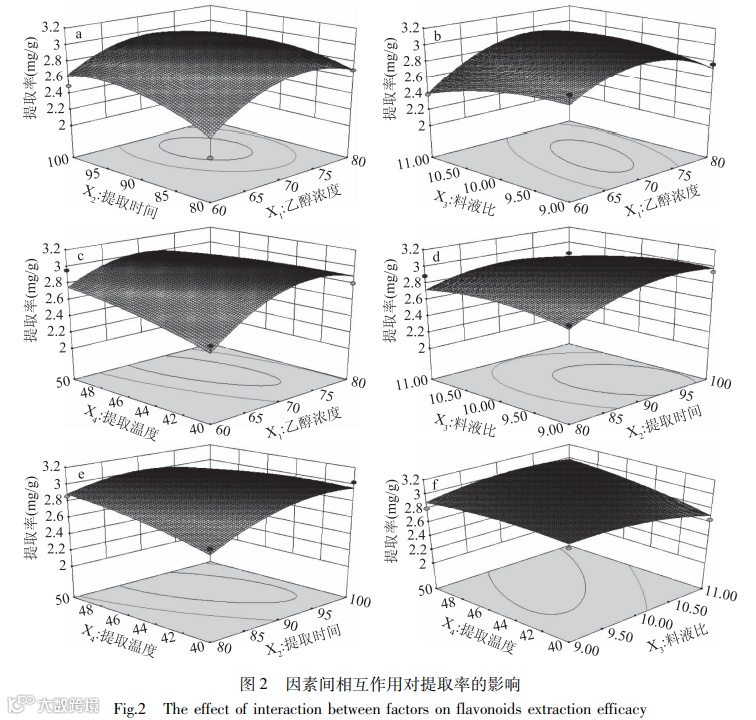
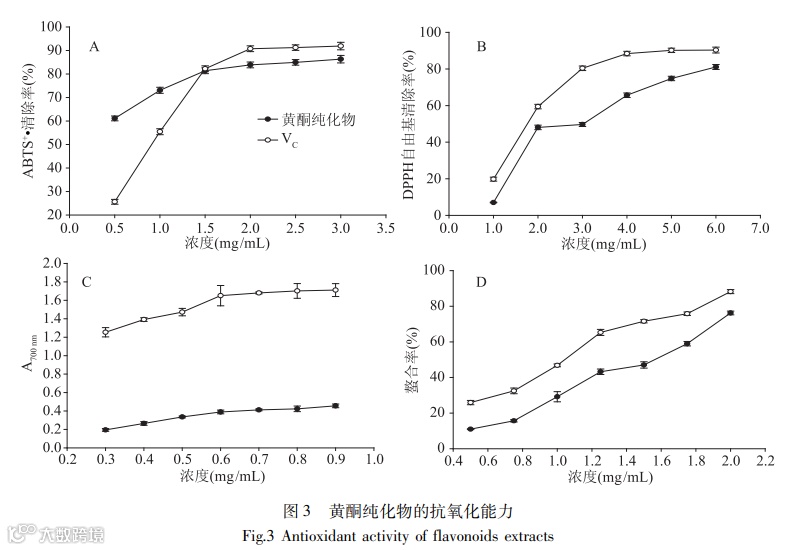
结果:薰衣草残渣中黄酮提取采用超声辅助提取工艺,运用单因素(提取时间、温度、乙醇浓度、料液比等)研究对黄酮提取的影响,提取溶剂乙醇与薰衣草残渣中黄酮的极性相似,利于黄酮类物质易于从残渣组织中释放,乙醇体积分数为70%具有最高的提取率;提取温度在 45 ℃时提取率达到最大值;超声波功率过低,超声波的能量低,分子运动慢,影响黄酮物质的提取,超过100 W后提取得率呈下降趋势,在100 W时提取率达到最大值;通过响应面实验进行优化,最佳工艺条件为提取时间92 min、乙醇浓度74%、提取温度48 ℃、料液比1:10 (w/v)。黄酮纯化物的总抗氧化能力随着黄酮浓度的增大而增大,当浓度在0.5~1.5 mg/mL之间时,总抗氧化能力随着浓度的增大显著增大,当浓度大于1.5 mg/mL后开始趋于平缓,在测定浓度范围内,总抗氧化能力达到80%以上,说明其抗氧化能力较强。黄酮纯化物清除DPPH自由基的能力随着黄酮浓度的增大而上升。当浓度达到6 mg/mL时清除率为81.11%。黄酮类化合物对铁离子具有很强的还原能力,它们提供的电子能够将Fe3+还原为Fe2+。还原力的大小和溶液的吸光度值呈正相关,吸光度值越高,样品的还原能力越强,螯合率也呈现相似趋势,抗氧化性越高。可见薰衣草黄酮具有较强抗氧化能力。
结论:本方法优化的超声辅助提取黄酮工艺方法可靠性强,黄酮纯化物的抗氧化能力较强,可将薰衣草残渣中的黄酮进行综合开发利用,应用于食品配料工业、化妆品业。同时,该方法也可用于其它农林副产物黄酮的提取。
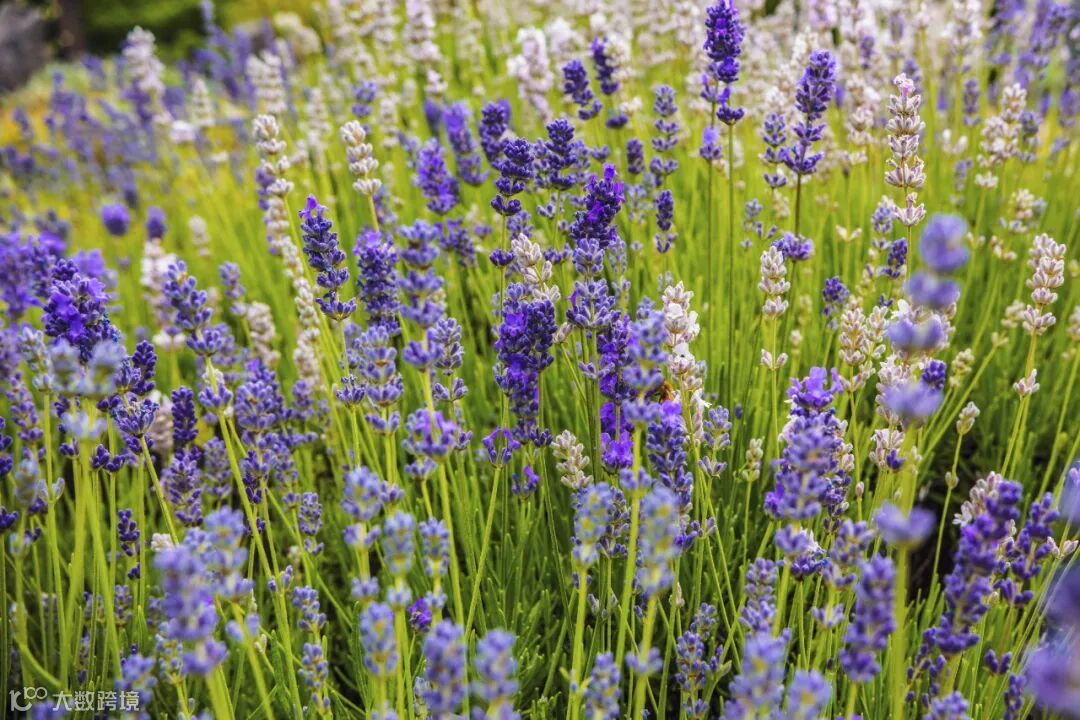
图片购买于壹图网。
Objectives: Lavender, rich in bioactive ingredients, is a rare and important natural spice plant. The output is hug, more than 30,000 mu has been planted in Yili, Xinjiang. The essential oil made of lavender flower spike is fragrant and pleasant, and has bactericidal, relaxed and smooth muscle, sedation, hypnotic and other effects, so it is widely used in the daily cosmetics industry. The annual output of lavender essential oil in China is more than 100,000 kilograms, and lavender essential oil only accounts for about 1.5% of the content of dried lavender flowers. The industrial extraction of lavender essential oil still contains a large amount of protein, sugar, flavonoids, trace elements and other substances. If directly thrown away, it will cause a huge waste of resources. Flavonoids is a natural product existing in plants, belongs to the natural antioxidant, pharmacological research from the plant stem and leaves, flowers of buckwheat shell, ginkgo leaf, pomelo leaf through solvent extraction, supercritical fluid extraction, microwave extraction method extraction of flavonoids with anti-inflammatory, antibacterial, antiviral, antioxidant and other biological activities. This experiment uses ultrasound-assisted extraction to flavonoids through the cavitation, thermal and mechanical effects and excavate the potential deep processing value of lavender.
Methods: The ultrasound-assisted extraction process of flavonoids in lavender residues was optimized by univariate and response surface analysis and purified using polyamide resin adsorption column. The antioxidant ability of flavonoids was investigated through total antioxidant capacity,1,1-Diphenyl-2-picrylhydrazyl radical (DPPH radical) scavenging, iron ion chelation and total reducing capacity.
Results: Flavonoids was extracted by ultrasonic-assisted extraction focusing on extraction time, temperature, ethanol concentration, liquid ratio. Ethanol as extracted solvent is similar polarity of flavonoids in lavender residue, which is easily released from the residue tissue, the ethanol volume fraction of 70% had the highest extraction rate; the maximum extraction rate was reached at 45℃; the lower the ultrasonic power, lower energy, lower molecular movement. After exceeding 100 W it will affect the extraction of flavonoids substances. The extraction rate reached the maximum value at 100W; Optimizing by the response surface experiments, the best process conditions are as follows: the extraction time of 92min, 74% ethanol concentration, 48℃, and the material / liquid ratio of 1:10 (w / v). The total antioxidant capacity of flavonoids increases with the concentration of the concentration of flavonoids. Between 0.5 and 1.5 mg/mL, the total antioxidant capacity increases significantly with the concentration, and the concentration is greater than 1.5 mg/mL. Within the measured concentration range, the total antioxidant capacity reaches more than 80%, indicating its strong antioxidant capacity. The DPPH scavenging ability of the flavonoid increased with the increasing concentration of the flavonoids. The DPPH scavenging ability was 81.11% at the 6 mg/mL. Flavonoids shows a strong reduction capacity to the iron ions, providing electrons capable of reducing Fe3+ to Fe2 +. The magnitude of the reduction force were positively correlated with the absorbance value of the solution. The higher the absorbance value, the stronger the reduction ability. A similar trend was in the chelation rate. It shows flavanoids has high the antioxidant activity.
Conclusions: The ultrasound-assisted extraction method of flavonoids is highly reliable, the antioxidant capacity of flavonoids is strong. It can be comprehensively developed and utilized in food ingredient industry and cosmetics industry. Moreover, the method can also used for the comprehensive utilization of other agricultural and forestry by-products.
作者简介

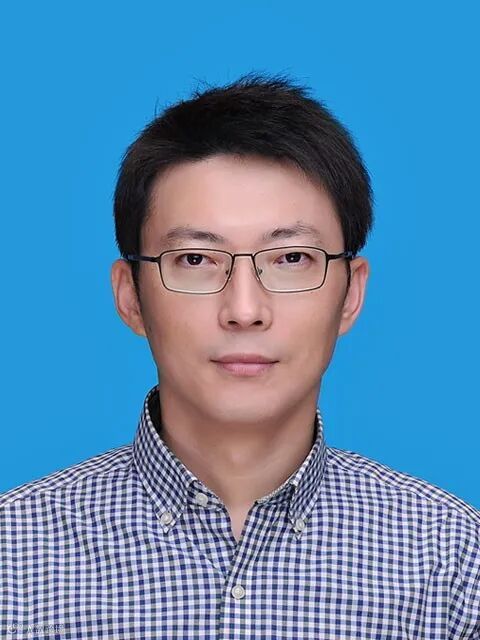


王强,博士,重庆第二师范学院教授,重庆市“英才计划”团队带头人,美国马萨诸塞大学访问学者。国家自然科学基金通讯评审,重庆市(江苏省、四川省)科技项目评审专家,重庆市农产品加工业协会特色农产品专委会主任,长期为《Bioresource Technology》、《Food Chemistry》、《Food Research International》等杂志审稿。先后主持国家自然科学基金面上项目、重庆市教委(重大)科技项目、重庆市应用开发计划等20余项,在《Food Chemistry》、《Ultrasonics Sonochemistry》、《Food & Function》、中国食品学报等刊物上发表文章60余篇,获得科技成果4项,授权发明专利6项,荣获省级科技进步二等奖2项。主要研究方向为油脂资源开发与利用、川渝特色食品加工及品质提升等领域。

版权声明
《食品工业科技》具有以上论文在全世界范围内的复制权、发行权、翻译权、汇编权、广播权、表演权、信息网络传播权、转许可权及以上权利的邻接权,且作者已授权期刊同论文著作权保护期。如需转载,可联系《食品工业科技》编辑部010-87244116,或直接在文末撰写转载来源。