

本文来源:npj计算材料学
非线性光学在太阳能、光探测等诸多方面都有重要应用,因此长期以来一直受到物理学家、化学家、材料学家和工程师们的广泛关注。一个重要的研究课题是如何能够提高材料的非线性光学响应,使其在低输入下达到人们预期的服役效果。虽然人们已经寻找到了很多新的潜在材料,一个常见的问题是能否在理论上给出相对比较通用的方案,并且依照这一方案完成材料设计?在去年的工作中,来自麻省理工学院的李巨(Ju Li)教授组通过模型分析和理论计算指出,拓扑绝缘材料有着优越的线性光学响应[J. Phys. Chem. Lett., 11, 6119–6126 (2020)]。值得说明的是,这里的拓扑绝缘材料指材料的电子态出现一种不太常见的杂化,它使得这些半导体(或绝缘体)材料的电子结构和普通的硅或者金刚石材料看起来很类似,但实质上具有不同的电子拓扑数。有一点像普通的纸环和墨比乌斯环一样,粗看差不多,但实际上完全不同。物理学家已经指出,这种拓扑绝缘材料中的电子能带结构和普通绝缘体(硅或金刚石)相比多了一次能带反转(就像墨比乌斯环一样),李巨教授课题组指出,这一反转会让价带和导带的电子波函数有更强的杂化,从而使得电子在价带和导带间的跃迁变得更容易,因此有着优越的光学响应。
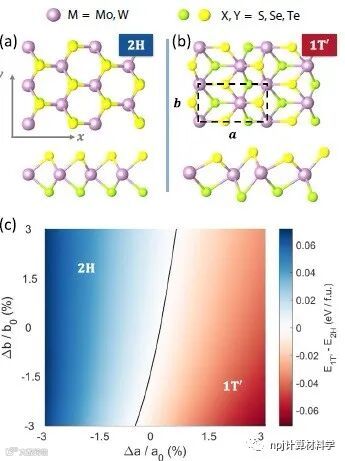
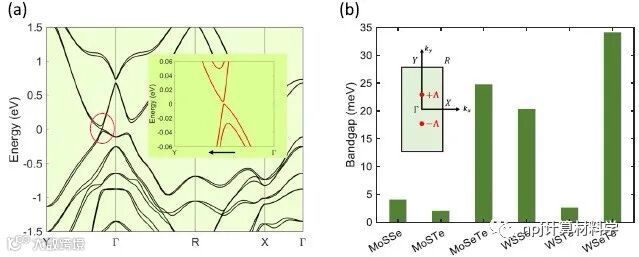
近日,李巨教授课题组在npj Computational Materials 中报道了他们在此领域的最新工作。他们联合MIT孔敬(Jing Kong)教授课题组将这一思想进一步拓展至非线性光学材料中,提出同时拥有1)拓扑型电子能带杂化,2)强烈的空间不对称性和3)较小能隙的材料,很可能具有优异的非线性光学性质。除了拓扑能带杂化之外,强烈的空间不对称性会使得空间中的两个相反的方向(比如向左和向右)变得极为不同,这样电子朝着某一特定方向移动的“意愿”更强,而向相反方向移动的“意愿”更弱。如此,就能产生更大的净电流。而能隙小的情况下,电子在价带和导带之间的跃迁也会变快。这有点儿像上台阶时,如果台阶比较矮,那么上起来就会比较容易。基于上述原理和孔敬教授课题组前期在二维非对称材料(Janus 过渡金属硫化物)中的实验成果,他们预测了一类新型的拓扑1T’相的Janus(双面神)过渡金属硫化物(Janus transition metal dichalcogenides, JTMDs),并且发现其拥有巨大的非线性光电导性。作者通过第一性原理计算发现,1T’ JTMDs的位移电流电导率可以达到2300 nm·μA·V−2(相当于2800 mA/W),而Circular current电导率则能达到104 nm·μA·V−2量级。这比过去常用的非线性材料的光学响应增强了1至2个数量级。也就是说与之前常见的材料相比,人们可以用更低强度的光照射JTMD材料,即可在材料中获得更大的光电流。由于1T’ JTMDs的能隙很小(10 meV量级,相当于2.5 THz),它们可被用于THz波段的光探测。该团队进一步发现,利用弹性形变和外加电场这样的外部刺激可让1T’ JTMDs发生电子态的拓扑相变,在相变前后位移电流的方向会发生反转。这样一个光电流方向的骤变可以用来表征拓扑相变,在光力学、光电子学中也有潜在应用。作者们的研究将有助于加深对拓扑材料光电性质的理解,并为未来寻找更多具有优秀光电性质的材料提供了理论参考。该文近期发布于npj Computational Materials 7, 31 (2021).
Editorial Summary
Nonlinear optical properties have potentially wide applications in energy harvesting, photodetections, etc., and have attracted great interest among physicists, chemists, and engineers. How to design materials with stronger photo-responsivity is thus an important and intriguing research topic. Indeed, people have found a number of new materials that can potentially possess good nonlinear optical properties. But we still need a universal protocol that can guide the material search and design. In a paper published last year, Prof. Ju Li’s group from MIT has theoretically and computationally pointed out that topological materials can have excellent linear optical properties [J. Phys. Chem. Lett., 11,6119–6126 (2020)]. It is worth mentioning here that in topological materials, electronic orbitals undergo some unusual hybridization, which makes them have distinct electronic properties than ordinary semiconductors (or insulators) such as silicon or diamond. Compared with ordinary semiconductors, topological materials have an extra band inversion. This is some what similar to the difference between a cup and a Möbius band: the Möbius band has an extra (half)-twisting. Prof. Ju Li’s group pointed out that, because of the band inversion, the wave function hybridization between the valence and conduction bands would be stronger, which accelerates the electronic interband transitions between the valence and conduction bands would be faster, and leads to outstanding optical properties.
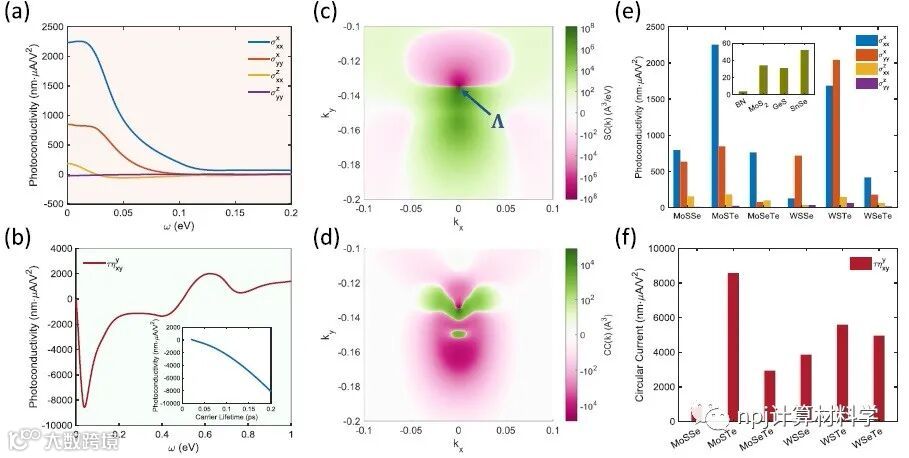
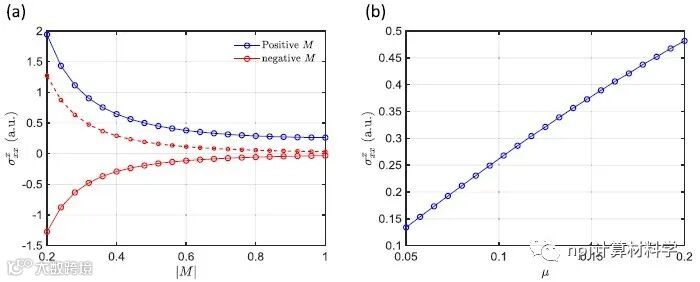
Fig. 4 Nonlinear photoconductivities of MoSTe.
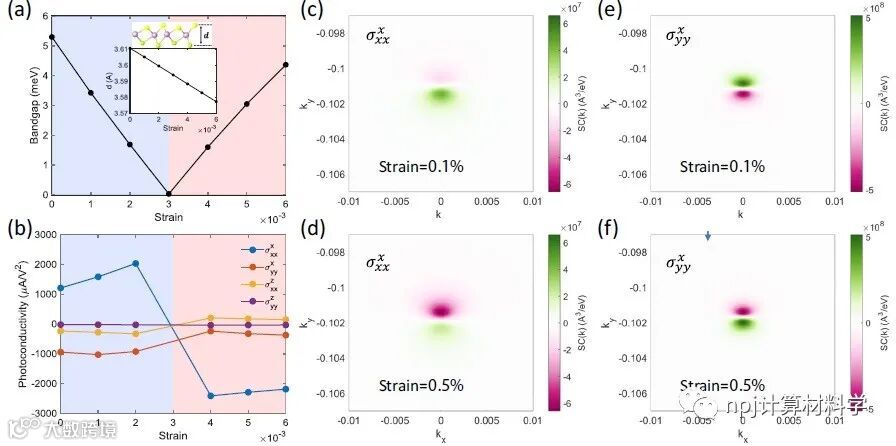
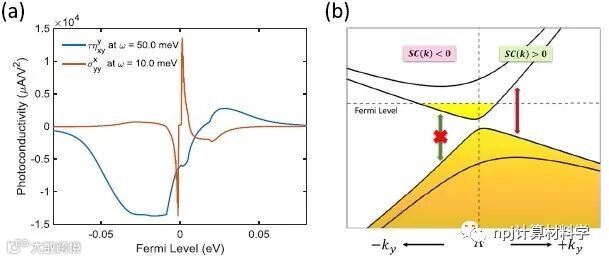
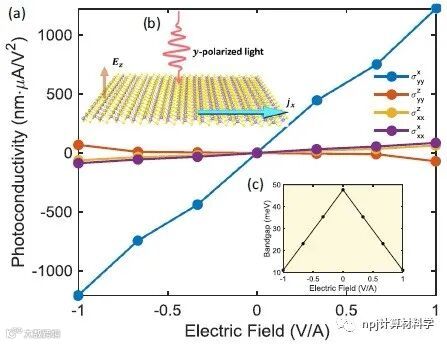
In recently published npj Computational Materials , Prof. Ju Li’s group,collaborating with Prof. Jing Kong’s group, extend this principle to nonlinear optical properties. They propose that materials with 1) topological band structure, 2) strong inversion asymmetry and 3) small electronic bandgap may well have excellent nonlinear optical properties. Besides topological band structure, strong inversion asymmetry would make two opposite directions in space (e.g., left and right) very different, so that electrons would have strong inclination to move in one direction, rather than the opposite, and the net charge current would be larger. In addition, small bandgaps can also make the electron interband transitions faster. This is somewhat similar to ascending steps. It is always easier to ascend lower steps. Guided by above theoretical principles and previous experimental results from Prof Jing Kong’s group, they predict a new class of topological materials: 1T’ phase Janus transition metal dichalcogenides (JTMDs), which have colossal nonlinear photoconductivity. With first-principle calculations, they find that the shift current conductivity in 1T’JTMDs can be as large as 2300 nm·μA·V−2, and the circular current conductivity can be on the order of 104 nm·μA·V−2 as well, which are larger than that of commonly used nonlinear materials by 1 to 2 orders of magnitude. In other words, the photocurrent in 1T’ JTMDs can be 10~100 times stronger than that in other materials under the same light illumination. Because1T’ JTMDs have small bandgaps (on the order of 10 meV ~ 2.5 THz), they can be used for photodetection in the THz range. The authors also find that under external stimuli such as in-plane strain and out-of-plane electric field, 1T’JTMDs can undergo topological phase transitions. And upon the phase transitions, the shift current can abruptly flip its direction, which can be used to characterize topological phase transitions. Their findings broaden our understandings on the optoelectronic properties of topological materials, and provide theoretical guidance for finding more materials with outstanding optical properties.
This article was recently published in npj Computational Materials 7, 31 (2021).
原文Abstract及其翻译
Colossal switchable photocurrents in topological Janus transition metal dichalcogenides(拓扑Janus过渡金属硫化物中超强光电流及其调控)
Abstract Nonlinear optical properties, such as bulk photovoltaic effects, possess great potential in energy harvesting, photodetection, rectification, etc. To enable efficient light–current conversion, materials with strong photo-responsivity are highly desirable. In this work, we predict that monolayer Janus transition metal dichalcogenides (JTMDs) in the 1T′ phase possess colossal nonlinear photoconductivity owing to their topological band mixing, strong inversion symmetry breaking, and small electronic bandgap. 1T′ JTMDs have inverted bandgaps on the order of 10 meV and are exceptionally responsive to light in the terahertz (THz) range. By first-principles calculations, we reveal that 1T′ JTMDs possess shift current (SC) conductivity as large as 2300 nm μA V−2, equivalent to a photo-responsivity of 2800 mA/W. The circular current (CC) conductivity of 1T′ JTMDs is as large as ∼104 nm μA V−2. These remarkable photo-responsivities indicate that the 1T′ JTMDs can serve as efficient photodetectors in the THz range. We also find that external stimuli such as the in-plane strain and out-of-plane electric field can induce topological phase transitions in 1T′ JTMDs and that the SC can abruptly flip their directions. The abrupt change of the nonlinear photocurrent can be used to characterize the topological transition and has potential applications in 2D optomechanics and nonlinear optoelectronics.
摘要 非线性光学性质(例如体光伏效应)在能源、光探测、光学整流等诸多方面都具有潜在的重要应用。为了实现有效的光电转换,人们需要具有强烈光学敏感性的材料。在这篇文章中,我们预测了1T’相的二维非对称过渡金属硫化物(Janus transition metal dichalcogenides, JTMDs)可以具有着非线性光伏性质,并且其光电导率非常大。这是因为1T’ JTMDs同时拥有拓扑能带结构、较强的空间不对称性和较小的能隙。1T’ JTMDs的反转能隙在10 meV 量级,因此它们对太赫兹(THz)波段的光极其敏感。通过第一性原理计算,我们发现1T’ JTMDs的光致位移电流电导率可以达到2300 nm·μA·V−2(相当于2800 mA/W),而circular current电导率则能达到104 nm·μA·V−2量级。这些优越的光电性质表明,1T’ JTMDs可以用于THz波段的光探测。同时我们发现,面内弹性应变和面外电场这样的外场可以调控1T’ JTMDs的电子结构并发生拓扑相变。在相变前后,位移电流的方向会发生反转。这样一个光电流方向的骤变可以用来表征拓扑相变,在光力学、光电子学领域也存在潜在应用。
微信分享

免责声明:本文旨在传递更多科研资讯及分享,所有其他媒、网来源均注明出处,如涉及版权问题,请作者第一时间后台联系,我们将协调进行处理(按照法规支付稿费或立即删除),所有来稿文责自负,两江仅作分享平台。转载请注明出处,如原创内容转载需授权,请联系下方微信号。