

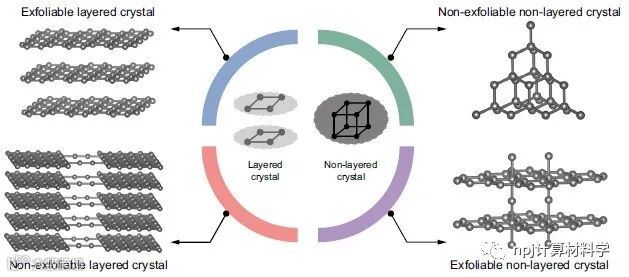
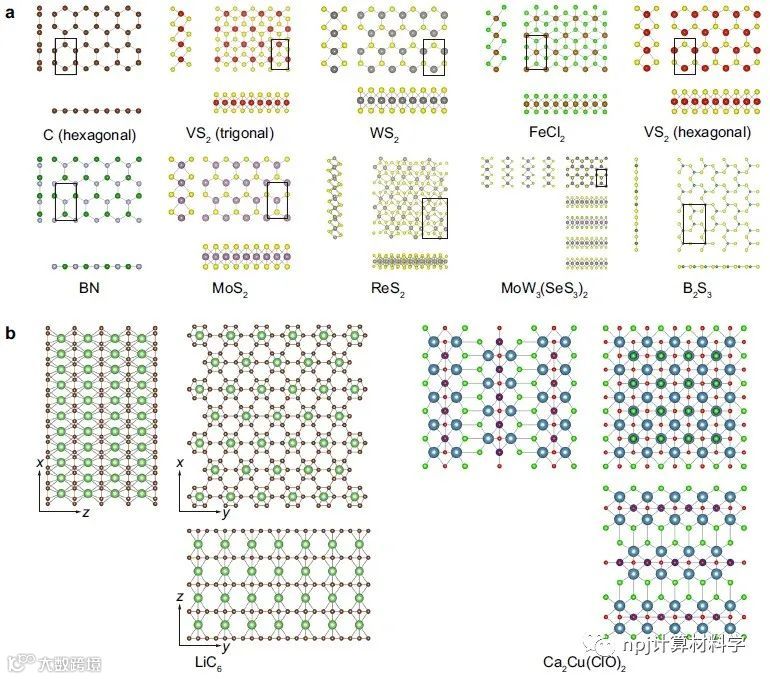
Fig. 1 Illustration of different types of crystals.
西瓜的熟没熟,无需切开看,用手指轻轻一弹就知道了。三维材料能不能机械剥离出二维材料,同样轻轻一弹就能知晓。来自武汉大学力学系的高恩来课题组基于剥离力学模型,提出了基于弹性矩阵度量二维材料剥离难易的指标。该指标具有明确的物理意义,适用于所有晶系,最重要的是可以由实验或者分子模拟高效测定,为高通量判断块体材料的剥离特性提供了理论工具。基于该指标本文给出了10,812种块体材料的剥离难易程度,筛选出148种可剥离的二维材料,其中包含34种已经被实验成功剥离。文章最后讨论了预测的可剥离二维材料的结构与性质。该文将148种预测的可剥离二维材料的详细结构与性质信息以长篇附件共享,便于实验人员参考。该文近期发布于npj Computational Materials7: 211 (2021)。
Editorial Summary
High-throughput: Computational exfoliation of 2D materials
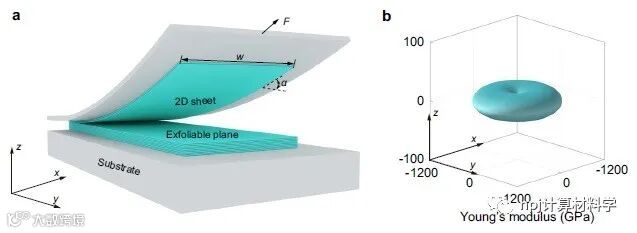
If the watermelon is ripe or not, you can just tap it to know. If 3D materials can be mechanically exfoliated into 2D materials, you can also tap it without damage. Jia et al. from Department of Engineering Mechanics, School of Civil Engineering, Wuhan University,,proposed an elasticity-based-exfoliability measure.
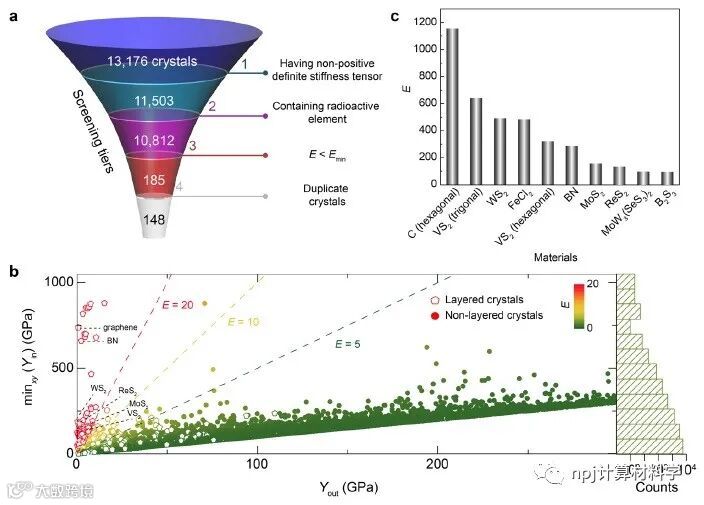
Fig. 3 High-throughput computational identifification of exfoliable 2D materials.
The proposed measure has a clear physical meaning and is universally applicable to all material systems. The most important thing is that it can be efficiently determined by experiments or molecular simulations, providing a theoretical tool for high-throughput computational exfoliation of two-dimensional materials. Based on this measure, they calculated the exfoliability of 10,812 crystals having a first-principles calculated elastic tensor, and predicted 148 exfoliable bulk materials into 2D materials. Literature survey shows that 34 predicted exfoliable bulk materials have been experimentally exfoliated into 2D materials. This article was recently published in npj Computational Materials7: 211 (2021).
原文Abstract及其翻译
Elasticity-based-exfoliability measure for high-throughput computational exfoliation of two-dimensional materials (弹性度量助力高通量发掘新型二维材料)
Xiangzheng Jia, Qian Shao, Yongchun Xu, Ruishan Li, Kai Huang, Yongzhe Guo, Cangyu Qu & Enlai Gao
Abstract Two-dimensional (2D) materials are promising candidates for uses in next-generation electronic and optoelectronic devices. However, only a few high-quality 2D materials have been mechanically exfoliated to date. One of the critical issues is that the exfoliability of 2D materials from their bulk precursors is unknown. To assess the exfoliability of potential 2D materials from their bulk counterparts, we derived an elasticity-based-exfoliability measure based on an exfoliation mechanics model. The proposed measure has a clear physical meaning and is universally applicable to all material systems. We used this measure to calculate the exfoliability of 10,812 crystals having a first-principles calculated elastic tensor. By setting the threshold values for easy and potential exfoliation based on already-exfoliated materials, we predicted 58 easily exfoliable bulk crystals and 90 potentially exfoliable bulk crystals for 2D materials. As evidence, a topology-based algorithm indicates that there is no interlayer bonding topology for 93% predicted exfoliable bulk crystals, and the analysis on packing ratios shows that 99% predicted exfoliable bulk crystals exhibit a relatively low packing ratio value. Moreover, literature survey shows that 34 predicted exfoliable bulk crystals have been experimentally exfoliated into 2D materials. In addition, the characteristics of these predicted 2D materials were discussed for practical use of such materials.
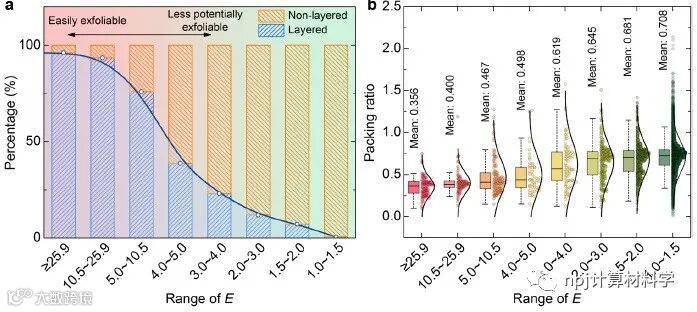
Fig. 5 Supports from topological and structural analysis of a large number of crystals.
摘要 二维材料有望应用于下一代光电器件,然而目前仅有少数高质量的二维材料被机械剥离出来。其中关键挑战之一是大量块体材料的剥离特性未知,导致试错试验代价高昂、进展缓慢。本文基于剥离力学模型,提出了基于弹性矩阵度量二维材料剥离难易的指标。该指标具有明确的物理意义,适用于所有晶系,最重要的是可以由实验或者分子模拟高效测定,为高通量筛选可剥离块体材料提供了理论工具。基于指标,本文给出了10,812种块体晶体的剥离特性,高通量筛选出58种易于剥离的二维材料和90种有望剥离的二维材料。为证明该指标的适用性,本研究发展拓扑结构分析算法,表明93%的预测可剥离材料层间没有化学键键合,99%的预测可剥离材料具有较小的原子填充比。此外,经文献调研后发现预测的148种可剥离材料中已有34种通过实验被剥离出来。文章最后讨论了预测的可剥离二维材料的结构与性质。
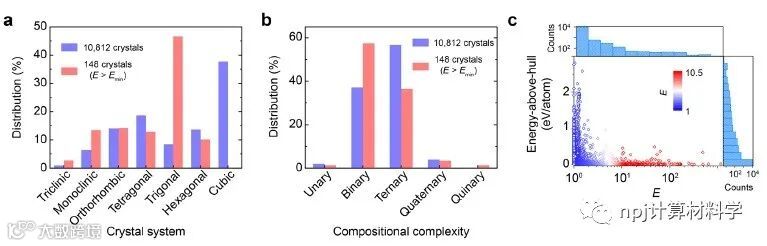
Fig. 6 Characteristics of 149 easily and potentially exfoliable crystals.
免责声明:本文旨在传递更多科研资讯及分享,所有其他媒、网来源均注明出处,如涉及版权问题,请作者第一时间后台联系,我们将协调进行处理,所有来稿文责自负,两江仅作分享平台。转载请注明出处,如原创内容转载需授权,请联系下方微信号