


文章来源:npj计算材料学
理解大规模原子结构(如铁电体的相变、拓扑极性畴等)的动力学行为是凝聚态物理与材料科学中的核心挑战之一。基于密度泛函理论的第一性原理计算虽精度高,但计算成本随原子数量激增,难以模拟超大规模体系(如超过千万原子的结构)。基于原子级模型的方法能模拟大规模的原子体系,但其中复杂相互作用(如铁电体的非线性耦合、原子占位的影响等)的参数化依赖人工经验,易引入误差且难以验证准确性。如何高效、自动且精准的构建适用于超大规模原子系统的物理模型,是计算材料学的重要课题。
南京大学吴迪、杨玉荣团队联合国际学者,提出了一种主动学习驱动的有效哈密顿量参数化方法,实现了从第一性原理数据到超大规模原子模拟的无缝衔接。该方法基于贝叶斯线性回归,在分子动力学模拟中实时预测能量、力和应力,并动态触发第一性原理计算以优化参数(图1)。
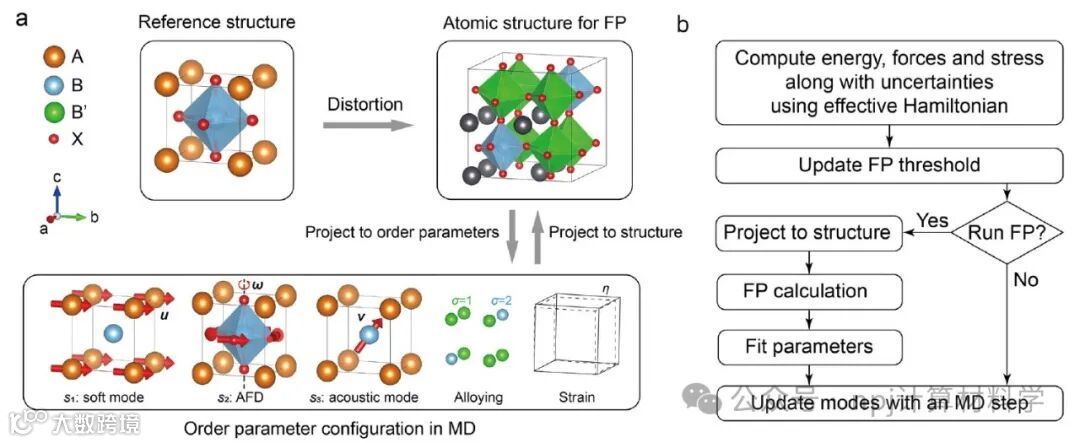
图1 基于主动学习的有效哈密顿量参数拟合方法示意图
Figure 1 Schematic for the active-learning based effective Hamiltonian parametrization method.
研究团队以钙钛矿材料(如BaTiO₃、PbTiO₃)为例,展示了该方法的突出优势:(1) 高效参数化:仅需少量第一性原理计算,即可自动化拟合有效哈密顿量参数;(2) 高效模拟计算:模拟速度比一般机器学习力场快2~3个数量级,可模拟超千万原子体系;(3) 精准预测相变和复杂体系:对BaTiO₃的顺电-铁电相变温度预测精度比以往工作显著提升,并能模拟极性拓扑结构等复杂结构。该方法不仅适用于钙钛矿体系,还可以推广到一般性的材料体系中。
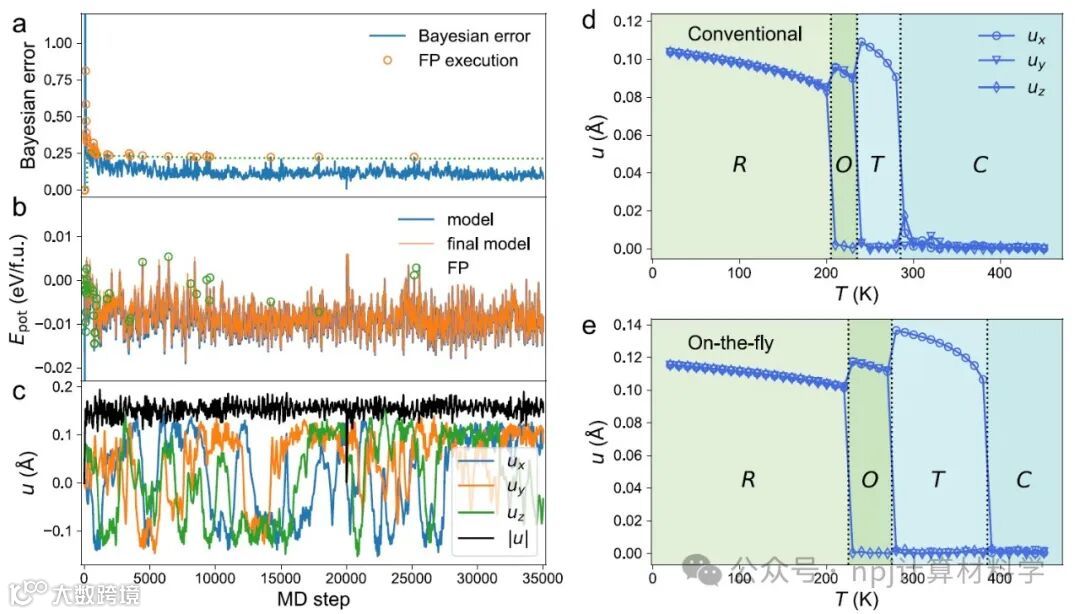
Fig. 2 | On-the-fly machine learning of parametrization for BaTiO3.
该方法为超大规模原子模拟提供了通用且高效的解决方案,为新型功能材料的研发提供了有力的工具。相关论文近期发布于npj Computational Materials11: 70 (2025)。手机阅读原文,请点击本文底部左下角“阅读原文”,进入后亦可下载全文PDF文件。
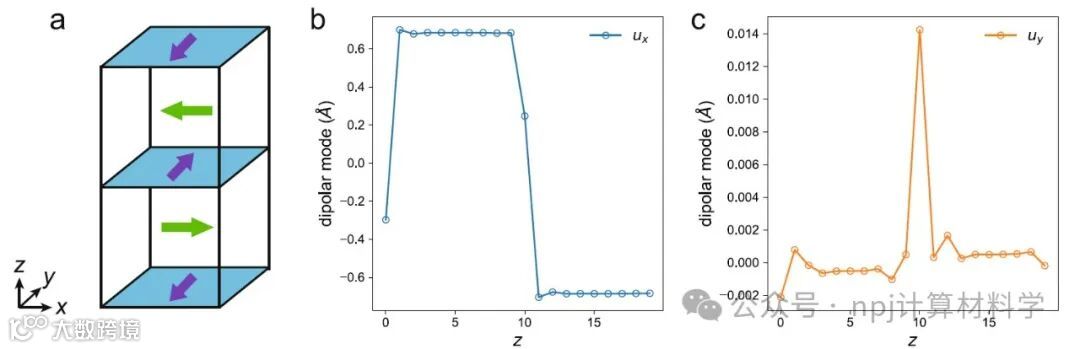
Fig. 3 | Dipolar mode distribution for a PbTiO3 multidomain with domain walls.
Editorial Summary
Machine learning meets Hamiltonian: A leap in million-atom simulations
Simulating super-large-scale atomic structures (e.g., phase transitions in ferroelectrics or polar topological domains) faces a fundamental bottleneck: Traditional first-principles methods, while accurate, become computationally prohibitive for systems exceeding millions of atoms.
The atomic models, on the other hand, could handle the large-scale atomic structures, however the parameterization of the complex interactions (e.g., nonlinear couplings in perovskites) often relies on manual adjustments, leading to inaccuracy or even errors.
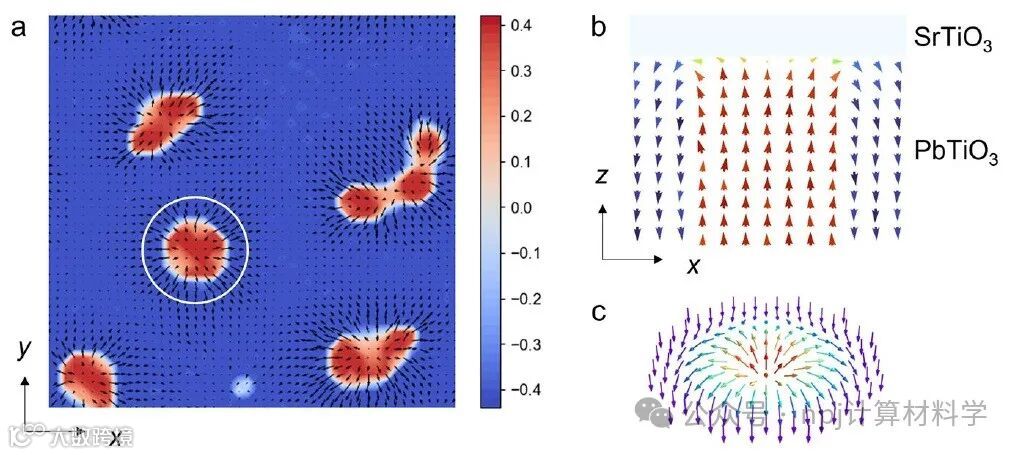
Fig. 4 | Polar distribution of SrTiO3/PbTiO3bilayer.
A team led by Prof. Yurong Yang and Prof. Di Wu from Nanjing University developed an active learning framework for effective Hamiltonian parametrization, integrating Bayesian linear regression with on-the-fly molecular dynamics. Demonstrated by perovskite examples, the outstanding advantages include: (1) Efficient parametrization: only a small amount of first-principles calculations is required; (2) Efficient simulation: faster than typical machine-learning force fields by 2 to 3 orders of magnitude, and could simulate systems with more than 10 million atoms; (3) Accurate prediction for complex systems: the prediction of phase transition temperatures for BaTiO3 is significantly improved, and successfully reproduces complex systems such as skyrmion-like nanodomains. The present method is not only applicable to perovskite, but could also be generalized to other material systems. It provides a universal, efficient and highly automatic solution for super-large-scale atomic simulation, offering a powerful tool for the development of novel functional materials.This article was recently published in npj Computational Materials11: 70 (2025).
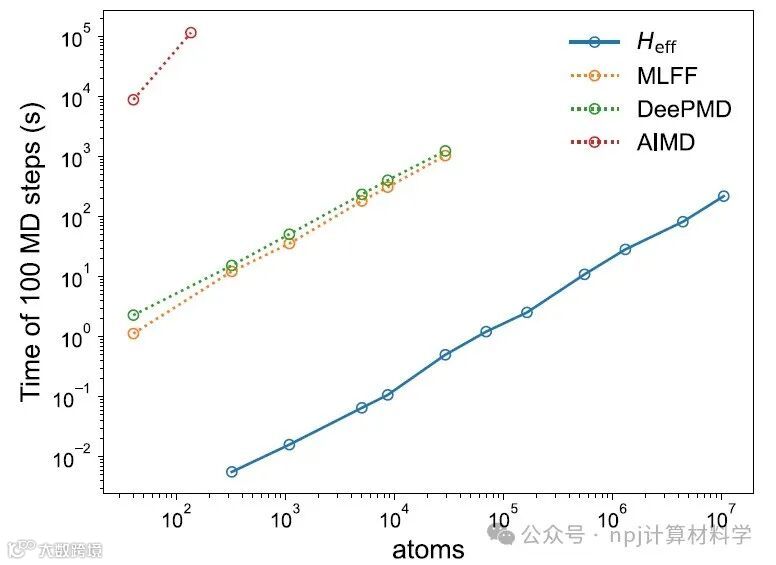
Fig. 5 | Computational time for 100 MD steps calculations as a function of the number of atoms in the simulated BaTiO3 supercell, using the effective Hamiltonian (Heff), MLFF, deep potential MD, and ab initioMD(AIMD).
原文Abstract机器翻译
Active learning of effective Hamiltonian for super-large-scale atomic structures (基于主动学习的有效哈密顿量方法用于超大尺度原子级结构模拟)
Xingyue Ma, Hongying Chen, Ri He,Zhanbo Yu, Sergei Prokhorenko, Zheng Wen, Zhicheng Zhong,Jorge Íñiguez-González, L. Bellaiche, Di Wu &Yurong Yang
Abstract The first-principles-based effective Hamiltonian scheme provides one of the most accurate modeling techniques for large-scale structures, especially for ferroelectrics. However, the parameterization of the effective Hamiltonian is complicated and can be difficult for some complex systems such as high-entropy perovskites. Here, we propose a general form of effective Hamiltonian and develop an active machine learning approach to parameterize the effective Hamiltonian based on Bayesian linear regression. The parameterization is employed in molecular dynamics simulations with the prediction of energy, forces, stress and their uncertainties at each step, which decides whether first-principles calculations are executed to retrain the parameters. Structures of BaTiO3, PbTiO3, Pb(Zr0.75Ti0.25)O3 and (Pb,Sr)TiO3system are taken as examples to show the accuracy of this approach, as compared with conventional parametrization method and experiments. This machine learning approach provides a universal and automatic way to compute the effective Hamiltonian parameters for any considered complex systems with super-large-scale (more than 107 atoms) atomic structures.
摘要基于第一性原理的有效哈密顿量方法为大规模结构(尤其是铁电体)提供了最精确的建模技术之一。然而,有效哈密顿量的参数拟合过程复杂,对于某些复杂系统(如高熵钙钛矿)尤为困难。本文提出了一种通用的有效哈密顿量形式,并开发了一种基于贝叶斯线性回归的主动机器学习方法,用于拟合有效哈密顿量参数。该方法在分子动力学模拟中实时预测能量、力和应力及其不确定度,从而决定是否执行第一性原理计算以重新训练参数。以BaTiO₃、PbTiO₃、Pb(Zr₀.₇₅Ti₀.₂₅)O₃和(Pb,Sr)TiO₃体系为例,展示了该方法的准确性,并与传统参数拟合方法和实验结果进行了对比。这种机器学习方法为所考虑的复杂系统(原子数)提供了一种通用且自动化的有效哈密顿量参数计算途径,并可以用于超大规模(超过10⁷原子)原子结构的模拟。