


Summary
-
I see rising redemption pressure, weaker confidence in private loan values, and early signs that stress could spread to banks if the selloff continues. -
I see a bank contagion risk because markdowns on loans tied to private credit borrowers could reduce leverage and tighten funding across the system. -
In my view, that can create a negative loop: lower marks cut leverage, weaker returns drive redemptions, and redemptions can force loan sales at worse prices. -
I think public BDCs trading well below NAV suggest that the market does not fully trust private loan values under stress. Especially for the funds exposed to software. -
To be clear, I think the SaaS-pocalypse is nonsense. Yet the only real catalyst for a positive re-rating is the reopening of the Strait of Hormuz, and I don't see that happening anytime soon.

ridvan_celik/E+ via Getty Images
I've been tuned in to private credit since the first cockroaches emerged in Q3 2025.
In fact, as earnings call, CEO James Dimon made the following remarks when asked about Tricolor, a used-car lender that filed Chapter 7 in September 2025:
But I -- my antenna goes up when things like that happen. And I probably shouldn't say this, but when you see one cockroach, there are probably more…
…There clearly was, in my opinion, fraud involved in a bunch of these things. But that doesn't mean we can't improve our procedures.
Those words ended up in the headlines of many media outlets, which is how I first discovered the nervousness around lending and private credit.
The impact of Tricolor’s bankruptcy on JPMorgan was minimal, with "only" $170M in written-off losses. However, other lenders were affected as well, including Barclays and Fifth Third, both disclosing a nine-figure loss tied to Tricolor.
In my view, Tricolor was one of the first cases that raised concerns among investors that asset-backed loans could involve duplicated collateral, weak controls, or both.
The other cockroach was the bankruptcy of First Brands. This time, there were quite a few more players in the private credit space with skin in the game.
Jefferies reported that Leucadia Asset Management (a Jefferies-managed fund) held about $715 million of receivables tied to First Brands. That said, Jefferies later said its own balance-sheet exposure was much smaller, about $43 million of receivables plus $2 million of loans, and that the larger position sat in the fund rather than the bank.
Either way, investors headed for the exit first and asked questions later. In the days surrounding this event, Jefferies' shares fell by double digits.
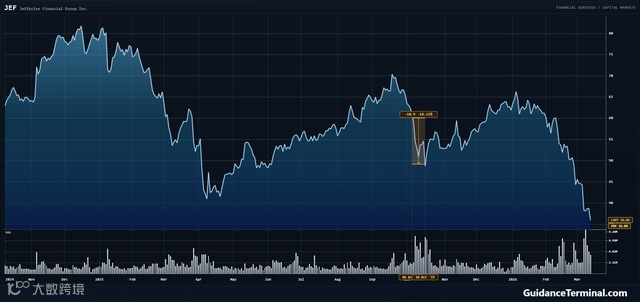
Guidance Terminal | JEF stock
UBS was also examining the impact of First Brands on several of its funds, with some sources floating an exposure of $500M. Bank of America said its First Brands exposure was through syndicated, secured asset-backed loans, although I did not find any figures indicating how much exposure it had.
Interestingly enough, the story with First Brands resurfaced earlier this month, with Western Alliance reportedly suing Jefferies over a $126.4 million payment tied to First Brands loans. Following the announcement, both stocks dropped by double digits, reflecting a pattern I will return to several times in this piece: investors appear to (panic) sell first and ask questions later.
Finally, one can't forget the November 17 news when U.S. prosecutors were probing telecom companies after HPS said it had lent more than $400 million backed by what appeared to be fake receivables. This time, the likes of BlackRock (side note: HPS had become part of BlackRock in 2025) and BNP Paribas seemed to have downside exposure.
Once again, I observe a similar pattern: private credit getting caught in collateral and diligence failures in specialty finance structures. This raises the question of whether these firms have taken on too much risk in their loan portfolios. That concern set the stage for the next brick in the wall of worry.
The SaaS-pocalypse
I have strong opinions on why the AI selloff is unwarranted, which I discussed in detail in this bullish on Blue Owl back then), except for one thing. OBDC stock was trading well below its reported net asset value. Therefore, if the move went ahead (which it didn’t), investors in OBDC II were effectively staring at a roughly 20% loss.
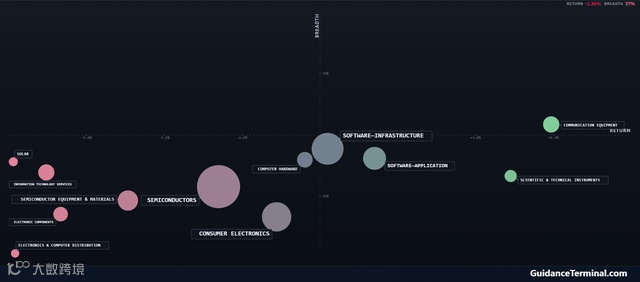
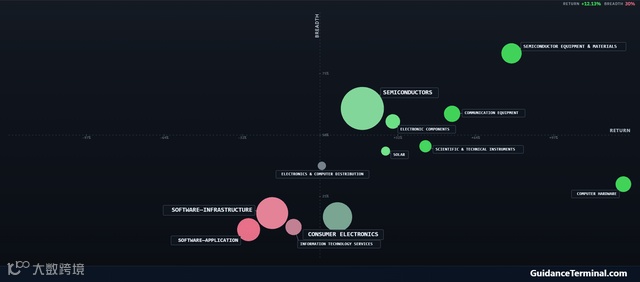
I won’t go into the reasons why AI tools like Codex, Cursor, or Claude Code will not make companies such as ServiceNow, CRM, Adobe, or SAP obsolete. My goal here is to look at the effects on private credit.
To begin with, the market’s concern is that software is the sector where private credit has the most exposure, the least collateral, and the greatest uncertainty around future underwriting due to the so-called "AI disruptions."
Some sources suggest that software/services represent around one-fifth of private credit exposure, with $180 billion of debt within the $835 billion broader U.S. private credit market. In fact, JPMorgan Private Bank said private credit has roughly 40% exposure to software when broader tech and business services are included.
That's a lot, if you ask me.
Now, let’s take a closer look at the most recent data for software exposure in some specific cases:
Apollo Debt Solutions: software was 13.2% of assets
KKR: Software was about 7% of the portfolio
Blue Owl: Management said software was 8% of firm assets
Blue Owl Technology Income Corp.: Software made up 46% of assets
Blackstone: Software was about 7% of total assets and 10% of credit holdings
Ares: said software was roughly 6% of total assets
Goldman Sachs Private Credit Corp.: Enterprise software exposure was 15.5%
BlackRock/HLEND: Reuters reported 19% software exposure in the fund
Even though software’s exposure is in the single digits in some cases, it’s enough for investors to associate private credit with software.
Therefore, the directional correlation between BIZD (the closest public-market proxy for BDCs) and the IGV since Q3 last year doesn't surprise me in the slightest.
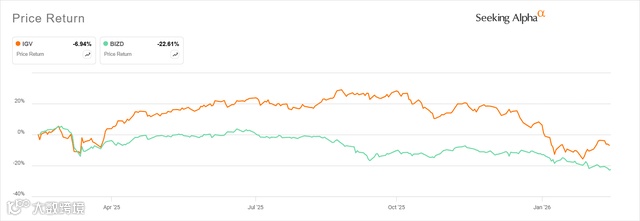
For reference, here are the 3-month returns of the companies in the asset management industry (where most private credit firms are classified):
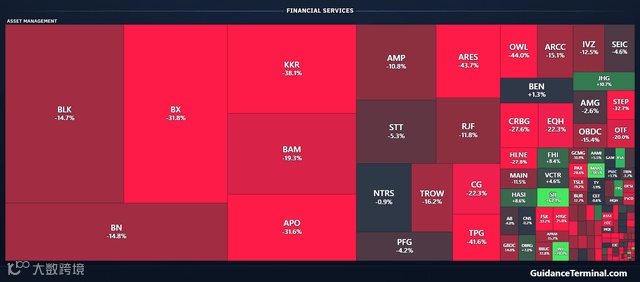
Call me crazy, but I see a high correlation in this industry from a return perspective (at least, directionally).
In fact, the picture is even worse when looking at the discounts to NAV in public BDCs.
First, let me clarify what these acronyms mean.
A BDC (or Business Development Company) is a publicly traded investment firm that raises money from investors and then uses that money to lend to midsize private companies. These BDCs earn interest on that loan and pass much of that income back to their shareholders as dividends.
Before explaining NAV, I’ll make a small tangent to cover the concept of a mark (which I will avidly use later).
A mark is the value a fund assigns to an investment on its books at a specific point in time. In private credit, the manager has to estimate what the loan is worth based on things like the borrower’s performance, interest rates, comparable loans, and whether the company looks stronger or weaker than before.
NAV is the simplest concept to understand. It stands for net asset value and represents the total value of a fund’s assets minus its liabilities. Keep in mind that changes in marks flow through to NAV. So, if one loan is marked down by $500 million, the fund’s asset value declines accordingly.
With that said, the recent data suggests that public BDCs were trading at an average of about 78 cents per $1 of NAV vs. 85 cents at the start of 2026 and roughly par in early 2025. The chart below shows the price-to-asset values for top BDCs, comparing the ratio in March 2026 vs. a year ago:
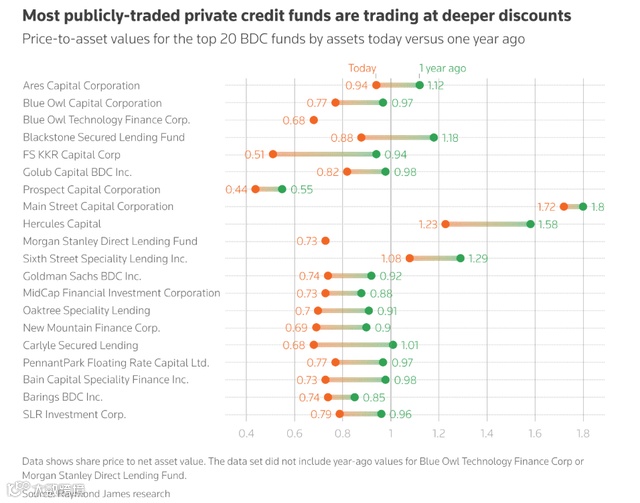
In my view, the discounts shown above speak volumes about the private credit sector.
To me, these discounts suggest that investors increasingly doubt that reported private marks equal realizable value under stress conditions. And that stress is mainly related to AI disruptions that led to the SaaS-pocalypse drama since the start of the year.
On the analysts' side, I found a few interesting comments this week.
Morningstar’s Jack Shannon said this week that investors appear to think the sector’s "best days are behind it." Evercore ISI’s Glenn Schorr said discounts now reflect recession and loss fears.
That said, I see an even bigger fear (or risk, if you want to call it that).
First Signs of Contagion to Banks?
You will understand the question mark in a second.
On March 12, a report suggested that JPMorgan had marked down some loans tied to private credit borrowers, especially where underlying software exposure was a concern. According to the report, the marks reduced the leverage available to a small cohort of borrowers.
If the report is correct, I see the risk of a domino effect in private credit that could spread to the broader banking system.
Let me explain.
In my view, if banks mark down the collateral value of private credit firms, that could translate into less borrowing capacity against the same assets. In other words, less leverage for some private credit firms.
So what?
Well, according to a recent OFR brief, some private funds may use derivatives to amplify returns. What a surprise, right?
The same brief notes that private funds can have leverage beyond what simple gross-to-net ratios show. For reference, the chart below shows the leverage of private credit funds in 2024, with an emphasis on the 95th percentile:
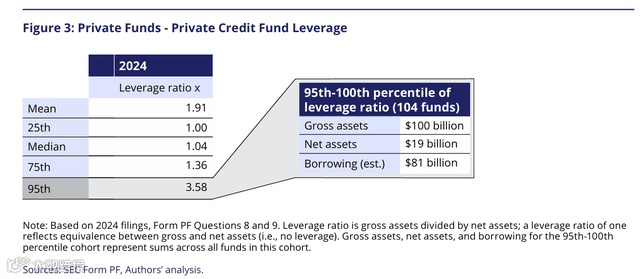
As a side note, BDCs are statutorily capped at 2:1 debt-to-equity.
Back to my point, less leverage in private credit may lead to lower returns. Therefore, some investors may head for the exit, forcing asset liquidation at sub-par values, leading to even tighter conditions from the banks, which reinforces the loop.
To be clear, there are mechanisms to manage this risk, which I will show in the next section.
To conclude this section, in a worst-case scenario, banks could be exposed to the losses in private credit, especially if these funds are forced to liquidate at subpar values as redemptions kick in.
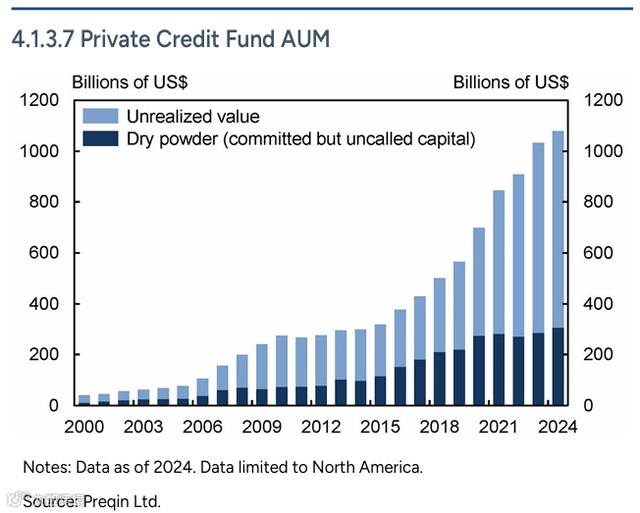
To put the size of this sector into perspective, the U.S. FSOC put North American private credit fund AUM at about $1.1 trillion at year-end 2024 and BDC AUM at $438 billion.
Redemption Pressures
In my view, this is the largest brick in the wall of worry around private credit right now.
Let me explain how the redemption mechanism works in plain English.
Companies like Blue Owl own private credit funds (think OBDC II). Well, it turns out that investors in these funds are allowed to ask for their money back each quarter, but only up to a certain limit. In the case of Blue Owl’s OBDC II, investors could ask to redeem up to 5% of capital per tender offer/quarter.
That limit makes sense only if withdrawal requests are happening at a normal pace. This becomes a problem when too many investors want to get out at once, because, remember, the fund owns private loans, not cash. These funds can’t sell these loans instantly, especially at par value.
In late 2025, Blue Owl tried to solve this problem by merging OBDC II into a listed sister fund, OBDC (which is public). The idea was to move investors from the private fund into the public vehicle and use that public listing as the liquidity outlet.
On paper, it made complete sense (in fact, I was bullish on Blue Owl back then), except for one thing. OBDC stock was trading well below its reported net asset value. Therefore, if the move went ahead (which it didn’t), investors in OBDC II were effectively staring at a roughly 20% loss.
Fast forward a few months, and Blue Owl came up with another solution: sell actual loans to institutional buyers and use the money to pay investors and reduce debt.
In February, Blue Owl sold $1.4 billion of assets at essentially fair value (99.7% of par) from three credit funds and replaced the quarterly 5% redemption with a direct payout worth 30% of the portfolio’s NAV (equivalent to $268 million). Technically, management didn’t halt redemptions, according to Blue Owl co-President Craig Packer:
We're not halting redemptions, we are simply changing the method by which we're providing redemptions
According to Reuters, 13% of the sold pool (128 companies in 27 industries) was in software/services. That's a decent amount, if you ask me.
Speaking of software, back in January, the Blue Owl Technology Income Corp. fund (another non-traded BDC) saw a 15.4% redemption rate after its redemption limit had been raised from the older 5%. As a side note, that’s the tech-focused fund I mentioned in a previous section, which had 46% of assets in software
The story around redemptions is not isolated to Blue Owl (once again, the word contagion comes to my mind).
Blackstone’s $82 billion private-credit fund, BCRED, experienced $1.7 billion in net withdrawals in Q1 2026. The redemption rate totaled 7.9% of the fund, above the normal 5% quarterly limit. In response, Blackstone increased the payout cap to 7%, and Blackstone (plus employees) invested $400 million to meet all requests.
There is more.
Earlier this month, HLEND, a private-credit fund owned by BlackRock, received $1.2 billion of redemption requests, equal to 9.3% of NAV. The fund did not meet all of those requests and only paid out about $620 million, which was effectively the amount allowed under its 5% quarterly withdrawal limit. As I said before, this fund had 19% software exposure.
Morgan Stanley and Cliffwater joined the list, which confirmed (at least, to me) that the stress in private credit was only beginning to spread.
Morgan Stanley’s private credit fund faced withdrawal requests equal to almost 11% of the fund. For reference, the fund returned about $169 million, satisfying only 45.8% of redemption requests.
Cliffwater’s private credit fund received redemption requests equal to about 14% of fund shares, with the firm capping its repurchases at 7%.
Overall, I see a clear domino effect here.
The more redemptions, the more nervousness among investors, which triggers even more redemptions. So far, we haven't seen any loans sold at subpar value. However, as Taleb would say, the absence of evidence is not evidence of absence.
What I’m Doing Right Now
Let’s start with what I’m not doing right now.
I’m definitely not shorting the private credit industry at this point. There are two main reasons.
First, most of the stocks in private credit are oversold. In fact, some of the players in this industry, like Blue Owl, have a short interest in the double digits.
In my view, these are the perfect conditions to spark a “relief rally” on any positive announcements. Which brings me to the second point.
Second, in my view, most of the pessimism in private credit was driven by the SaaS-pocalypse in Q1 this year. In my view, the fear is unwarranted, as these SaaS firms are unlikely to be replaced by individual vibe coders building a Salesforce in their bedrooms. Distribution, user acquisition, and stickiness are the moats of the incumbents.
I strongly believe these moats are intact, despite the fact that pretty much anyone can vibe code any software tool out there.
In my view, a catalyst for the positive rerate of private credit could be the reopening of the Strait of Hormuz.
To be clear, I don’t expect this to happen in the near term. However, over the next few weeks (and even months), I think the U.S. will push for a ceasefire given the high gas prices at the pump. Why?
In a few words, due to the midterm elections in November.
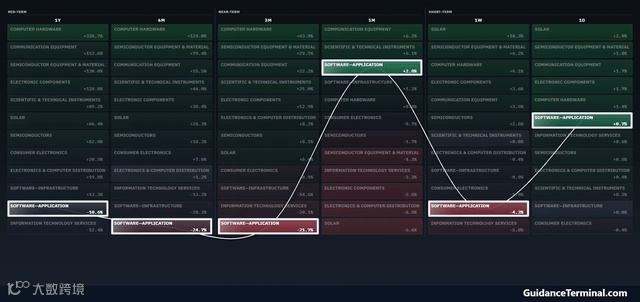
So far, the first signs of a rebound in software are already visible below.
Guidance Terminal
This industry was the second-best performing in the tech sector when looking at its 1-month returns (even outperforming semiconductors).
I warn readers (and especially the bears) that any improvement in the sentiment around software could lead to a turnaround in sentiment in private credit.
In my view, that could lead to a slowdown in the rate of redemptions, which would lead to fewer negative headlines around this industry and a likely return to the status quo prior to Q3 2025.
Overall, I don’t see any asymmetric upside in private credit right now. Going short could easily backfire, and by going long (in my view), one is betting on a turnaround in software, which could only happen if the risk appetite of investors returns in the markets. With Hormuz blocked and reports of mining activity, I don’t see this happening any time soon.
Bottom line. I’m staying on the sidelines on this one.
https://seekingalpha.com/article/4882527-the-private-credit-selloff-rising-risk-of-bank-contagion