


Summary
-
The U.S. housing market reached unprecedented bubble levels in 2025, now showing early signs of price weakness and declining affordability. -
Home affordability has deteriorated sharply, with the Home Affordability Index at 80, well below the threshold for sustainable demand. -
Mortgage rates remain elevated above 6%, with limited prospects for significant declines, further pressuring housing demand and prices. -
Surging negative equity, rising foreclosures, and job market weakness suggest a growing risk of a downward spiral in home prices.
 wildpixel/iStock via Getty Images
In late 2025, the housing outlook showed some signs of hope. In December, President Trump said he planned to introduce the most aggressive housing reform plan in history, which was expected to include policies such as lower mortgage rates, less regulation for homebuilders, and increased limits for FHA loans. The Trump Administration also discussed the possibility of creating portable mortgages and allowing homebuyers to withdraw funds from 401k accounts for a down payment.
While interest rates did drop in early 2026, that did not last long, and mortgage rates have recently ticked higher. I still think President Trump might take additional action to improve the housing market, especially before the midterm elections. However, at this time, the housing market seems poised to remain challenged and could face big declines. Many homeowners who bought property in the past couple of years now have negative equity, as prices have started to soften. With all this in mind, let's take a closer look at housing:
The U.S. Is In The Biggest Housing Bubble Ever
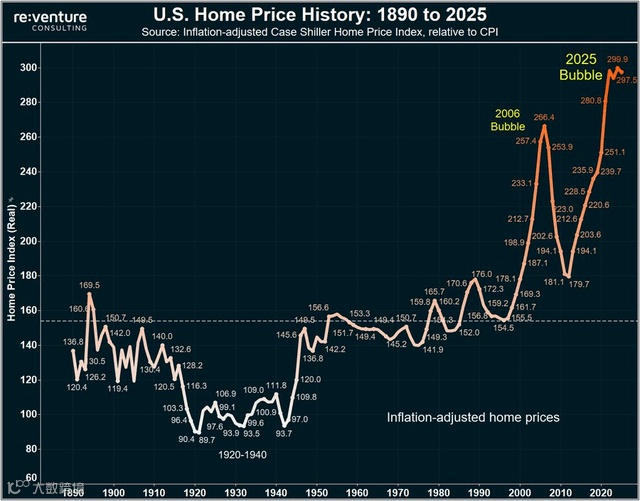
I feel like people are complacent about the fact that the U.S. housing market hit all-time highs in 2025, surpassing the levels of the 2006 housing bubble. Home prices surged shortly after the Covid pandemic due to the incredibly low-interest rates that the Federal Reserve implemented to keep the economy from major declines. The Fed also kept interest rates low for a long time, which fueled inflation and asset price appreciation. Even though the Fed finally raised rates a couple of years ago, housing price appreciation momentum continued until very recently. As shown in the chart below, home prices hit unprecedented levels in 2025, suggesting we are in the biggest housing bubble ever. The chart also shows a slight pullback in home prices recently, the first sign of weakness in years.
reventureapp.blog
Home Affordability Is At Extremely Low Levels
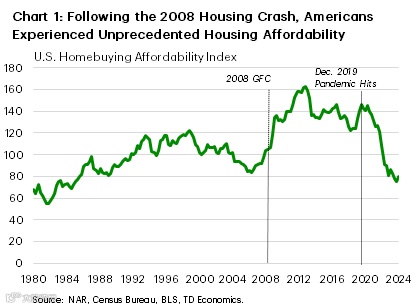
With home values extremely elevated, home affordability has become a big issue for many potential homebuyers. As shown below, the "Home Affordability Index" measures whether a family earning the median income could qualify for a mortgage on a median-priced home. When the index has a value of 100, it means that a family has 100% of the income needed to afford a mortgage on a median-priced house. When the index is at 140, as it was in 2020, it means that homes are very affordable and potential homebuyers have 140% of the income required to buy a median-priced house. However, the current index is around 80, meaning a homebuyer currently has only about 80% of the income required to buy a median-priced home. This means something has to give: either home prices need to drop, or incomes need to rise significantly, or mortgage rates need to decline. It could also be a combination of these.
economics.td.com
Mortgage Rates Could Stay At Relatively High Levels Or Even Go Higher
Mortgage rates declined a bit a few weeks ago; however, they have been rising again more recently. The current rate for a 30-year mortgage is around 6.1%. Inflation remains a threat, especially as energy prices have been rising recently. In addition, with the U.S. national debt load at unprecedented levels, bond investors are demanding higher yields. All of this suggests that mortgage rates might not have much room to go down, and if inflation reignites, rates could even rise from here. The Mortgage Bankers Association expects that mortgage rates will remain high, and their economists see mortgage rates staying above 6% through 2026. All of this means that mortgage rates probably won't be going down enough to boost the housing market.
Major Housing Market Warning Signs
Home prices appear to have already peaked and may now be at unsustainable levels. I see multiple warning signs suggesting home prices could be ripe for a major correction. Here are some additional major potential red flags for investors to consider since home price declines could lead to a recession or exacerbate a recession:
1) The number of homeowners with negative equity surged by about 60% in 2025, and now over 1 million homeowners have negative equity. This is a big concern, because when people have no equity, it is a lot easier to walk away if there is an economic downturn. This could create a wave of foreclosures.
2) Foreclosures are surging across the United States, and this is happening at a time when the economy is relatively strong. This makes me wonder how much more foreclosures could rise if the economy enters a recession. This could create a tidal wave of foreclosures.
3) In yet another sign of distress with homeowners, Google searches for "help with mortgage" have recently reached levels that were last seen during the Great Financial Crisis, or "GFC."
4) AI-related layoffs have been surging and could accelerate in the coming years. The job market is showing signs of weakness, and if this doesn't improve soon, it could put many homeowners in jeopardy and at risk of foreclosure.
Where I Could Be Wrong
It's possible that the new Federal Reserve Chair will lower rates more than investors currently expect when Jerome Powell is replaced in May. This could greatly improve affordability and prevent the housing market from reaching a worst-case scenario. President Trump could become more focused on housing affordability and on boosting the economy in general, especially just before the midterm elections. Oil prices have been surging due to the war in Iran, and this has raised inflation concerns, which has helped push interest rates higher. But if a ceasefire is announced and oil prices drop, this could allow rates to begin easing again.
In Summary
With home prices potentially declining due to a lack of affordability, many more homeowners could be at risk of having negative equity. This suggests the housing market could be poised for a downward spiral, with rising layoffs likely to create another wave of what is already a surge in foreclosures. There appears to be a real chance of a growing negative feedback loop for housing prices whereby each negative input just exacerbates other negative factors. Once a downward spiral gets started, it can be very hard to stop it. If these concerns grow, it could also spook potential homebuyers since they might decide to wait for further price declines. I believe a home price correction is increasingly likely, and declines could accelerate in the next economic downturn.
https://seekingalpha.com/article/4883304-the-housing-bubble-over-1-million-homeowners-have-negative-equity-downward-spiral-looms