


Summary
-
Social Security’s Old Age and Survivors Insurance Trust Fund is projected to be depleted by fiscal year 2031, accelerating previous insolvency forecasts. -
The annual Social Security deficit is rapidly growing due to demographic shifts, high COLA adjustments, and legislative changes reducing revenue. -
If no action is taken, benefits will be cut by 24% across the board, devastating nearly 70 million retirees and causing broad economic strain. -
Immediate bipartisan reform, similar to the Social Security Act of 1983, is urgently needed to avert a severe national crisis.
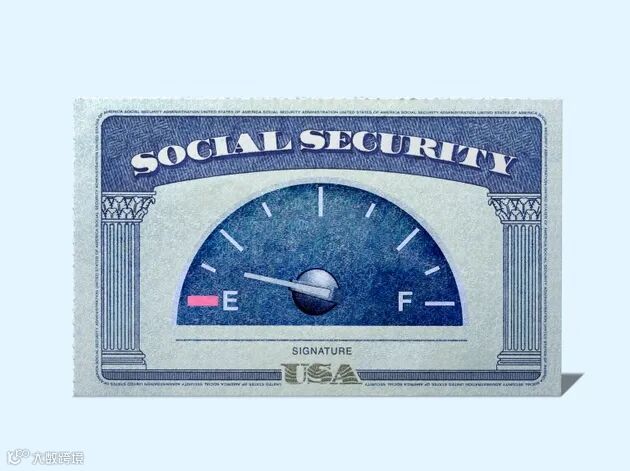
DNY59/iStock via Getty Images
Introduction
I’m old enough to remember when Al Gore coined the term “lockbox” as a euphemism for how he was going to protect the Social Security surplus.
The year was 2000, and Gore was the incumbent Vice President, campaigning for the presidency. His administration had just recorded a budget surplus of $236 billion, the largest in American history still to this day. More than two-thirds of the surplus, or $160 billion, was created by the revenue from Social Security taxes exceeding payments to Social Security recipients.
Vice President Gore wanted to save that Social Security surplus for the future, while his opponent, then Texas Governor George W. Bush, wanted to return the surplus to American citizens through tax cuts.
Gore was memorably parodied by Darrell Hammond on Saturday Night Live, a performance that helped turn the word “lockbox” into a lasting piece of SNL lore.
Unfortunately, American retirees will not be laughing now.
CBO Forecasts That The Social Security Surplus Will Be Depleted By The End Of Fiscal Year 2031
On Wednesday, Congressional Budget Office Director Phillip Swagel testified before the Senate Finance Committee about the fiscal outlook over the next ten years. As he has for the past several years, Swagel stressed how our expenditures continue to exceed our revenues, causing our debt to GDP to balloon. He warned the lawmakers, again, that the trajectory of budget deficits was unsustainable.
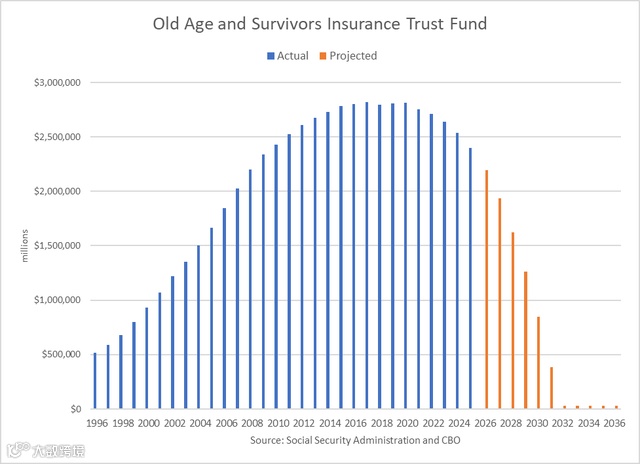
Of particular interest to me, though, was Swagel emphasizing that Social Security’s Old Age and Survivors Insurance (OASI) Trust Fund would be exhausted by the end of fiscal year 2031.
That is only 5 years away!
Social Security Administration and CBO
As recently as 2022, when CBO published a similar ten-year fiscal outlook, the forecast was that the Trust Fund would last until 2035.
Even one year ago, CBO projected that OASI wouldn’t become insolvent until the end of Fiscal Year 2032.
Over the past 4 years, the expected end of OASI has been shortened by four years. This is an extremely rapid deterioration in the Social Security program.
Why Social Security Is Deteriorating
The Social Security Act was passed in 1935, during the Great Depression, as part of President Franklin D. Roosevelt’s New Deal. There was widespread unemployment and poverty in our country, and the Act was created as a contributory system that would provide future retirement benefits for workers.
The Old Age and Survivors Insurance Trust Fund was established in 1939 as the depository of all Social Security payroll taxes collected by the government. After benefits were paid, the surplus was invested in non-marketable U.S. Government bonds.
Everyone who ever received a paystub has been surprised to see that their take-home pay was much less than the gross amount they earned for the pay period. They knew that they would have state and federal income taxes withheld from their check, but then there was this mysterious FICA tax as well.
The Federal Insurance Contributions Act, or FICA, is a mandatory federal payroll tax deduction of 6.2% of earnings to fund Social Security. This amount is matched by employers.
There have been many changes to Social Security over the years to extend its solvency. The Social Security Amendment of 1983 accelerated payroll tax increases and gradually raised the full retirement age from 65 to 67. This led to a significant increase in the Social Security surplus.
Social Security Administration and CBO
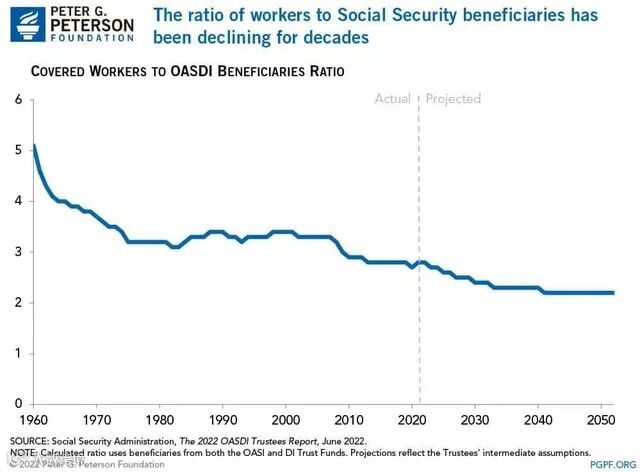
The fundamental problem with Social Security, though, is a demographic one. We have an aging population, and the ratio of workers paying taxes to retirees receiving benefits is shrinking. In 1940, shortly after the program was created, there were many workers and few retirees who had paid into the system. The ratio started at 159 to 1.
As the program matured, the ratio narrowed. By 1960 the ratio was 5.3 to 1, and gradually it has declined to the current ratio of 2.8 to 1. By 2035 it is expected to fall further to 2.2 to 1.
SSA and PGPF.Org
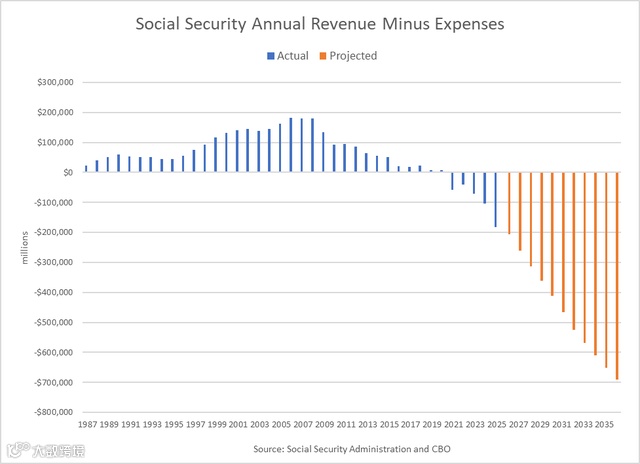
The impact of this demographic shift is that current Social Security revenue is no longer large enough to cover current Social Security expenses. Hence, to meet the shortfall to pay retirees their earned benefits, Social Security must dip into the OASI Trust Fund.
Annual Social Security expenses began exceeding annual revenues in 2021. This was in part due to an acceleration in Cost-of-Living Adjustments tied to the then 40-year high CPI increase. That the Fed has not been able to bring CPI back down to its target 2% rate has exacerbated the problem.
Last summer’s One Big Beautiful Bill Act increased the deficit further by reducing total revenue targeted for Social Security.
As seen in the above chart, the annual Social Security deficit is growing rapidly; hence, it needs to reach for the Trust Fund to cover the shortfall. But, as stated earlier, the Trust Fund will only be able to cover Social Security benefits for 5 more years.
What This Means For Retirees
Americans depend on, and rely on, Social Security. Currently there are almost 70 million retirees collecting Social Security benefits. Of these people, almost half receive at least 50% of their household income from Social Security, and 25% count on Social Security for 90% of their income.
In fiscal year 2032, if nothing is done, OASI will become insolvent, and retirees will see an automatic drastic cut in their Social Security benefits. The agency will only have current income to meet expenses,
The Committee for a Responsible Federal Budget estimates that in this situation, benefits will be cut by 24% across the board. Such an action would be devastating to the neediest of families, leading many to sink deeper into poverty.
There would be a ripple effect throughout the economy. Consumer spending would drop, and growth would slow. Plus, strains would be placed on other government-funded social service programs, both federal and state.
It is simply an untenable situation.
What Must Be Done
This is a five-alarm fire situation that has significant long-term costs for our country. Yet, it is not well known.
Yes, everyone sees that Social Security is the single largest program in the federal budget, accounting for 22% of total federal spending, but the severity of the problem has not been widely discussed. And time is of the essence.
What should be done is something similar to what was done the last time Social Security expenses exceeded Social Security revenues on an annual basis. That period occurred in the late 1970s. When President Ronald Reagan came into office in 1981, he created the National Commission on Social Security Reform. This was a 15-member bipartisan group tasked with solving the severe pending crisis with Social Security.
The negotiations were difficult and tense, but ultimately a compromise was reached. The Social Security Act of 1983 was passed and has sustained Social Security for the past 43 years. The time is now for an update.
Conclusion
CBO Director Phillip Swagel testified before the Senate Finance Committee regarding the fiscal outlook over the next 10 years, and what stood out to me was the pending insolvency of the Social Security Trust Fund by the end of fiscal year 2031.
In 2021, annual Social Security expenses began exceeding revenue, requiring dipping into the OASI Trust Fund to cover the shortfall. This operating deficit will continue to grow based on CBO projections, and the Trust Fund will become insolvent in the next 5 years.
If nothing is done, Social Security recipients will see their benefits slashed by 24% across the board, according to the Committee for a Responsible Budget.
This will have a devastating impact on the 70 million Americans who count on Social Security. Benefits currently represent 50% of household income for almost half of retirees, and 25% of retirees count on Social Security for 90% of their income
A drastic cut to benefits will send many to deep poverty, cause consumer spending to slow, weaken the economy, and put a strain on other state and federal social service agencies.
Something needs to be done, on a bipartisan basis, to solve this imminent Social Security crisis.
Where is the lockbox when we need it?