


Editor’s note: Wendy Zellner made an in-depth presentation on silicon and its use as a biocontrol agent in vegetable crops at the Biocontrols USA West 2017 Conference & Expo.
编者按:Wendy Zellner在Biocontrols USA West 2017 Conference&Expo上深入介绍了硅及其作为蔬菜作物生物防治剂的用途。
〈
Silicon:Plant Nutrient and Biocontrol Agent
〉
By Wendy L. Zellner
Silicon is used in a number of physiological processes within plants. The most visible and well-studied is its role in stress alleviation to both abiotic and biotic stress. While the molecular mechanisms are not yet known, this protection has been demonstrated in a number of plants against a variety of stressors. In addition to stress, Si has also been shown to interact with heavy metals and thought to play roles in both nutrient toxicity and deficiency. Si is known to be involved in the reactive oxygen species (ROS) pathway and is responsible for the priming phenomenon where plants are more sensitive to stress, allowing them to respond more quickly. Si also has been implicated in developmental pathways, but this is even less understood.
硅用于植物内的许多生理过程。 最明显的和被充分研究的是它在缓解非生物和生物胁迫的压力方面的作用。 虽然分子机制尚不清楚,但这种保护已在许多植物中针对各种胁迫因素展现出来。 除了压力之外,Si还表现出与重金属相互作用,并被认为在营养毒性和缺乏症方面发挥作用。 已知Si参与活性氧(ROS)途径,并且负责植物对胁迫更敏感的启动现象,使其更快响应。 Si也牵涉到发展途径,但这一点甚至不太了解。
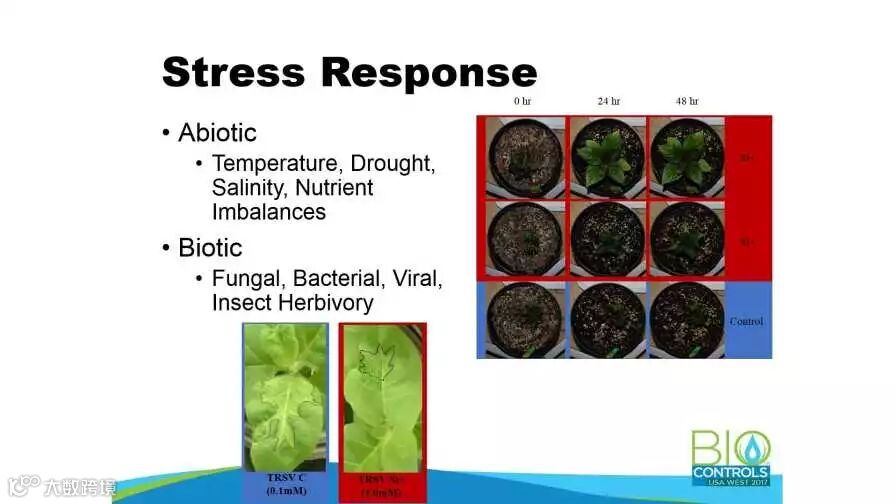
Si has reduced adverse growth effects experienced by abiotic stress such as temperature, drought, salinity and nutrient imbalance. In Figure 1 is an example of drought stress where New Guinea Impatiens treated with Si (in red) recovered from a severe dry down sooner than control plants as seen below in blue. In addition, Si is known to protect plants from a number of pathogens, reducing both the onset and spread of these organisms.
Si减少了非生物胁迫如温度,干旱,盐度和营养失衡等不利影响。 图1是一个干旱胁迫的例子,其中用Si(红色)处理的新几内亚凤仙花从严重干旱中恢复得比对照植物快,如下面蓝色所示。 此外,已知Si可以保护植物免受多种病原体的侵害,从而减少这些生物体的发病和传播。
Figure 1 also shows an example of tobacco plants grown with low or moderate amounts of Si and infected with Tobacco ringspot virus. Si-treated plants had a reduction in the spread of viral symptoms as well as a delay in the onset of symptoms, compared to the controls.
Si has the ability to protect plants through both physical and chemical means. Physically, Si helps strengthen cell walls and is present in protective layers, such as scales on the surface of epidermal tissue. This thickening protects the roots and allows for plants to better deal with adverse environmental conditions.
Chemical responses enhanced by Si include both the induction of the reactive oxygen species pathway and production of phenolic compounds. ROS is responsible for the hyper-sensitive response that leads to necrosis within plants and is part of the innate defense pathway, giving rise to protection against a wide range of infections. The Phenolic pathway protects plants against both environmental stress and pathogens through the production of defense compounds.
图1还显示了用低或中等量的Si生长并感染了烟草环斑病毒的烟草植物的实例。与对照相比,Si处理的植物具有病毒症状蔓延的减少以及症状发作的延迟。
Si有能力通过物理和化学手段保护植物。在物理上,Si有助于加强细胞壁并存在于保护层中,例如表皮组织表面上的鳞屑。这种增稠保护了根部,并使植物更好地处理不利的环境条件。
由Si增强的化学反应包括活性氧物种途径的诱导和酚类化合物的产生。 ROS负责导致植物内坏死的超敏感应答,并且是先天防御途径的一部分,导致对多种感染的保护。酚途径通过生产防御化合物来保护植物抵抗环境压力和病原体。
Silicon as Insect Control …
Other researchers also have some interesting examples of how Si works as a biocontrol agent, reducing both insect herbivory and pathogen infection. Many studies are beginning to emerge showing how Si reduces insect pressure. Studies conducted by Goussain and colleagues (Neotropical Entomology, 2005) in wheat have shown that treating plants with Si reduces the ability of aphids to produce eggs resulting in a lower number of offspring. They have observed that these insects also have a reduction in honeydew droplets and believe that Si has an effect on the sap ingestion as opposed to a simple physical barrier to stylet penetration. On cucumber, Correa and colleagues (Neotropical Entomology, 2005) found that foliar Si treatment has also been shown to reduce the incidence of whiteflies. And there are a number of studies that have been performed by Certis USA with Sil-Matrix, a foliar applied potassium silicate, showing reductions in various insect pests, including spider mites on strawberries, apple European red mites, and lettuce green peach aphids.
硅作为昆虫控制...
其他研究人员也有一些有趣的例子说明Si如何作为一种生物防治剂,减少昆虫食草和病原体感染。许多研究正在开始显示Si如何减少昆虫压力。 Goussain及其同事(Neotropical Entomology,2005)在小麦中进行的研究表明,用Si处理植物可降低蚜虫产卵的能力,从而减少后代数量。他们观察到,这些昆虫的蜜滴也有所减少,并认为硅对汁液的摄入有影响,而不是对探针渗透的简单物理屏障。在黄瓜上,Correa及其同事(Neotropical Entomology,2005)发现,叶面喷施Si也能减少粉虱的发生。还有一些研究已经由Certis美国公司用Sil-Matrix(一种叶面喷施的硅酸钾)进行,显示各种害虫的减少,包括草莓上的红蜘蛛,苹果欧洲红螨和莴苣绿桃蚜虫。
… and as Disease Control
Si not only reduces insect pressure, but it also has an even more pronounced effect on fungal pathogens. A majority of the research focuses on Si reduction in fungal pathogens, as it is easily observed. It is Important to note that Si does NOT protect against all stress at all times. The response can be highly variable and depends on both environmental conditions and plant species. This is why Si has shown protection and no effect against some of these pathogens, including powdery mildew, coffee leaf rust, and Asian soybean rust.
Foliar-applied Si may reduce the incidence of fungal pathogens through both a physical and chemical response. When foliar Si is applied, as it dries, it polymerizes to form an amorphous Si layer on top of the cuticle. As the Si is sprayed, some of the material may also run-off leaves into the media and be taken up into the plant via the roots and transported to shoots, where it can play a role in internal plant defense pathways. As fungal spores move through the air and land on the surface of the leaf, its structures are thought to more easily penetrate a non-treated vs. Si treated plant. Since it takes these structures longer to penetrate, this helps reduce disease pressure on the plant. In addition, once the fungus is able to penetrate, in untreated plants, it can quickly grow and spread in the nutrient-rich environment, while the Si-treated plant has the ability to quickly produce defense compounds, such as phenolics, further reducing the growth and spread of the fungus.
...和疾病控制
Si不仅降低了昆虫的压力,而且对真菌病原体的影响更为显着。大部分研究集中于真菌病原体中硅的减少,因为它很容易观察到。重要的是要注意,Si不能始终保护所有的压力。响应可能变化很大,取决于环境条件和植物物种。这就是为什么Si对这些病原体(包括白粉病,咖啡叶锈病和亚洲大豆锈病)表现出保护性和无效果的原因。
叶面施用的硅可以通过物理和化学反应降低真菌病原体的发病率。当施用叶面Si时,当其干燥时,它会聚合形成角质层顶部的非晶Si层。随着硅被喷洒,一些物质也可能流失到叶片中,并通过根吸收到植物中并运输到枝条,在那里它可以在植物内部防御通路中发挥作用。随着真菌孢子穿过空气并落在叶片表面,其结构被认为更容易穿透未处理的与Si处理的植物。由于这些结构需要更长的时间才能穿透,这有助于减轻植物的疾病压力。此外,一旦真菌能够穿透未经处理的植物,它可以快速生长并在富含营养的环境中传播,而硅处理的植物能够快速生成防御化合物,如酚类,进一步减少真菌的生长和传播。
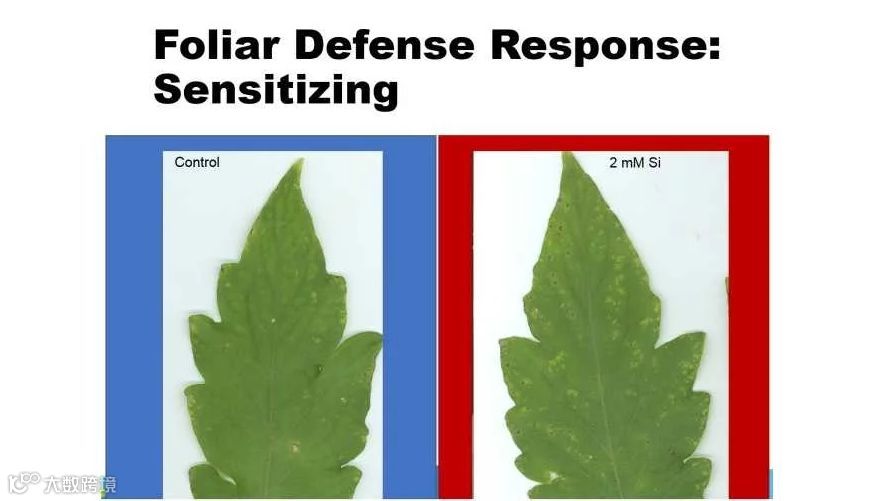
This quicker response time is known as priming. Figure 2 shows an example of priming in tomatoes infected with Xanthomonas gardnerii.
这种更快的响应时间被称为启动。 图2显示了加利福尼亚黄单胞菌感染西红柿的启动实例。
Both plants were inoculated with the same concentration of the bacteria and the Si-treated plants on the right responded more quickly to the bacteria, showing enhanced necrosis and chlorosis, compared to the control plant. By responding more rapidly to infections, plants can reduce the spread of the disease both within its tissue as well as to neighboring plants.
两种植物都接种相同浓度的细菌,右侧的Si处理植物对细菌的反应更快,与对照植物相比,表现出增强的坏死和萎黄病。 通过更迅速地对感染作出反应,植物可以减少其组织内以及邻近植物的疾病传播。
Product Forms to Consider
By reducing disease and stress, Si amendment leads to healthier plants with better yields, compared to their Si-deprived counterparts. So what products are available to suit your current needs?
It may be surprising to know that there are a number of products on the market that provide Si to plants through both soil-amendment and foliar applications. Solid products include recycled steel slag, mined wollastonite and ignimbrite, recycled glass and plant-based material such as rice hulls and biochar produced from gasified rice hulls. These solid products tend to be incorporated into media and allow for a slower release of silicic acid to the plants. The liquid products are used for foliar application methods or as drenches or additives to hydroponic or aeroponic type systems and include potassium, calcium and sodium silicates. Both the liquid and solid products are labeled for a wide variety of uses, including alternative liming agents, fertilizers, biostimulants, and biocontrol agents. Since we now know that Si has many roles within plants, it is not surprising that it fits into all these categories. Products are labeled based on listed claims. This means that Si products labeled as a biocontrol agent have been tested to reduce insect and/or other pathogens. Liquid applied products tend to have a more rapid response compared to solid amendments, which tend to vary in response time depending on material composition and surface area.
需要考虑的产品形式
通过减少疾病和压力,Si修正导致更健康的植物具有更好的产量,相比之下他们的Si剥夺对手。那么有哪些产品可以满足您当前的需求?
知道市场上有许多产品通过土壤改良和叶面施用为植物提供硅,这可能令人惊讶。固体产品包括回收的钢渣,开采的硅灰石和ignimbrite,回收的玻璃和基于植物的材料,如稻壳和由气化稻壳生产的生物炭。这些固体产品往往被纳入媒体,并允许向植物缓慢释放硅酸。液体产品用于叶面施用方法或作为水培或气调类型系统的淋溶或添加剂,并包括硅酸钾,硅酸钙和硅酸钠。液体和固体产品都标有各种用途,包括替代浸灰剂,肥料,生物刺激剂和生物控制剂。由于我们现在知道Si在工厂中有很多角色,因此它适合所有这些类别并不奇怪。产品根据列出的权利要求进行标记。这意味着被标记为生物防治剂的Si产品已经过测试以减少昆虫和/或其他病原体。与固体修正相比,液体应用产品倾向于具有更快的响应,固体修正通常根据材料组成和表面积而在响应时间内变化。
Silicon Handling and Application Tips
With the wide variability in these products, as with any material, it is extremely important to read and follow all labeled instructions.
While precautions are needed for many of these products, they tend to pose less risk than alternative chemical reagents. Silicon products labeled for biocontrol have a risk for eye, skin and respiratory irritation and proper PPE is required for application, including gloves, goggles and dust mask (for solid products that may be inhaled). The concentrated potassium silicates have a high pH and as with many pesticides, diluting the concentrated material poses the highest risk of exposure.
硅处理和应用技巧
由于这些产品具有很大的可变性,与任何材料一样,阅读并遵循所有标签说明非常重要。
虽然许多这些产品需要预防措施,但与替代化学试剂相比,它们的风险更低。 标有生物防治标签的硅制品有眼睛,皮肤和呼吸道刺激的风险,并且需要使用适当的个人防护装备,包括手套,护目镜和防尘面罩(用于可能吸入的固体产品)。 浓缩的硅酸钾具有很高的pH值,并且与许多农药一样,稀释浓缩的材料造成最高的暴露风险。
When mixing the liquid silicates into solution, there may be some adverse reactions. To begin, these concentrated silicon solutions have the ability to gel at pH 6.0. If your target pH range is lower than 6 then it is suggested to move through pH 6 as quickly as possible to avoid this reaction. Some water sources are more sensitive to gelling and those containing higher Ca or Mg may see this effect occur more rapidly. Once the material gels, it is impossible to re-suspend back into solution. Another possible problem is with the addition of the soluble silicate to a premixed nutrient solution where high pH may precipitate out nutrients within the solution. Diluting the material and lowering the pH prior to mixing may help avoid this problem. As with all products, make sure to talk with your sales rep. to determine how to avoid these potential issues.
Another effect you might see when beginning to use these products are unintended responses in the plants. Foliar-applied, liquid silicates are recommended to be sprayed at concentrations of 600-1500 ppm. My research works with Si applied as media drenches at concentrations below 50 ppm, since silicic acid begins to polymerize around 58 ppm (or 2.7 mM), reducing the amount of available Si for uptake. This graph is representative of the amount of available Si for plant uptake as Si concentrations increase. We see that as concentrations rise above 58 ppm, less Si is available to the plant, so the priming effect and other internal Si defenses we discussed earlier are inhibited, as you are reducing the concentration of Si within the plant. In addition, these high concentrations of polymerized Si in the growth media can also begin to chelate out other micronutrients such as copper, manganese, molybdenum and zinc.
当将液态硅酸盐混入溶液时,可能会有一些不良反应。首先,这些浓缩硅溶液具有在pH 6.0下凝胶化的能力。如果您的目标pH范围低于6,则建议尽可能快地通过pH 6以避免此反应。一些水源对胶凝更敏感,而那些含有较高Ca或Mg的水源可能会更快地发生这种效应。一旦材料凝胶化,就不可能重新进入解决方案。另一个可能的问题是将可溶性硅酸盐添加到预混合营养液中,其中高pH可能会使溶液中的营养物质沉淀。在混合之前稀释材料并降低pH值可能有助于避免这个问题。与所有产品一样,请务必与您的销售代表交谈。以确定如何避免这些潜在问题。
您开始使用这些产品时可能会看到的另一个影响是工厂中的意外反应。建议喷洒叶面喷施的液态硅酸盐,浓度为600-1500 ppm。由于硅酸开始聚合约58 ppm(或2.7 mM),因此减少了可吸收硅的量,因此我的研究适用于硅浓度低于50 ppm的介质喷雾剂。该图表示随着Si浓度增加,植物吸收的可用Si量。我们发现,当浓度超过58 ppm时,工厂可用的硅就会减少,因此我们之前讨论的启动效应和其他内部硅防护措施会受到抑制,因为您正在降低工厂内硅的浓度。此外,生长培养基中的这些高浓度聚合硅也可以开始螯合其他微量营养素,如铜,锰,钼和锌。
This chelation of micronutrients can lead to deficiency symptoms in sensitive plants or cropping systems. In a study by Kamenidou and Cavins (HortScience, 2008), they reported that Si caused foliar malformations in sunflower and warned of its toxicity to certain plants. The researchers were adding 100-200 mM Si to the media which likely caused a zinc deficiency in the sunflowers leading to their findings. Reports of foliar burn on plants have also been reported and this could be due to salt effects on the leaves. As with any new amendment or biologic, plants should be tested to determine application doses. For sensitive plants, reducing the concentration of the biocontrol or increasing the addition of micronutrients could help counteract these effects.
微量营养素的这种螯合作用可导致敏感植物或种植系统中的缺乏症状。在Kamenidou和Cavins的一项研究中(HortScience,2008),他们报告说Si导致了向日葵叶片畸形,并警告其对某些植物的毒性。研究人员将100-200毫米硅加入到媒体中,这可能导致向日葵缺锌导致他们的发现。关于植物叶面燃烧的报道也有报道,这可能是由于盐对叶片的影响。与任何新的修正或生物制剂一样,应测试植物以确定施用剂量。对于敏感植物,降低生物防治浓度或增加微量营养素的添加可能有助于抵消这些影响。
In conclusion, Si is an important plant nutrient for all plants. Si has a specific role in stress responses and plants deficient in Si will not respond as well to stress as Si-fed plants. Both foliar and soil-applied Si show benefits to stress in a wide range of plant species and it’s important to understand your cropping system and how to best incorporate the products to get the most benefits.
总之,硅是所有植物的重要植物营养素。 Si在胁迫反应中具有特定的作用,缺乏Si的植物对Si胁迫植物的压力反应不佳。叶面和施用硅的土壤都能在各种各样的植物种类中表现出应力,因此了解您的耕作系统以及如何最好地整合产品以获得最大效益非常重要。

本篇文章来源于Growing Produce