

FDA官网法规解释栏,发表《ECA:亚硝胺杂质:FDA拒绝延长风险评估提交时限》,文中指出:已批准药品的风险评估初次提交期限,即指南发布之后6个月(2021年3月1日),在企业压力下延长了4周(2021年3月31日)。
在2021年5月4日召开了一次听证会(2021年7月19日发布备忘),参与方有FDA、行业协会代表,讨论重点在于申请进一步延长该期限,企业代表提到在截止日期前完成风险评估所需的时间增加,要求将提交期限延长至2021年9月1日,但企业代表的观点未能说服FDA,延长期限的申请被驳回。
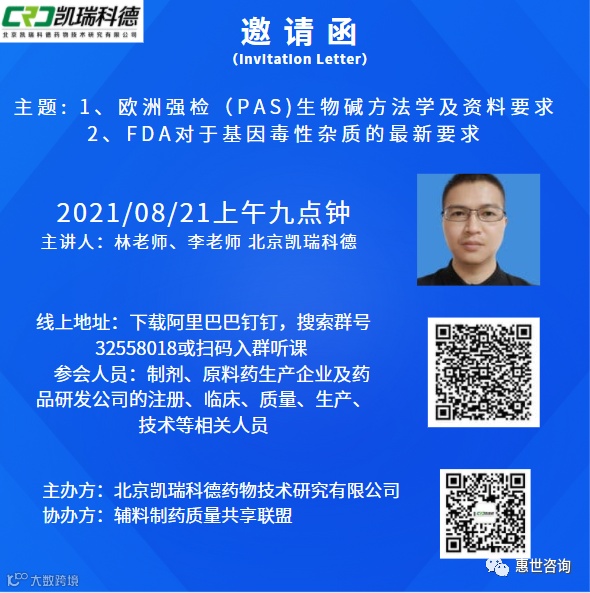
鉴于这次法规解释公告,我们约请了北京凯瑞科德的注册专家林老师和李老师于2012.8.21日(本周六)上午九点钟在辅料与制药联盟群与大家一起探讨FDA对基因毒性杂质的最新要求及欧洲强检(PAS)生物碱方法学及资料要求。
欢迎大家到时收听收看。
Nitrosamine Impurities: FDA Rejects the Extension of Deadline for Submission of Risk Assessments亚硝胺杂质:FDA拒绝延长风险评估上报时限
FDA's Guidance for Industry "Control of Nitrosamine Impurities in Human Drugs" from September 2020 governs the management of nitrosamine impurities in medicinal products for human use and was published in its updated version in February 2021.
FDA行业指南“人药中亚硝胺杂质的控制”自2020年9月开始用于管理人药中亚硝胺杂质,并于2021年2月发布了更新版本。
The original submission deadline for risk assessments of authorised medicines already on the market, i.e. 6 months after publication of the Guidance (1 March 2021) was initially extended by 4 weeks (31 March 2021) following pressure from the industry. In a hearing held on 4 May 2021 (memorandum issued on 19 July 2021) involving FDA and industry association representatives (Association for Accessible Medicines, MAA; Consumer Healthcare Products Association, CHPA; and Pharmaceutical Research and Manufacturers of America,PhRMA), a further extension of this deadline was the focus of the discussion. The industry representatives cited the increased time required to complete risk assessments by the deadline, pointing out that this would, among other things, bind necessary resources for drug development on Covid 19 therapies. The request was for an extension of the submission deadline to 1 September 2021.Specifically, this request was supported by the following arguments:
已批准药品的风险评估初次提交期限,即指南发布之后6个月(2021年3月1日),在企业压力下延长了4周(2021年3月31日)。在2021年5月4日召开了一次听证会(2021年7月19日发布备忘),参与方有FDA、行业协会代表(无障碍药品协会MAA、消费者保健品协会CHPA,以及美国药物研究与生产商,PhRMA),讨论重点在于进一步延长该期限。企业代表提到在截止日期前完成风险评估所需的时间增加,指出这样会抑制COVID-19治疗用药开发资源。要求将提交期限延长至2021年9月1日。具体来说,该申请有以下几方面支持理由:
Different regulatory requirements 法规要求不同
The requirements for testing medicinal products on nitrosamines and submitting risk analyses are not harmonized at the global level. For example, this requirement exists for OTC products in oral dosage form for the USA, but not for Europe or Canada.
全球对于药品中亚硝胺的检测要求与风险分析提交要求不统一。例如,USA要求包括了口服制剂OTC药品,但欧洲和加拿大不包括。
The production of low-cost generics for the U.S. market, which account for 90% of prescription drugs, is slowed by the lack of time and human resources to do so and, in the worst case, can result in supply bottlenecks or shortages.
Delays in procuring information from API, raw material, excipient manufacturers and suppliers of production auxiliaries (solvents, catalysts, etc.) make it virtually impossible to meet this deadline. The same applies to the time-consuming and sometimes complex testing of a large number of substances.
美国市场上低成本仿制药(占处方药的90%)将因为在进行风险评估的时间和人力匮乏而降低生产速度,最差情况则可能导致供应瓶颈或短缺。
从 API、原料、辅料生产商和生产助剂(溶剂、催化剂等)供应商处获取信息的延迟使得在截止日期前完成几乎不可能。要对大量物质进行检测而耗费时间,有时检测很复杂也导致同样结果。
Scientific divergences 科学分歧
The analytical methods published by the FDA and the USP for the determination of nitrosamine impurities are not always applicable, since in many cases interactions of the analyte with the matrix may falsify the result. Therefore, new suitable methods have to be developed and validated, which requires additional effort.
FDA和USP所发布的亚硝胺杂质检测分析方法并不总是适用,因为很多情况下,被检测对象与基质可能会发生相互作用,产生错误结果。因此,要开发和验证合适的新方法,这需要付出更多工作努力。
Studies to determine and apply purge factors as part of a control strategy are in line with the state of the art and would save time. However, no opinion or regulation exists on this issue from the FDA.
The 96 ng/day limit is established for all drugs; this is abnormally strict for drugs for short-term or intermediate duration of use. The less-than-lifetime approach of the ICH M7(R1) guideline would be appropriate for this purpose. Industry representatives find it concerning that the FDA deviates from generally accepted, scientifically supported principles of quality risk management in various individual policy documents.
确定和应用清除因子作为控制策略的一部分的研究符合现有技术并且可以节省时间。但是,FDA在这方面没有观点或规定。现在为所有药品建立的限度都是96ng/天,这对于中短期使用的药品来说是异常严格的。ICH M7(R1)指南的短于生命周期方法其实更为适合。企业代表认为FDA偏离了普遍接受的有科学支持的质量风险管理科学原则,这些原则在多个政策文件中均有表述。
In its guidance, the FDA provides no scientific rationale for the AI values set forth in that document. It also lacks a statement or expectation of studies to determine individual, scientifically supported AI values for various nitrosamine species.
There is no inclusion of product-specific features related to AI values as described in the ICH S9 Guideline " Non-clinical Evaluation for Anticancer Pharmaceuticals." The FDA guidance contains no reference to this, nor does a corresponding policy document exist on this topic.
在其指南中,FDA并没有提供在该份文件中设定该AI值的科学理由,同时也没有声明或期望进行研究,为不同亚硝胺种类确定有科学支持的AI值。
没有包含与 ICH S9 指南“抗癌药物的非临床评估”中描述的 AI 值相关的产品特定特征。FDA指南没有引用它,亦不存在对此专题的相应政策性文件。
The arguments of the industry representatives could not convince the FDA. The extension of the deadline was rejected on the following grounds:
In the past, concessions were made to manufacturers who had detected nitrosamines in their products above the AI limits. This flexibility on the part of the FDA allowed for continued marketing of batches to reduce the risk of supply shortages. A case-by-case evaluation for each drug product for the purpose of a risk-benefit trade-off by the agency will continue to be conducted in close collaboration with manufacturers.
企业代表的观点未能说服FDA。延长期限的申请被驳回,原因如下:
过去,FDA对检测出产品中亚硝胺超过 AI 限值的生产商做出了让步,当时采取这种灵活性是为了允许继续销售批次以降低供应短缺的风险。FDA将继续与制造商密切合作,对每种药品进行逐案评估,以权衡风险收益。