
The New Generation
of Steel Turning Products
2
0
2 6
GESAC
New Product
The New generation of steel turning products
……
When addressing the turning challenges brought by changes in steel materials, in addition to selecting the right tool materials and coatings, chip control is also a key factor determining processing efficiency and safety. Poor chip formation can scratch workpieces, accelerate tool wear, and even cause unplanned downtime due to chip winding, directly eroding production efficiency.
In the previous issue, we discussed the impact of material changes on processing. In this issue, we will focus on four practical methods to improve chip breaking in steel turning,helping to achieve efficient, reliable and clean processing.
……
1
Optimize the tool path to maximize
the chip-breaking performance of
cutting tools
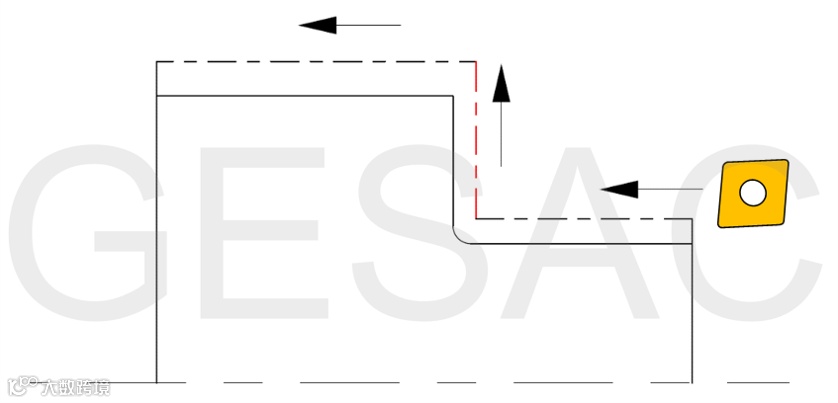
The tool path determines the actual entering angle during turning and has a significant impact on chip breaking. Take the common face turning as an example: the traditional "external pulling" method tends to produce thin and wide chips, with a high risk of chip winding, and the chips are fluffy and difficult to handle.
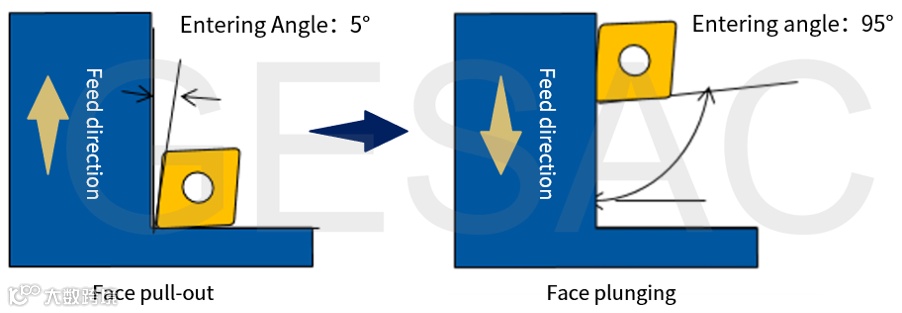
The root cause is that "external pulling" results in an excessively small actual entering angle (only 5°), leading to abnormal chip formation. Moreover, the geometry cannot perform to its full potential, which directly impairs chip breaking efficiency.
Switching to the "plunging" method for face turning can achieve a standard main entering angle close to 95°, avoiding the formation of wide and thin chips and allowing the geometry design to function effectively.
Therefore, when setting the tool path for turning, attention should be paid to the actual entering angle of the tool. Excessively small entering angle should be avoided, and dynamic adjustments should be made based on the actual chip performance to achieve an acceptable effect.
Match the nose radius
with the cutting depth to control
chip formation from the source
2

The nose radius is a crucial factor affecting chip formation and optimizing chip-breaking performance. It is a key parameter that works in conjunction with the cutting depth: a smaller nose radius is more likely to form thick and narrow chips with a small curling radius and low breaking difficulty, resulting in significantly improved chip-breaking performance. When the nose radius is smaller than the cutting depth, the chip-breaking improvement effect is more prominent, and the chip formation is more regular and controllable. In actual processing, the two can be flexibly matched according to the specific machining allowance and surface requirements, which is an effective means to improve chip breaking.
3
Reasonably distribute machining
allowances to create favorable
chip-breaking conditions for finish turning
A workpiece usually requires multiple rough and finish turning processes. How to distribute the machining allowances for each process is also an important factor affecting chip breaking.
With the upgrading of forging processes and the push for cost reduction, the blank allowance of workpieces has been continuously reduced, leaving increasingly limited allowances for finish turning. The core goal of finish turning is to ensure surface quality, which usually adopts processing parameters with small feed rates and small cutting depths. Under such working conditions, chip formation is more difficult to control, and the risk of chip winding increases significantly. Therefore, when formulating the process allowance distribution plan, chip-breaking performance must be taken as a core consideration. Dynamic adjustments should be made to the allowances and cutting parameters of each process in combination with the workpiece surface quality requirements, tool service life and chip-breaking stability, so as to achieve a comprehensive optimization of processing quality, tool life and chip-breaking effect.
Core tool: Select a geometry
with a wide adaptation range
4
The aforementioned methods create favorable conditions for chip breaking, and the geometry of the tool itself is the core to achieve stable chip breaking. Different geometry have their effective chip-breaking ranges; the wider the adaptation range, the stronger the ability to cope with complex working conditions.
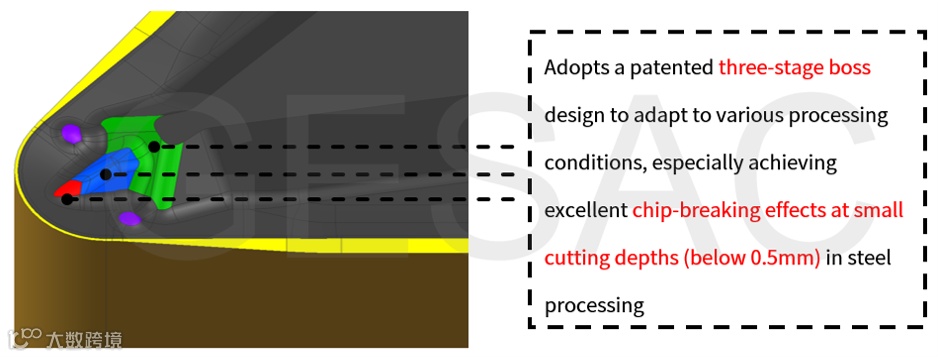
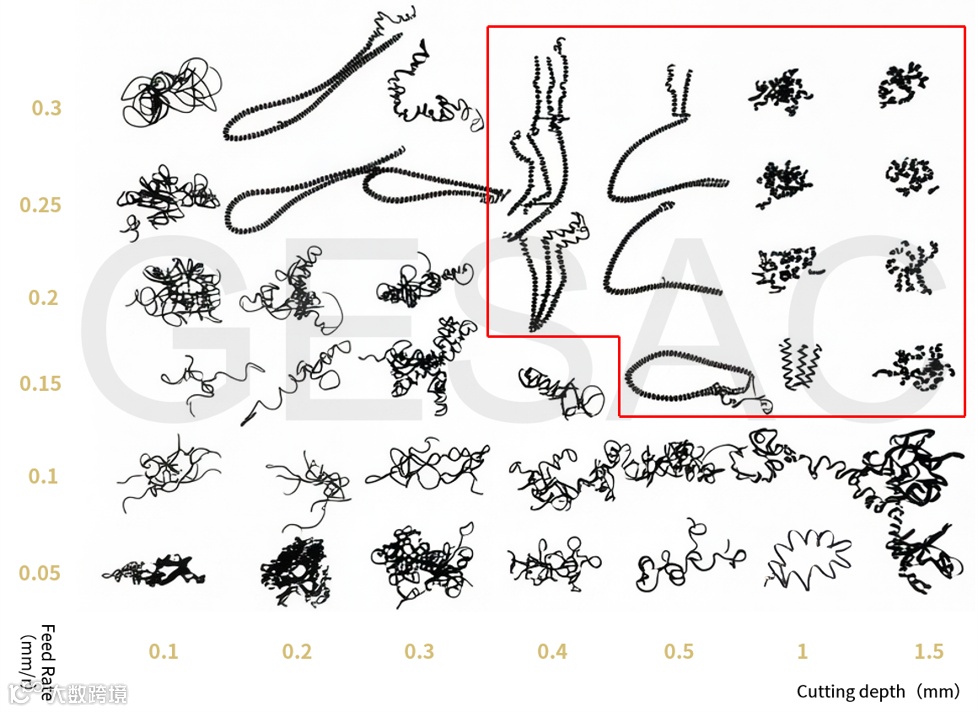
PF for finish turning in GESAC's new generation steel turning products features an original three-stage boss structure, which precisely enhances the chip-breaking performance under small cutting depth conditions, while greatly expanding the chip-breaking range to cover a wider range of cutting parameters. It is suitable for finish turning of steel in multiple scenarios, with dual upgrades in chip-breaking stability and versatility.
Taking the processing of 45# steel as an example, with WNMG080408 inserts and a cutting speed of 250m/min, its chip-breaking performance in the small cutting depth range is significantly superior to that of similar competitors, achieving a wider and more stable excellent chip-breaking range and ensuring efficient and smooth finish turning of steel.
(Chip-breaking effect comparison: Red marks indicate the excellent chip-breaking range)
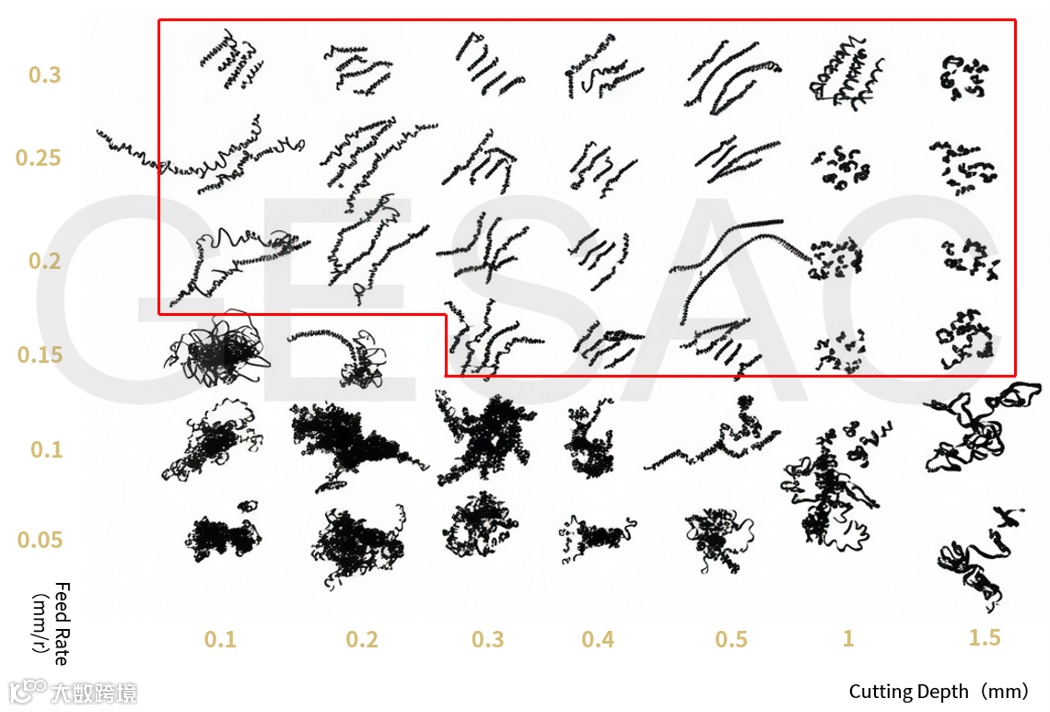
GESAC PF
Competitor Insert
Addressing the chip-breaking challenges in steel turning is a systematic project involving processing strategies, parameter matching and tool selection. By optimizing the tool path, matching parameters, reasonably distributing allowances, and using tools specially designed for a wide chip-breaking range such as GESAC's PF geometry, the problem of chip winding can be solved systematically, making the processing process safer and more efficient.
G
e
s
a
c
Stable chip breaking is the cornerstone of efficient turning, but it is by no means everything. In actual processing, are you often troubled by other problems? For example:
How to deal with abnormal wear/chipping during steel turning?
How to select the right inserts for steel turning?
Next Issue Preview We will delve into common problems and processing considerations in steel turning, analyze typical challenges in the process, and share practical strategies based on GESAC's new generation steel turning solutions. Stay tuned!
Gesac
Click the "Read More" link below to get advance information about GESAC's new steel turning products and have the opportunity to obtain new product testing opportunities!👇
end