



1. 悬崖寻路问题介绍
悬崖寻路问题是指在一个4 x 12的网格中,智能体以网格的左下角位置为起点,以网格的下角位置为终点,目标是移动智能体到达终点位置,智能体每次可以在上、下、左、右这4个方向中移动一步,每移动一步会得到-1单位的奖励。

智能体在移动中有以下限制:
(1) 智能体不能移出网格,如果智能体想执行某个动作移出网格,那么这一步智能体不会移动,但是这个操作依然会得到-1单位的奖励
(2) 如果智能体“掉入悬崖” ,会立即回到起点位置,并得到-100单位的奖励
(3) 当智能体移动到终点时,该回合结束,该回合总奖励为各步奖励之和
请设计算法求解悬崖寻路问题的最佳策略。
2. 时序差分强化学习算法
2.1 Q-learning训练算法
算法1 Q学习:一种异策略的时序差分学习算法
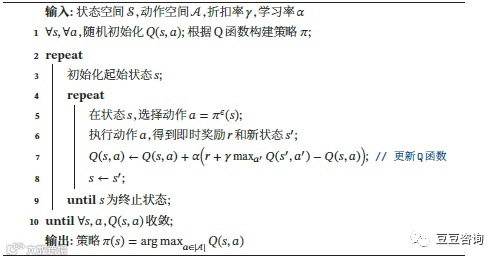
解释:
其中:状态是4*12格子的位置决定的;动作是上下左右四个动作决定的,分别用0、1、2、3表示;Q(s,a)表是Q = np.zeros([4, 12, 4])初始化的,记录着分数状态和状态下的得分情况。
位置表示状态,在程序实现过程中,用格子三种状态:'ground'、'terminal'和'trap'分别表示位置所处的状态;
异策略(off-policy):在执行【策略评估】和【策略提升】的时候,使用的不是相同的策略。off表示在策略评估时,我们使用的策略(我们叫做behavior policy)【偏离】了我们的目标策略(target policy)。
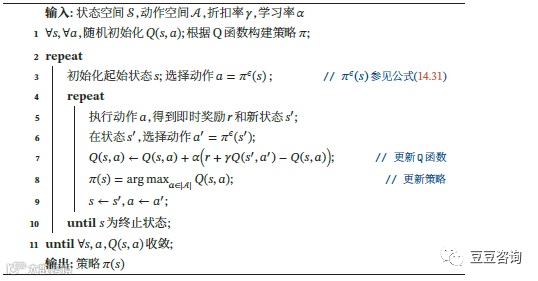
同策略(on-policy):在执行【策略评估】和【策略提升】的时候,使用的是相同的策略。
Sarsa是on-policy的更新方式,它的行动策略和评估策略都是ε-greedy策略,并且是先做出动作后更新策略。
Q-Learning是off-policy的更新方式,假设下一步选取最大奖赏的动作,从而更新价值函数。然后再通过ε-greedy策略选择下一步动作。(Q-Learning的思想根据值迭代得到。由于无法遍历样本较大情况下的状态空间和动作空间,因此难以得到各状态期望价值的精准估计,所以只能利用有限的样本数据,通过类似梯度下降的方式一步步去估计Q值,而不是直接赋予,最终使得Q收敛至最优)
算法2 Sarsa:一种同策略的时序差分学习算法
2.2 Q-learning原理
其学习的原理:基于时序差分学习方法,(书籍:神经网络与深度学习,作者:邱锡鹏)具体如下:
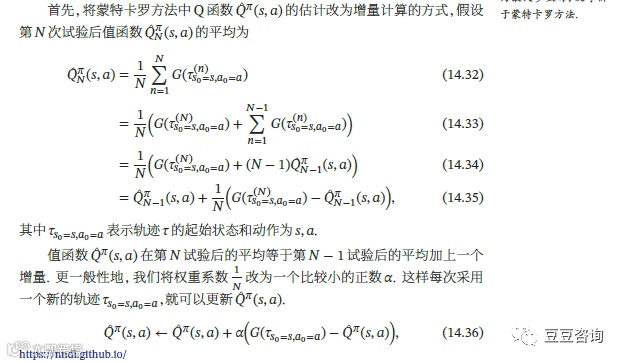
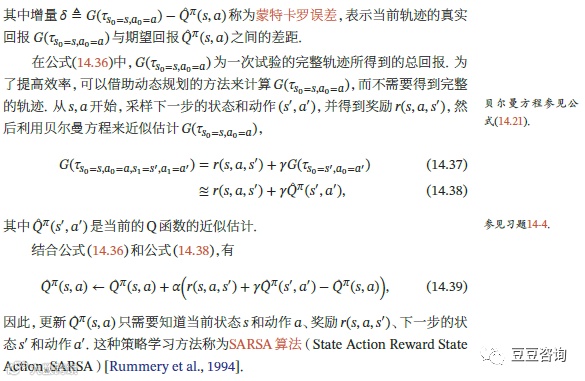
3. Q学习训练代码
import numpy as np
import random
# 获取一个格子的状态
def get_state(row, col):
if row!=3:
return 'ground'
if row == 3 and col == 11:
return 'terminal'
if row == 3 and col == 0:
return 'ground'
return 'trap'
# 在某一状态下执行动作,获得对应奖励
def move(row, col, action):
# 状态检查-进入陷阱或结束,则不能执行任何动作,获得0奖励
if get_state(row, col) in ["trap", "terminal"]:
return row, col, 0
# 执行上下左右动作后,对应的位置变化
if action == 0:
row -= 1
if action == 1:
row += 1
if action == 2:
col -= 1
if action == 3:
col += 1
# 最小不能小于零,最大不能大于3
row = max(0, row)
row = min(3, row)
col = max(0, col)
col = min(11, col)
# 掉进trap奖励-100,其余每走一步奖励-1,让agent尽快完成任务
reward = -1
if get_state(row, col) == 'trap':
reward = -100
return row, col, reward
# 初始化Q表格,每个格子采取每个动作的分数,刚开始都是未知的故为零
Q = np.zeros([4, 12, 4])
# 根据当前所处的格子,选取一个动作
def get_action(row, col):
# 以一定的概率探索
if random.random() < 0.1:
return np.random.choice(range(4))
# 返回当前Q表格中分数最高的动作
return Q[row, col].argmax()
# 计算当前格子的更新量(当前格子采取动作后获得的奖励,来到下一个格子及要进行的动作)
def update(row, col, action, reward, next_row, next_col):
"""计算量更新同srasa有差异
Saras: 估计当前贪婪策略的价值函数Q[row, col, action](在线策略)
Q-learning: 直接估计最优Q[row, col](离线策略)
在线策略:行为策略和目标策略是同一个策略
离线策略:---------------不是同一个策略
"""
target = reward + Q[next_row, next_col].max() * 0.95
value = Q[row, col, action]
# 时序查分计算td_error
td_error = 0.1 * (target - value)
# 返回误差值
return td_error
def train():
for epoch in range(4000):
# 每次迭代开始,随机一个起点,尽可能多地与环境交互,同时绑定一个动作
row = np.random.choice(range(4))
col = 0
action = get_action(row, col)#随机选择一个动作,或者选择分数最高的动作
# 计算本轮奖励的总和,越来越大
rewards_sum = 0
# 一直取探索,直到游戏结束或者进入trap(要判断)
while get_state(row, col) not in ["terminal", "trap"]:#根据位置,获取状态
# 当前状态下移动一次,获得新的状态
next_row, next_col, reward = move(row, col, action)#根据当前的位置row,col和动作action,获得了一个新的位置next_row、next_col和得分reward
rewards_sum += reward#得分加上reward
next_action = get_action(next_row, next_col)#在新位置next_row, next_col,随机选择动作或者选择得分最大的动作
# 获取此次移动的更新量
td_error = update(row, col, action, reward, next_row, next_col)
# 更新Q表格
Q[row, col, action] += td_error
# 状态更新
row, col, action = next_row, next_col, next_action
if epoch % 500 == 0:
print(f"epoch:{epoch}, rewards_sum:{rewards_sum}")
# 保存Q表格数据到文件
def save():
npy_file = './q_table.npy'
np.save(npy_file, Q)
print(npy_file + ' saved.')
# 从文件中读取Q值到Q表格中
def restore(npy_file='./q_table.npy'):
Q = np.load(npy_file)
print(npy_file + ' loaded.')
train()
save()
#print(Q)
#test()
训练结果如下:
epoch:0, rewards_sum:-111
epoch:500, rewards_sum:-112
epoch:1000, rewards_sum:-13
epoch:1500, rewards_sum:-13
epoch:2000, rewards_sum:-16
epoch:2500, rewards_sum:-13
epoch:3000, rewards_sum:-14
epoch:3500, rewards_sum:-18
epoch:4000, rewards_sum:-104
epoch:4500, rewards_sum:-14
epoch:5000, rewards_sum:-14
epoch:5500, rewards_sum:-14
epoch:6000, rewards_sum:-13
epoch:6500, rewards_sum:-14
epoch:7000, rewards_sum:-14
epoch:7500, rewards_sum:-113
epoch:8000, rewards_sum:-109
epoch:8500, rewards_sum:-110
epoch:9000, rewards_sum:-108
epoch:9500, rewards_sum:-17
[[[-10.7336123  -10.24650042 -10.73344798 -10.24650042]
  [-10.24602278  -9.73315833 -10.73177298  -9.73315833]
  [ -9.73114076  -9.19279825 -10.24330152  -9.19279825]
  [ -9.18860185  -8.62399815  -9.71934594  -8.62399815]
  [ -8.62062915  -8.02526122  -9.16607     -8.02526122]
  [ -8.01177885  -7.39501181  -8.61667075  -7.39501181]
  [ -7.38284039  -6.73159137  -7.8800845   -6.73159137]
  [ -6.65523622  -6.03325408  -7.35559032  -6.03325408]
  [ -5.96181829  -5.29816219  -6.55092082  -5.29816219]
  [ -5.20557519  -4.52438125  -5.71929578  -4.52438125]
  [ -4.2665695   -3.709875    -4.76517345  -3.709875  ]
  [ -3.29211171  -2.8525      -3.6500356   -3.30771276]]

 [[-10.73311209  -9.73315833 -10.2448655   -9.73315833]
  [-10.22383066  -9.19279825 -10.23292195  -9.19279825]
  [ -9.71398046  -8.62399815  -9.73136975  -8.62399815]
  [ -9.15720592  -8.02526122  -9.15786455  -8.02526122]
  [ -8.54598217  -7.39501181  -8.50477269  -7.39501181]
  [ -7.97384834  -6.73159137  -7.98814648  -6.73159137]
  [ -7.37252716  -6.03325408  -7.35337743  -6.03325408]
  [ -6.6883798   -5.29816219  -6.67601993  -5.29816219]
  [ -5.96942013  -4.52438125  -5.9456582   -4.52438125]
  [ -5.16871589  -3.709875    -5.08949395  -3.709875  ]
  [ -4.43322669  -2.8525      -4.20632995  -2.8525    ]
  [ -3.60748154  -1.95        -3.49776269  -2.77677297]]

 [[-10.24650041 -10.24650037  -9.73315828  -9.19279825]
  [ -9.73315833 -99.99999834  -9.73315826  -8.62399815]
  [ -9.19279821 -99.99999958  -9.1927982   -8.02526122]
  [ -8.62399815 -99.99999879  -8.62399814  -7.39501181]
  [ -8.02526118 -99.99999989  -8.02526121  -6.73159137]
  [ -7.3950118  -99.99999999  -7.39501181  -6.03325408]
  [ -6.73159137 -99.99999993  -6.73159137  -5.29816219]
  [ -6.03325407 -99.99999999  -6.03325407  -4.52438125]
  [ -5.29816219 -99.99999953  -5.29816219  -3.709875  ]
  [ -4.52438125 -99.99999995  -4.52438125  -2.8525    ]
  [ -3.709875   -99.99999998  -3.709875    -1.95      ]
  [ -2.8525      -1.          -2.8525      -1.95      ]]

 [[ -9.73315833 -10.24603711 -10.2462804  -99.99734386]
  [  0.           0.           0.           0.        ]
  [  0.           0.           0.           0.        ]
  [  0.           0.           0.           0.        ]
  [  0.           0.           0.           0.        ]
  [  0.           0.           0.           0.        ]
  [  0.           0.           0.           0.        ]
  [  0.           0.           0.           0.        ]
  [  0.           0.           0.           0.        ]
  [  0.           0.           0.           0.        ]
  [  0.           0.           0.           0.        ]
  [  0.           0.           0.           0.        ]]]
训练1000的结果如下:
epoch:0, rewards_sum:-194
epoch:500, rewards_sum:-103
[[[ -9.94490996  -9.94360817  -9.97559011  -9.94452946]
  [ -9.51585588  -9.44351953  -9.66630798  -9.44520752]
  [ -8.94950359  -8.94035402  -8.97403876  -8.91880636]
  [ -8.41839808  -8.37622344  -8.65962805  -8.3654473 ]
  [ -7.91864297  -7.79685693  -7.97026698  -7.78756449]
  [ -7.29418985  -7.19235148  -7.33119326  -7.17601956]
  [ -6.58283168  -6.54340907  -6.5981396   -6.53974411]
  [ -5.90440248  -5.88558833  -6.00542477  -5.8706739 ]
  [ -5.20343271  -5.18787969  -5.47593413  -5.16342653]
  [ -4.54982414  -4.43279411  -4.63806879  -4.42671076]
  [ -3.72812163  -3.65173715  -3.92759929  -3.65447304]
  [ -2.87025922  -2.84112686  -3.05667397  -2.87657142]]

 [[ -9.79891126  -9.69117624  -9.88039999  -9.6878703 ]
  [ -9.22944782  -9.15519518  -9.23105301  -9.15599234]
  [ -8.74901972  -8.59526921  -8.9817166   -8.59481486]
  [ -8.11761072  -8.00441628  -8.42395077  -8.0021373 ]
  [ -7.47168752  -7.37896549  -7.57759868  -7.37745416]
  [ -6.81696759  -6.71901959  -7.05975507  -6.71913662]
  [ -6.26863472  -6.02464771  -6.41904386  -6.02488305]
  [ -5.42534354  -5.29322521  -5.61223089  -5.2930385 ]
  [ -4.71174584  -4.52179183  -4.72612995  -4.52188988]
  [ -3.80662536  -3.70890451  -4.20602672  -3.70895616]
  [ -3.39842609  -2.85226608  -2.91211438  -2.8522578 ]
  [ -1.95923843  -1.94999982  -2.57083671  -2.31178442]]

 [[ -9.47646205  -9.8651947   -9.52811595  -9.19279825]
  [ -9.18880666 -92.02335569  -9.2185477   -8.62399815]
  [ -8.6344983  -86.49148282  -8.63605077  -8.02526122]
  [ -8.01909585 -89.05810109  -8.2776437   -7.39501181]
  [ -7.61934948 -81.46979811  -7.72127988  -6.73159137]
  [ -6.95180844 -89.05810109  -6.94801873  -6.03325408]
  [ -6.37553803 -81.46979811  -6.08940406  -5.29816219]
  [ -5.4130512  -84.99053647  -5.64342035  -4.52438125]
  [ -4.95889574 -81.46979811  -5.12358091  -3.709875  ]
  [ -4.28833417 -81.46979811  -4.04539097  -2.8525    ]
  [ -3.50983057 -81.46979811  -3.54163826  -1.95      ]
  [ -2.60357885  -1.          -2.5591377   -1.83702669]]

 [[ -9.73315832  -9.89557882  -9.84333736 -86.49148282]
  [  0.           0.           0.           0.        ]
  [  0.           0.           0.           0.        ]
  [  0.           0.           0.           0.        ]
  [  0.           0.           0.           0.        ]
  [  0.           0.           0.           0.        ]
  [  0.           0.           0.           0.        ]
  [  0.           0.           0.           0.        ]
  [  0.           0.           0.           0.        ]
  [  0.           0.           0.           0.        ]
  [  0.           0.           0.           0.        ]
[ 0. 0. 0. 0. ]]]
4. Q学习测试代码
import numpy as np
import random

Q = np.zeros([4, 12, 4])

# 从文件中读取Q值到Q表格中
def restore(npy_file='./q_table.npy'):
    global Q
    Q = np.load(npy_file)
    #print(Q)
    print(npy_file + ' loaded.')

restore('./q_table.npy')
#print(Q)

# 获取一个格子的状态
def get_state(row, col):
    if row!=3:
        return 'ground'
    if row == 3 and col == 11:
        return 'terminal'
    if row == 3 and col == 0:
        return 'ground'
    return 'trap'

# 在某一状态下执行动作,获得对应奖励
def move(row, col, action):
    # 状态检查-进入陷阱或结束,则不能执行任何动作,获得0奖励
    if get_state(row, col) in ["trap", "terminal"]:
        return row, col, 0
    # 执行上下左右动作后,对应的位置变化
    if action == 0:
        row -= 1
    if action == 1:
        row += 1
    if action == 2:
        col -= 1
    if action == 3:
        col += 1
    # 最小不能小于零,最大不能大于3
    row = max(0, row)
    row = min(3, row)
    col = max(0, col)
    col = min(11, col)

    # 掉进trap奖励-100,其余每走一步奖励-1,让agent尽快完成任务
    reward = -1
    if get_state(row, col) == 'trap':
        reward = -100
    return row, col, reward

# 根据当前所处的格子,选取一个动作
def get_action1(row, col):
    # 以一定的概率探索
    #if random.random() < 0.1:
    #    return np.random.choice(range(4))
    # 返回当前Q表格中分数最高的动作
    return Q[row, col].argmax()

def test():
    for epoch in range(20):
        # 每次迭代开始,随机一个起点,尽可能多地与环境交互,同时绑定一个动作
        row =  np.random.choice(range(3))
        #print(row)
        col = np.random.choice(range(12))
        print('Initial position:',row,col)
        #print(col)
        action = get_action1(row, col)
        # 计算本轮奖励的总和,越来越大
        rewards_sum = 0

        # 一直取探索,直到游戏结束或者进入trap(要判断)
        while get_state(row, col) not in ["terminal", "trap"]:
            # 当前状态下移动一次,获得新的状态
            next_row, next_col, reward = move(row, col, action)
            #print(next_row,next_col)
            next_action = get_action1(next_row, next_col)
            print(next_row,next_col,next_action)
            rewards_sum += reward
            # 获取此次移动的更新量
            #td_error = update(row, col, action, reward, next_row, next_col)
            # 更新Q表格
            #Q[row, col, action] += td_error
            # 状态更新
            row, col, action = next_row, next_col, next_action
        if epoch % 1 == 0:
            print(f"epoch:{epoch}, rewards_sum:{rewards_sum}")
#print(Q)
test()
测试运行结果如下:
0
epoch:0, rewards_sum:-14
3
epoch:1, rewards_sum:-13
3
epoch:2, rewards_sum:-13
1
epoch:3, rewards_sum:-13
1
epoch:4, rewards_sum:-13
2
epoch:5, rewards_sum:-12
0
epoch:6, rewards_sum:-14
1
epoch:7, rewards_sum:-13
2
epoch:8, rewards_sum:-12
1
epoch:9, rewards_sum:-13