

Hexi Corridor connected China to the world and provided a route for culture and commerce, Zhao Xu and Ma Jingna report.
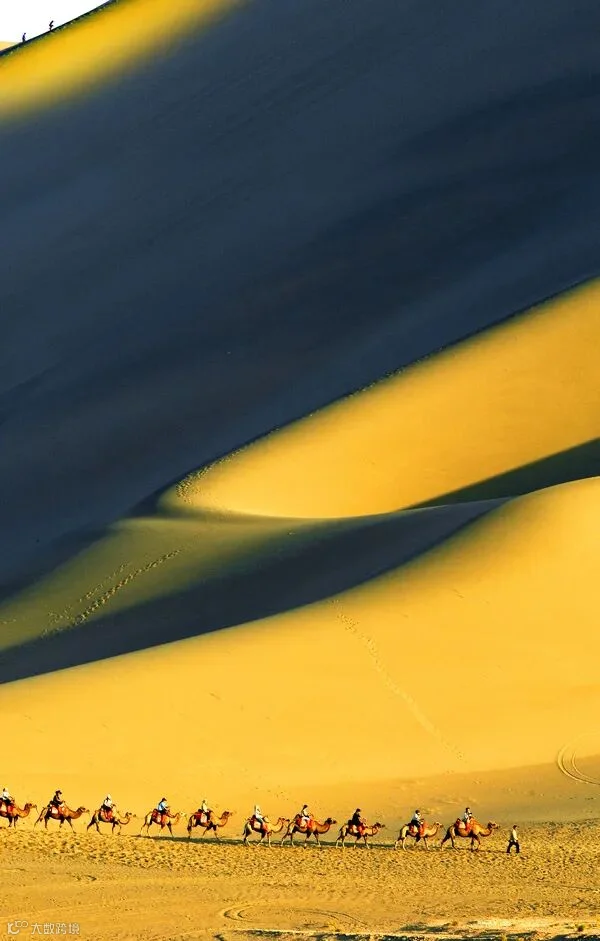
Visitors take a camel trek into the desert of the Hexi Corridor in Gansu province, a region famed for its wealth of historical sites and a variety of natural landscapes. [Photo/China Daily]
Editor's note: China Daily reporters leverage local expertise to devise different itineraries that showcase a blend of historical landmarks and natural wonders in highly recommended cities and sites, offering practical guidance to experience the country.
This is a passageway that has connected China to the world for more than two millennia — a corridor where the wind howls and sand dances year-round, where travelers and their camels once trudged, laden with bundles of silk and sacred scrolls. It was an artery of coveted treasures and the teachings of Buddhism, a crossroads for dreamers, adventurers and believers — souls drawn by an innate yearning for the unknown. Today, it remains a path of wonder, traversed by those who stand in awe of nature's power to sculpt the land and humanity's indomitable desire to shape history.
This passageway is known as the Hexi Corridor — a corridor in name and essence, flanked by the towering Qilian Mountains to the south and the unyielding deserts to the north. Falling entirely within the borders of modern-day Gansu province in northwestern China, it winds through a chain of oases, fragile yet vital, their very existence owing to the mountains whose name, Qilian, means "heaven" and whose soaring peaks produce the life-giving meltwater that sustains this arid land.
"Hexi" means "west of the Yellow River". For ancient travelers from China's heartland, a westward journey through the corridor began with crossing the Yellow River. By contrast, a 7th-century traveler from West Asia or the Mediterranean, having journeyed the full 1,200 kilometers of the corridor, would look out over the river to the expansive plains of central China, and ultimately to Chang'an, the glorious capital of the Tang Dynasty (618-907).
The name of this passageway is therefore self-explanatory: the Hexi Corridor was a window through which China and the world reached out to each other. A vital stretch of the ancient Silk Road, it became a conduit for art, culture and trade — a witness to the will of man and the building of a state.
That human will was repeatedly put to test in this part of the world, where life was a constant struggle due to water scarcity and many other challenges.
来源 | gogansu.com
Editor: Dang Lingyi
编辑(见习):党凌怡