
BMC已经成为当今生物医学期刊出版界当之无愧的“巨无霸”!从这次一次性撤销41篇中国“问题”论文的动作来看,一是体现了欧美学术期刊一贯的严谨、求真的作风,二是“杀鸡给猴看”,给今后试图弄虚作假者敲响警钟!
中国论文的“问题”究竟出在哪里呢?我把论文问题归结为“知情”问题与“不知情”问题两大类,前者是故意捏造数据,弄虚作假,后者是“第三方”在论文投稿时伪造评审人及评审意见欺骗编辑。这次被撤销的中国问题论文当属后者。
现在国内外提供论文服务的“第三方”机构如雨后春笋般涌现,但各自的服务项目千差万别,服务质量良莠不齐,其中被普遍认可的服务项目似乎仅限于语言润色(polishing),但是有少数论文服务公司为了捞取最大的经济利益,不断突破这个许可服务“底线”。
据我所知,某些服务公司已经不满足于润色带来的微薄利润,不断拓宽可提供的服务范畴,包括(1)代写稿;(2)代投稿;(3)代写稿和代投稿;(4)“一条龙”服务,从课题申请、项目实施到课题汇报、论文发表全包,当然服务价格不菲。如果谁来查一查这里面的“猫腻”,可能比我说的以及你想象的还要严重!
我就曾被某个服务公司“咨询”是否有兴趣代写SCI论文,对方给出的条件是3分以上,付款5万,还可以讲价。对方不限制学科领域,也不限制特定杂志,这篇论文可以在他完全不知情的情况下发表,只要署上他作为第一作者的姓名和单位就行。
乍一想来,似乎达到他的上述要求并不太难,因为我们经常发表文章,而且他作为第一作者排名第一完全不影响我作为通讯作者排名最后。退一步说,我的学生还可以作为共同作者与他并列第一。但是,我果断地拒绝了这个颇有“诱惑力”的邀请,原因不言自明。
因此,若是有关部门兴起“学术反腐”之风,查查第一作者与通讯作者不是同一单位的论文,我相信必将大有斩获!不能排除这次被撤销的论文是否也是“花钱买论文”,但估计绝大部分论文的问题还是出在投稿环节,即审稿人完全由公司敲定,作者完全不知情。
那么,是不是作者不知情就能完全免责呢?这要看作者的主观故意是什么。有关部门应该成立专门的调查小组慎重调查这41篇论文中有多少篇属于“投稿造假”(作者亲自完成实验,但公司投稿造假),还有多少篇属于“实验造假”(作者没有做过任何实验,全部由公司代办),然后再追认相关责任,根据情节的严重程度做出不同的处理。
我们曾于2011年在一份BMC期刊(非SCI)——BMC Reserch Notes上发表过一篇论文,记得当初好像没有给编辑部推荐任何审稿人,而是由他们自己寻找审稿人。论文经2位审稿人评审后,一位同意修改后发表,另一位不同意发表,但都提出了中肯的修改意见(见下)。我们据此认真修改有关专业问题后,还特意请英国的一家服务公司为文章润色,最后编辑部同意发表。
在作者与编者信件往来中,总的感觉是编辑程序严谨规范,编辑人员认真负责,但也许是因为这份杂志刚刚创刊,还没有被SCI收录,所以他们接受文章的门槛也较低。我推测,如果另一份不愁稿源的知名期刊得到这样的评审意见,编辑多半会做出退稿处理。至于我们这篇论文学术水平怎样,发表在这份名不见经传的期刊上是否亏了,我在这里不表达意见,我的一贯做法是奉行publish or perish的信条,因此发表论文吃亏也不奇怪。
话说回来,我现在仍然认为英语为非母语的中国人花钱请英语为母语的外国人修改论文的语言错误无可厚非,而且如果想往“顶尖”杂志上挤可能还要找专业公司画那些质量上乘的矢量图,至于该不该追求高影响因子则另当别论。
这次撤稿事件再次证明,发表论文与晋升职称挂钩无异于“逼良为娼”,而且今后会愈演愈烈,让中国的学术声誉荡然无存,现在彻底摈弃恰逢其时。我的建议是:论文应该不强制而是凭兴趣发表!
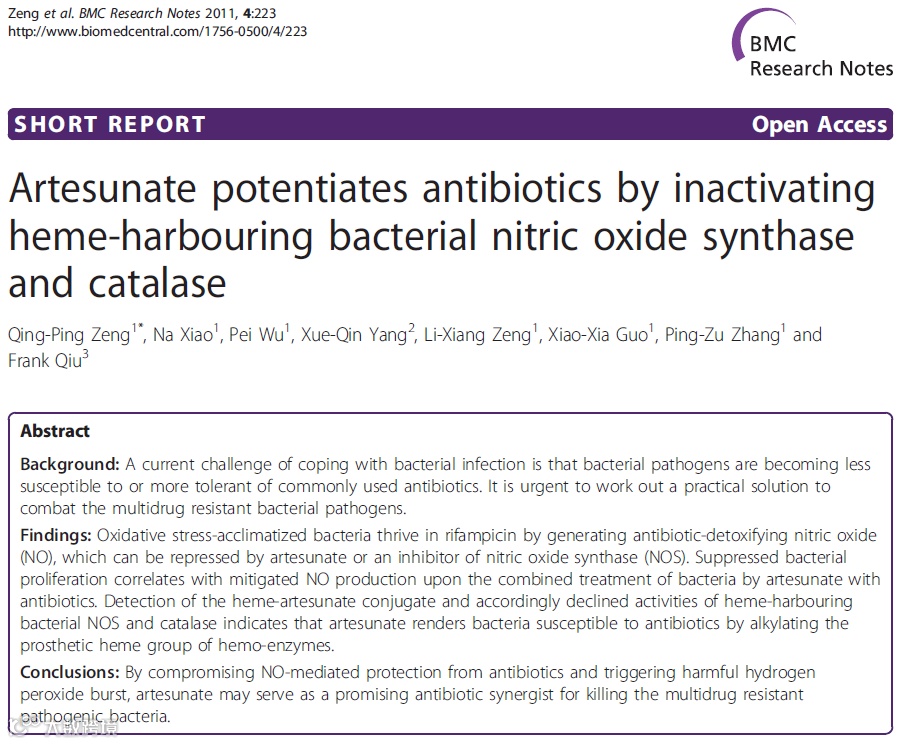
附:评审意见及答复
Reviewer's report
Title: Artesunate potentiates antibiotics by inactivating bacterial heme-harbouring nitric oxide synthase and catalase
Version: 1 Date: 22 March 2011
Reviewer number: 1
Reviewer's report:
The ms describes some interesting findings about artensuate’s ability to potentiate some antibiotics which are otherwise inactivated by NO. This is an interesting and novel finding which deserves to be published. However I have a few issues with the data analysis and presentation.
Major compulsory revisions
Figure1b, c, d–the authors should explain why they did not continue to stationary phase (or include these data if available). There may be further interesting effects of the compound manifesting themselves in,for example,reduced cell density at stationary phase. Furthermore, missing much of the exponential phase makes it hard to compare maximum specific growth rates, another interesting parameter.
We did not previously test the A600 data of acclimatized bacterial proliferation in the presence of rifampicin beyond the stationary phase, so we could only provide the A600 data until 12 h for acclimatized bacterial proliferation (Figure 1b, 1c, 1d). However, we add the 36 h A600 data of bacterial growth under rifampicin (Figure 2a).
Figure1b, c, d–The method used to draw the lines is not really appropriate. In many cases, the line “sags” between points (for example, in 1b between the 6h and 10h points in almost all the lines). This cannot be justified. Do the authors really mean to infer that the cell density actually went DOWN during these periods? I suspect not. They should find a method which fits the data less flamboyantly. It would actually be simpler if the cell shad been grown to stationary phase (see above) as there are a number of curve fits which can be readily applied.
Those mistakes have been corrected by changing the round lines to the direct lines.
Minor essential revisions
P5: Correct “cystine” to “cysteine”
While cystine contains two cysteine by oxidation, cysteine can be formed by reduction from cystine. So we can say “cystine reduction to cysteine”.
P5: I am not clear what is meant by “robustic base”–“strong base”?
The word “robustic”(large-scale) has been deleted. “Base” indicated one of the constituents of nucleotides, including base (ACGT), deoxyribulose, and phosphate.
P5: “may hurdle the obstacle of prohibiting” is an odd way of expressing“may prohibit”.
The expression of “may hurdle the obstacle of prohibiting” has been shortened to “may prohibit”.
Figure1b: I presume that Rif20 (etc) indicates a concentration of rifampicin–this should be stated clearly and the units given in the figure legend.
Rif20 (etc) has changed to Rif20μg/ml (etc), and Rif was also indicated as the abbreviation of rifampicin in the figure legend.
Discretionary revisions
The authors may wish to expand on their reasons for their choice of microorganism. I assume it was chosen as it is able to exhibit the NO-mediated antibiotic resistance phenotype. However, how clinically relevant is this species (or closely related ones)?
We have add a set of new data on E. coli, but clincal pathogens have not been included. Additionally, cefotaxime and ampicilin were used except for rifampicin.
What next?: Accept after minor essential revisions
Level of interest: An article whose findings are important to those with closely related research interests
Quality of written English: Needs some language corrections before being published
Proof-reading of the manuscript has been completed by the commercial service from Charlesworth of UK.
Statistical review: No, the manuscript does not need to be seen by a statistician.
Reviewer's report
Title: Artesunate potentiates antibiotics by inactivating bacterial heme-harbouring nitric oxide synthase and catalase
Version: 1 Date: 28 March 2011
Reviewer number: 2
Reviewer's report:
Major Compulsory Revisions
In the present study, the authors investigated the potentiation of artesunate on antibiotics by inactivating bacterial heme-harbouring nitric oxide synthase and catalase.There is less papers about the potentiation of artesunate, so this work is interesting. However, the experiment design is relatively simple, and the results are not sound to support the conclusion.
1. The important should be selected for investigation. B. licheniformis is a probiotics,why it was selected? The results from B.licheniformis are not significant for pathogens? Additionally, more bacteria should be investigated.
Now we have added the A600 and NO data from E. coli. We selected B.licheniformis and E.coli because they are representatives of a Gram-positive bacterium and a Gram-negative bacterium, respectively. Secondly, the non-pathogenic B.licheniformis was included in a representative list of bacteria that possess eukaryote-like NOS as the pathogenic B. anthracis and B.cereus (Gusarov et al., Science, 2009, 325: 1380). Besides, we selected them only for safty consideration for the in vitro experiment.
2. There are many antibiotics used in clinic, rifampicin is not widely used in clinic to treat normal bacterial infection except bacillus tuberculosis. Why rifampicin is selected as the representative antibiotic?
We are planning to extend the experiment to B. tuberculosis in the near future, so we selected rifampicin as a model antibiotics. Additionally, we have also added the test results of cefotaxime and ampicilin for B. tuberculosis and E. coli in the revised manuscript.
3. Although NO production is affected by artesunate, it is insufficient to get the conclusion that artesunate potentiates antibiotics by inactivating bacterial heme-harbouring nitric oxide synthase and catalase because there is no any results to show artesunate directly the enzymes.
Preliminary evidence came from the spectrophotometric shift from heme to heme-ART and corresponding inactivation of NOS and catalase. More confidential evidence of isolating and identifying the heme-ART conjugate is not easy to obtained in our laboratory.
4. This is not the first time that artesunate reported to exert an anti-bacterial role in combination with antibiotics. Some researchers reported it earlier. (J Antimicrob Chemother. 2011; 66(4): 769-77.)
You are right, but they are from the view of a multidrug efflux pump, and never involving NO, NOS and catalase described in our manuscript. We have cited this reference in the manuscript.
5. Fig1C# at 24h time-point the inhibitory effect on bacterial proliferation of ART was better than rifampicin. Is it right?
The curve representing ART has been deleted in the revised manuscript for avoiding misunderstanding. Acturally, we always noticed that ART60μg/ml really played a direct inhibition role to bacteria.
6. The Figures were confusing. For example, the bars in histogram were always blank. In fig1b, the label of “Ac+Rif120” was similar with“NonAc+Rif120”.
This figure has been modified to make clear.
What next?: Reject because scientifically unsound
We have revised according your advice.
Level of interest: An article of insufficient interest to warrant publication in a scientific/medical journal
Quality of written English: Needs some language corrections before being published
Proof-reading of the manuscript has been completed by the commercial service from Charlesworth of UK.
Statistical review: No, the manuscript does not need to be seen by a statistician.
(来源:科学网)