网络直播时间:2023年9月29日22:00-23:15 (北京时间)
www.global-engage.com/event/nash-or-diabesity-which-comes-first
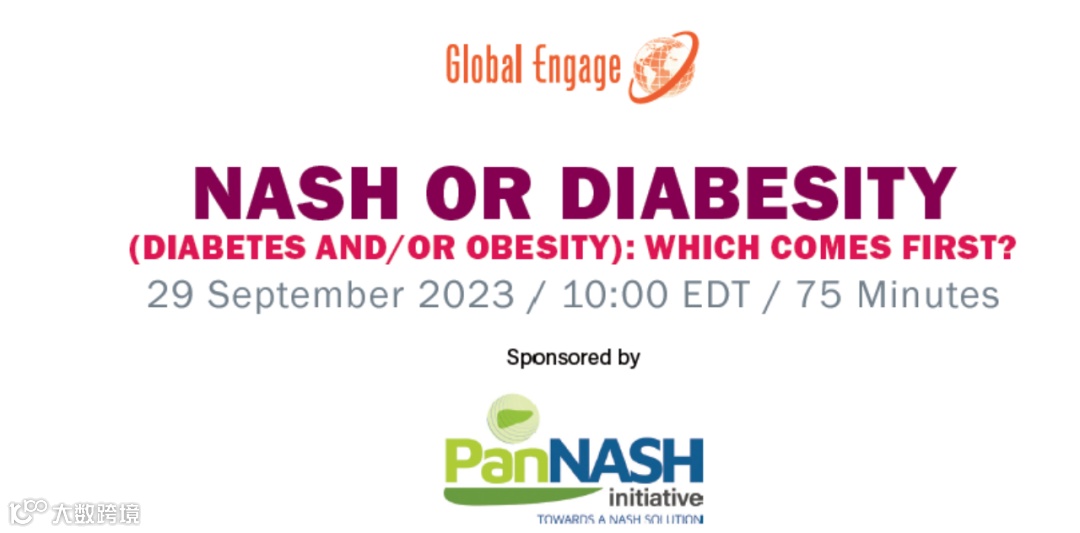
会议日程:Welcome & Introductions (15 min) + Keynote Presentation (45 min)+ Q&A / Closing Remarks (15 min)
注册费:免费对感兴趣的同道开放(Registration Fee: Complimentary access to all delegations).
Key Discussion Areas
The context = NAFLD / NASH epidemic in diabesity environment (diabetes and obesity).
What are the relations / consequences between the 2 diseases and obesity? (extrahepatic problems).
The existing treatments and their respective benefits (with PPAR / lani).
How to monitor those treatments?
Presentation by Jian-Gao Fan entitled: China's Fatty Liver Crisis.
PanNash webinar program’ s key messages
Demonstrate the central and leading role of the liver in metabolic control, so: the liver as an organ contributing to normal metabolic control. The impact of the diseased liver in NASH/MASH on altered metabolism and its contribution to metabolic derangements and to CVD. Basically, to clearly state that the liver is not simply a victim of obesity and diabetes, but, once diseased, contributes to metabolic derangements and CVD. Given the time restraints (one hour), focus on the important role of the liver, once diseased, in driving, as an additional contributing factor, metabolic and CVD alterations.
Help participants understand that the liver is: Not just a victim of metabolic syndrome. But an active contributor.
Another part of the message, but which is strongly related to that, is that:Treating the components of the metabolic syndrome is hence not always enough. Reducing obesity improves the liver but not all are responders. Diabetes treatment not always suffices to solve the liver problem. MASH might make diabetic control more challenging.
Message = complex multidirectional interactions and their relevance for treatment are the main message this webinar aims at.
About current status of fatty liver disease nomenclature: Positive name + diagnosis and non-stigmating. Look for and treat all potential causes. NAFLD and MASLD only largely overlap, and cryptogenic SLD is only difference and a small fraction. MetALD defines a separate group of patients. Impact on existing literature and ongoing studies is minor. Helps improving design of new studies. MetALD clearly defines a separate group of patients. Impact on existing literature and ongoing trials is minor. Helps improving design of new studies, ie, role of different factors combined, including studies for MetALD emerging as a separate area of research.
Prof. Sven Francque presents the overall concept, explains MASH as the result of the (im)balance between: Metabolic drivers of disease on the one hand,and liver vulnerability/repair capacity on the one hand. Illustrate that metabolic improvements induce liver improvements especially in early disease but less so in more advanced disease and always with a number of non-responders). Briefly explains the concept of the multi-directionality of all these liver-metabolic-CVD interactions.
Prof. Kenneth Cusi explains: The liver contribution in diabetes control, how this is altered in MASH and how the liver could impact on the development of diabetes (e.g. the data on incident diabetes in NASH patients if no diabetes at baseline) or on diabetes control. How some treatments for diabetes do not impact on NASH whereas others do.
Prof. Jian-Gao Fan explains: China's Fatty Liver Crisis (fatty liver disease is just a weight and metabolic problem). There is a common trend to increasing epidemic of obesity, T2DM, metabolic syndrome, alcoholism and FLD over time in China. Non-obese or lean NAFLD are common both in Chinese children and adults. NAFLD is acquired metabolic stress related FLD and most of them belong to or might develop to MAFLD. Prevalence of MAFLD has been broadly matched to that reported for NAFLD, it is somewhat higher than NAFLD.MAFLD can be developed in adults and children, with and without alcoholism or chronic HBV infection.

声明:本文仅供医疗卫生专业人士了解最新医药资讯参考使用,不代表本平台观点。该信息不能以任何方式取代专业的医疗指导,也不应被视为诊疗建议,如果该信息被用于资讯以外的目的,本站及作者不承担相关责任。
(来源:爱肝联盟)