



01
引言
在神经网络中,我们在像线性层(Linear/Dense)或卷积层(Conv2D)等层之后经常使用非线性激活函数,例如Sigmoid、Tanh、ReLU等。考虑一个具有两个隐藏层的神经网络,如下所示。

上图中,输入首先通过一个线性层,然后我们应用激活函数ReLU,再传递到第二个隐藏层Linear2。
02
为了更具体一些,让我们考虑一个将数据点分类为两个类别之一的问题。我们将使用scikit - learn来生成一个小型数据集。在我们深入这个过程之前,先导入几个库:
import torchimport numpy as npfrom lets_plot import *import pandas as pd
现在,让我们使用scikit - learn中的make_moons函数生成一个小数据集并绘制出来。
from sklearn.datasets import make_moonsX, y = make_moons(n_samples=10000, noise=0.2, random_state=10)df = pd.DataFrame(X, columns=['feature1', 'feature2'])df['y'] = yggplot(df, aes('feature1', 'feature2', color='y')) + geom_point(size=0.7) + scale_color_discrete() + labs(title="Toy dataset")
可视化结果如下:

我们生成的数据集有2个输入特征,每个数据点属于两个类别之一。我选择这个数据集是为了突出非线性的重要性。
03
现在让我们创建有无非线性的神经网络,并看看它们之间的区别。我将使用Pytorch创建一个具有两个隐藏层的简单神经网络。
由于我们的输入有2个特征,第一层以(batch_size, 2)张量作为输入,并产生(batch_size, 10)张量作为输出。如果启用非线性层,我们将使用ReLU作为非线性层。fc1层的输出将传递给ReLU。ReLU的输出形状与其输入完全相同,即(batch_size, 10)。
接下来,fc2层产生形状为(batch_size, 2)的输出,其中第一列表示类别0的logits(未归一化的分数),第二列表示类别1的logits。这些logits可以传递给softmax函数(在评估期间)以获得类别概率,或者通过argmax来确定预测的类别。
class DemoModel(torch.nn.Module):def __init__(self, use_relu=False):super().__init__()self.use_relu = use_reluself.fc1 = torch.nn.Linear(2, 10)self.fc2 = torch.nn.Linear(10, 2)def forward(self, x):x = self.fc1(x)if self.use_relu:x = torch.relu(x)return self.fc2(x)linear_model = DemoModel(use_relu=False)non_linear_model = DemoModel(use_relu=True)
04
接着,我定义了一个名为train的函数,它是一个简单的训练循环。我使用了torch.optim.AdamW优化器和torch.nn.CrossEntropyLoss作为损失函数。
我还创建了训练和测试数据集以及数据加载器。
from sklearn.model_selection import train_test_splitfrom torch.utils.data import TensorDataset, DataLoaderdef train(model: torch.nn.Module, train_dl, val_dl, epochs=10, ):optim = torch.optim.AdamW(model.parameters(), lr=1e-3)loss_fn = torch.nn.CrossEntropyLoss()losses = []for epoch in range(epochs):train_loss = 0.0model.train()for batch_X, batch_y in train_dl:optim.zero_grad()logits = model(batch_X)loss = loss_fn(logits, batch_y)loss.backward()optim.step()train_loss += loss.item() * batch_X.size(0)train_loss /= len(train_dl.dataset)model.eval()val_loss = 0.0with torch.no_grad():for batch_X, batch_y in val_dl:logits = model(batch_X)loss = loss_fn(logits, batch_y)val_loss += loss.item() * batch_X.size(0)val_loss /= len(val_dl.dataset)log_steps = int(0.2 * epochs)losses.append((train_loss, val_loss))if epoch % log_steps == 0 or epoch == epochs - 1:print(f'Epoch {epoch+1}/{epochs}, Training Loss: {train_loss:.4f}, Validation Loss: {val_loss:.4f}')return lossesX_train, X_test, y_train, y_test = train_test_split(torch.Tensor(X), torch.LongTensor(y))train_ds = TensorDataset(X_train, y_train)test_ds = TensorDataset(X_test, y_test)train_dl = DataLoader(train_ds, shuffle=True, batch_size=32)test_dl = DataLoader(test_ds, shuffle=False, batch_size=32)
让我们训练这两个模型50个epoch,并查看训练和验证损失曲线图。
linear_losses = train(linear_model, train_dl, test_dl, epochs=50)non_linear_losses = train(non_linear_model, train_dl, test_dl, epochs=50)
结果如下:

左边的图是一个不使用ReLU激活函数的模型的损失曲线,右边的图是一个使用ReLU激活函数的模型的损失曲线。我们可以看到训练/验证损失之间有很大的差异。线性模型的损失没有下降,而是停滞在大约0.29左右,而非线性模型在整个epoch中损失都在下降。
05
让我们检查一下这两个模型的预测结果。在测试集上,线性模型的准确率为0.85,非线性模型的准确率为0.96,两者之间存在很大差异。

在上面的结果中,圆形表示类别0,三角形表示类别1。
我们看到线性模型有一个尖锐的线性边界,边界上方的点被分类为0,下方的点被分类为1。由于这个原因,许多点被错误分类。在左边的图中,理想情况下所有的圆形都应该为蓝色,所有的三角形都应该为红色,但实际上并非如此。
在右边的图中,我们看到了更好的结果。该模型能够学习一个非线性边界,正确分类了96%的数据点。
上述可视化代码如下:
from sklearn.metrics import classification_reportfrom lets_plot.mapping import as_discretedef plot_classification(model, model_name: str):preds = model(X_test).argmax(dim=1).numpy()report_dict = (classification_report(y_test, preds, output_dict=True))plot_df = pd.DataFrame({"feature1": X_test[:, 0].numpy(), "feature2": X_test[: ,1].numpy(), "y": y_test, "pred": preds})title = f"{model_name}"subtitle = f"Accuracy: {report_dict['accuracy']:.2}, F1-Score {report_dict['weighted avg']['f1-score']:.2}"return ggplot(plot_df) + geom_point(aes('feature1', 'feature2', color=as_discrete('pred'), shape=as_discrete('y')), size=2.5, alpha=0.7) + labs(title=title, subtitle=subtitle, color="Predicted Class", shape="Actual Class")fig_linear = plot_classification(linear_model, model_name="Linear")fig_non_linear = plot_classification(non_linear_model, model_name="Non Linear")bunch = GGBunch()bunch.add_plot(fig_linear, 0, 0)bunch.add_plot(fig_non_linear, 600, 0)bunch
06
现在让我们来看模型中各个层的输出。我从测试集中取了前10行数据,并在下面绘制了每个层的输出。我还展示了每个数据点的真实标签,作为最后一列的参考。
在下面的图表中,我使用了线性和非线性两种模型。由于第一层产生的是一个大小为10的向量,因此我们从每个神经元得到10个不同的值,以及每个样本末尾的一个标签列。
在这两种模型中,fc1的输出包含一系列正负值。这是通过线性运算(输入与层权重之间的矩阵乘法)得到的。
然而,当我们使用ReLU时,我们看到引入了非线性,使得负值被设置为0,而正值保持不变。这意味着只有正值会对下一层的输出做出贡献。

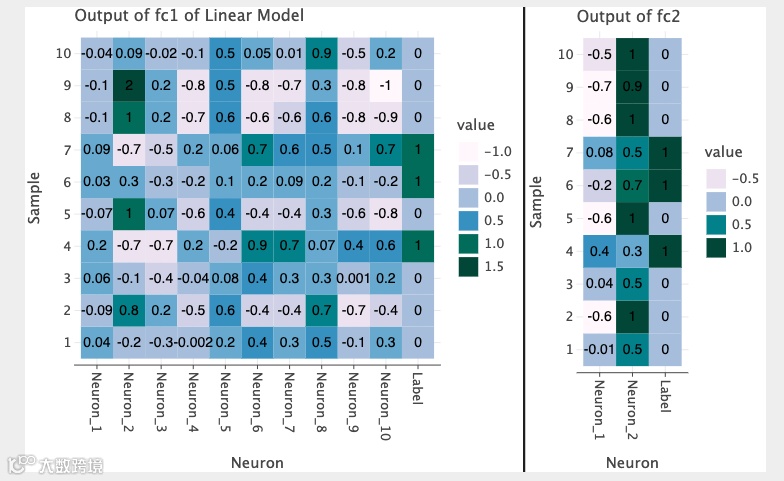
上述可视化的代码如下:
def plot_activations(activations, labels, title: str):df_logits = pd.DataFrame(activations, columns=[f"Neuron_{i+1}" for i in range(activations.shape[1])])df_logits['Label'] = labelsdf_logits["Sample"] = range(1, len(df_logits) + 1)df_logits = df_logits.melt(id_vars="Sample", var_name="Neuron")return (ggplot(df_logits, aes("Neuron", as_discrete("Sample")))+ geom_tile(aes(fill="value"))+ geom_text(aes(label="value"), label_format=".1", color='black')+ scale_fill_brewer(type='seq', palette=9)+ labs(title=title))with torch.no_grad():logits_fc1 = non_linear_model.fc1(X_test[:10])logits_fc1_relu = torch.relu(logits_fc1)logits_fc2 = non_linear_model.fc2(logits_fc1_relu)bunch = GGBunch()bunch.add_plot(plot_activations(logits_fc1.numpy(), y_test[:10], title="Output of fc1 of Non-Linear Model"), 0, 0, 500, 500)bunch.add_plot(plot_activations(logits_fc1_relu.numpy(), y_test[:10], title="Output of fc1 of Non-Linear Model after RELU"), 502, -7, 500, 510)bunch.add_plot(plot_activations(logits_fc2.numpy(), y_test[:10], title="Output of fc2"), 872, 9, 500, 478)display(bunch)bunch = GGBunch()with torch.no_grad():linear_logits_fc1 = linear_model.fc1(X_test[:10])linear_logits_fc2 = linear_model.fc2(logits_fc1_relu)bunch.add_plot(plot_activations(linear_logits_fc1.numpy(), y_test[:10], title="Output of fc1 of Linear Model"), 0, 0, 500, 500)bunch.add_plot(plot_activations(linear_logits_fc2.numpy(), y_test[:10], title="Output of fc2"), 375, 15, 500, 470)bunch
07
结论
点击上方小卡片关注我
添加个人微信,进专属粉丝群!
