



ANN Visualizer
一个伟大的可视化python库,用于Keras。它使用python的graphviz库来创建您正在构建的神经网络的一个直观的图形。
Version 2.0 is Out!
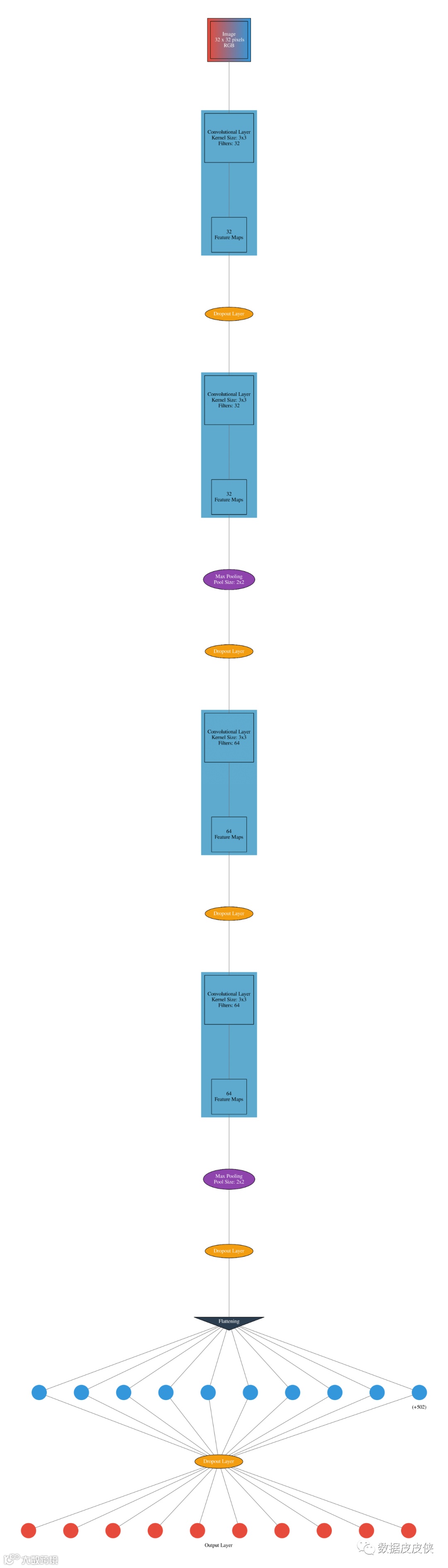
Version 2.0 of the ann_visualizer is now released! The community demanded a CNN visualizer, so we updated our module. You can check out an example of a CNN visualization below!
Happy visualizing!
Installation
From Github
Download the
ann_visualizerfolder from the github repository.Place the
ann_visualizerfolder in the same directory as your main python script.
From pip
Use the following command:
pip3 install ann_visualizer
Make sure you have graphviz installed. Install it using:
sudo apt-get install graphviz && pip3 install graphviz
Usage
from ann_visualizer.visualize import ann_viz;
#Build your model here
ann_viz(model)
Documentation
ann_viz(model, view=True, filename="network.gv", title="MyNeural Network")
model- The Keras Sequential modelview- If True, it opens the graph preview after executedfilename- Where to save the graph. (.gv file format)title- A title for the graph
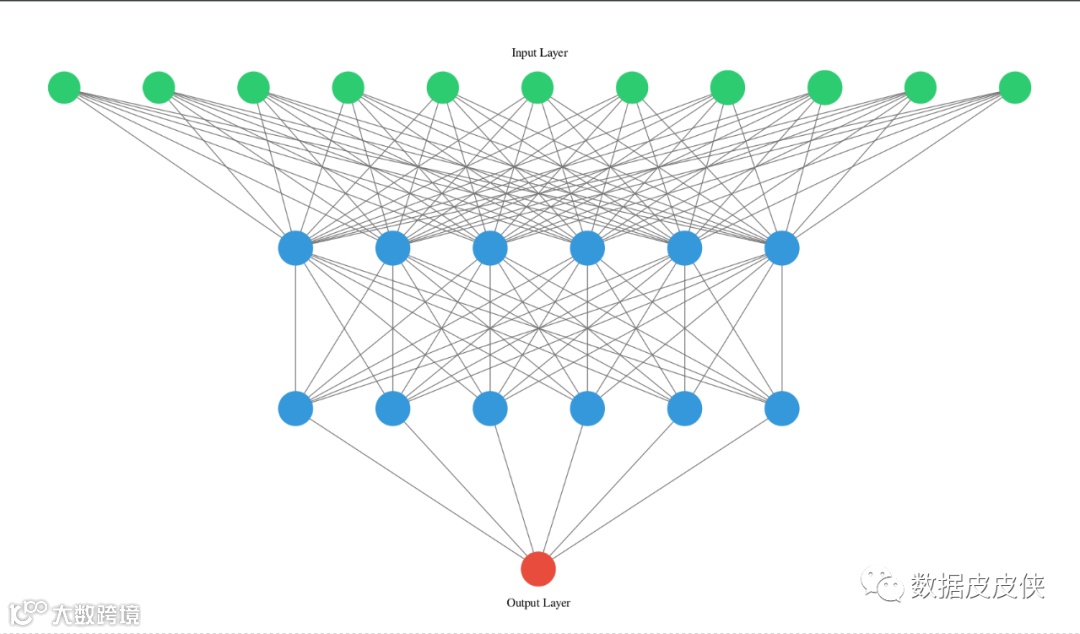
Example ANN
import keras;
from keras.models import Sequential;
from keras.layers import Dense;

network = Sequential();
        #Hidden Layer#1
network.add(Dense(units=6,
                  activation='relu',
                  kernel_initializer='uniform',
                  input_dim=11));

        #Hidden Layer#2
network.add(Dense(units=6,
                  activation='relu',
                  kernel_initializer='uniform'));

        #Exit Layer
network.add(Dense(units=1,
                  activation='sigmoid',
                  kernel_initializer='uniform'));

from ann_visualizer.visualize import ann_viz;

ann_viz(network, title="");
This will output:
Example CNN
import keras;
from keras.models import Sequential;
from keras.layers import Dense;
from ann_visualizer.visualize import ann_viz
model = build_cnn_model()
ann_viz(model, title="")

def build_cnn_model():
  model = keras.models.Sequential()

  model.add(
      Conv2D(
          32, (3, 3),
          padding="same",
          input_shape=(32, 32, 3),
          activation="relu"))
  model.add(Dropout(0.2))

  model.add(
      Conv2D(
          32, (3, 3),
          padding="same",
          input_shape=(32, 32, 3),
          activation="relu"))
  model.add(MaxPooling2D(pool_size=(2, 2)))
  model.add(Dropout(0.2))

  model.add(
      Conv2D(
          64, (3, 3),
          padding="same",
          input_shape=(32, 32, 3),
          activation="relu"))
  model.add(Dropout(0.2))

  model.add(
      Conv2D(
          64, (3, 3),
          padding="same",
          input_shape=(32, 32, 3),
          activation="relu"))
  model.add(MaxPooling2D(pool_size=(2, 2)))
  model.add(Dropout(0.2))

  model.add(Flatten())
  model.add(Dense(512, activation="relu"))
  model.add(Dropout(0.2))

  model.add(Dense(10, activation="softmax"))

  return model
This will output:
Contributions
This library is still unstable. Please report all bug to the issues section. It is currently tested with python3.5 and python3.6, but it should run just fine on any python3.
微信公众号:数据皮皮侠
如果你觉得该公众号对你有帮助,欢迎关注、推广和宣传