

更多与社科因果推断、文本、音像、网络结构数据挖掘、机器学习、网络爬虫相关的学术资源交流,请关注“社科学术汇”公众号,后台回复“社群”添加
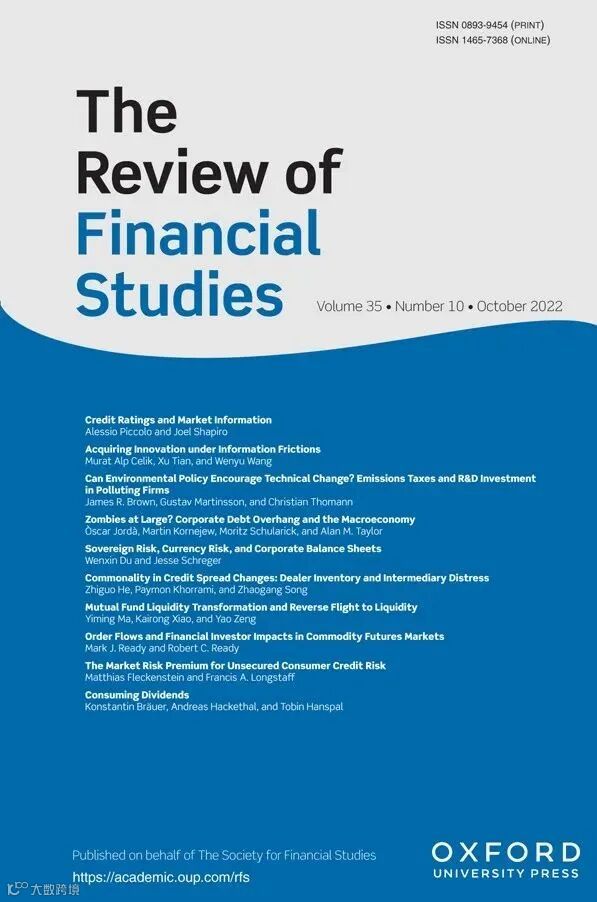

01 Zombies at Large? Corporate Debt Overhang and the Macroeconomy
02 Acquiring Innovation under Information Frictions
03 Can Environmental Policy Encourage Technical Change? Emissions Taxes and R&D Investment in Polluting Firms
04 Credit Ratings and Market Information
05 Sovereign Risk, Currency Risk, and Corporate Balance Sheets
06 Commonality in Credit Spread Changes: Dealer Inventory and Intermediary Distress
07 The Market Risk Premium for Unsecured Consumer Credit Risk
08 Mutual Fund Liquidity Transformation and Reverse Flight to Liquidity
09 Consuming Dividends
10 Order Flows and Financial Investor Impacts in Commodity Futures Markets
【Title】
Zombies at Large? Corporate Debt Overhang and the Macroeconomy
【Author】
Òscar Jordà (Federal Reserve Bank of San Francisco and University of California, Davis and CEPR)
Martin Kornejew (University of Bonn)
Moritz Schularick (University of Bonn and Sciences Po and CEPR)
Alan Taylor (University of California, Davis, NBER and CEPR)
【Abstract】
Debt overhang is associated with higher financial fragility and slower recovery from recession. However, while household credit booms have been extensively documented to have this property, we find that corporate debt does not fit the same pattern. Newly collected data on nonfinancial business liabilities for 18 advanced economies over the past 150 years shows that, in the aggregate, greater frictions in corporate debt resolution make for slower recoveries, with weak investment and more persistent “zombie firms” and that this is an important factor in explaining the difference in outcomes relative to household credit booms.
【Title】
Acquiring Innovation under Information Frictions
【Author】
Murat Alp Celik (University of Toronto)
Xu Tian (University of Georgia)
Wenyu Wang (Indiana University)
【Abstract】
Acquiring innovation through M&A is subject to information frictions, as assessing the value of innovative targets is a challenging task. We find an inverted U-shaped relation between firm innovation and takeover exposure; equity usage increases with target innovation; and the deal completion rate drops with innovation. We develop and estimate a model of acquiring innovation under information frictions, featuring endogenous merger, innovation, and offer composition decisions. Our estimates suggest that acquirers’ due diligence reveals only 30% of private information possessed by targets. Eliminating information frictions increases capitalized merger gains by 59%, stimulates innovation, and boosts productivity, business dynamism, and social welfare.
【Title】
Can Environmental Policy Encourage Technical Change? Emissions Taxes and R&D Investment in Polluting Firms
【Author】
James Brown (Iowa State University)
Gustav Martinsson (KTH Royal Institute of Technology)
Christian Thomann (Stockholm School of Economics)
【Abstract】
Higher country taxes on noxious manufacturing emissions lead to substantial increases in firms’ R&D spending. The R&D response is entirely driven by those high-pollution firms most affected by emissions taxes. Pollution taxes increase the marginal value of R&D spending in polluting firms, even when this spending does not lead to new innovation. Pollution taxes have the strongest effect on R&D investment in sectors in which new invention is difficult to appropriate and outside knowledge is easier to acquire, suggesting an important reason dirty firms invest in R&D is to expand their capacity to absorb external knowledge and technical know-how.
【Title】
Credit Ratings and Market Information
【Author】
Alessio Piccolo (Indiana University)
Joel Shapiro (University of Oxford)
【Abstract】
Accurate credit ratings are important for both investors and regulators. We demonstrate that the market for credit risk provides an important source of discipline for credit rating agencies (CRAs). We examine a model in which a CRA’s rating is followed by a market for credit risk that provides a public signal – the price. More informative trading increases the CRA’s incentives to be accurate by making rating errors more transparent. We show that this source of discipline is (a) robust to moral hazard, multiple CRAs, and connected primary and secondary markets and (b) specific to the market for credit risk.
【Title】
Sovereign Risk, Currency Risk, and Corporate Balance Sheets
【Author】
Wenxin Du (University of Chicago, Federal Reserve Bank of New York, NBER and CEPR)
Jesse Schreger (Columbia Business School, NBER and CEPR)
【Abstract】
We provide a comprehensive account of the evolution of the currency composition of sovereign and corporate external borrowing by emerging markets from 2003 to 2017. We show that a higher reliance on foreign currency debt by the corporate sector is associated with higher sovereign default risk. We introduce local currency sovereign debt and private sector currency mismatch into a standard sovereign debt model to examine how the currency composition of corporate borrowing affects the sovereign’s incentive to inflate or default. A calibration of the model generates the empirical patterns of sovereign credit risk.
【Title】
Commonality in Credit Spread Changes: Dealer Inventory and Intermediary Distress
【Author】
Zhiguo He (University of Chicago and NBER)
Paymon Khorrami (Imperial College London)
Zhaogang Song (Johns Hopkins University)
【Abstract】
Two intermediary-based factors—a corporate bond dealer inventory measure and a broad intermediary distress measure—explain more than 40% of the puzzling common variation in credit spread changes beyond canonical structural factors. A simple intermediary-based model with partial market segmentation accounts for intermediary factors’ explanatory power and delivers three further implications with empirical support. First, whereas bond sorts on risk-related variables produce monotonic loading patterns on intermediary factors, non-risk-related sorts produce no pattern. Second, dealer inventory comoves with corporate-credit assets only, whereas intermediary distress comoves with both corporate-credit and non-corporate-credit assets. Third, dealers’ inventory responds to (instrumented) bond sales by institutional investors.
【Title】
The Market Risk Premium for Unsecured Consumer Credit Risk
【Author】
Matthias Fleckenstein (University of Delaware)
Francis Longstaff (University of California at Los Angeles and NBER)
【Abstract】
We use the prices of credit card asset-backed securities to study the market risk premium associated with unsecured consumer credit risk. We find that the market incorporates a substantial credit risk premium into the prices of these securities. Furthermore, there has been a major repricing of unsecured consumer credit risk since the 2007–2009 financial crisis. We find evidence that this increase is linked to balance-sheet costs imposed by postcrisis changes in regulations that have placed credit card securitizations back onto issuer balance sheets. These regulatory changes may have added more than 100 basis points to the cost of unsecured household credit.
【Title】
Mutual Fund Liquidity Transformation and Reverse Flight to Liquidity
【Author】
Yiming Ma (Columbia Graduate School of Business)
Kairong Xiao (Columbia Graduate School of Business)
Yao Zeng (University of Pennsylvania)
【Abstract】
We identify fixed-income mutual funds as an important contributor to the unusually high selling pressure in liquid asset markets during the COVID-19 crisis. We show that mutual funds experienced pronounced investor outflows amplified by their liquidity transformation. In meeting redemptions, funds followed a pecking order by first selling their liquid assets, including Treasuries and high-quality corporate bonds, which generated the most concentrated selling pressure in these markets. Overall, the estimated price impact of mutual funds was sizable at a third of the increase in Treasury yields and a quarter of the increase in corporate bond yields during the COVID-19 crisis.
【Title】
Consuming Dividends
【Author】
Konstantin Bräuer (Goethe University Frankfurt)
Andreas Hackethal (Goethe University Frankfurt and Leibniz Institute SAFE)
Tobin Hanspal (WU Vienna University of Economics and Business)
【Abstract】
This paper studies why investors buy dividend-paying assets and how they time consumption accordingly. We combine administrative bank data linking customers’ consumption and income to portfolio data and survey responses on financial behavior. We find that private consumption is excessively sensitive to dividend income. Investors across wealth, income, and age distributions increase spending precisely around days of dividend receipt. Our results are at odds with a number of existing rational and behavioral explanations, such as financial constraints and impulsiveness. Instead, consumption responses reflect “planned” excess sensitivity, driven by investors who select dividend portfolios, anticipate dividend income, and plan consumption accordingly.
【Title】
Order Flows and Financial Investor Impacts in Commodity Futures Markets
【Author】
Mark Ready (University of Wisconsin-Madison)
Robert Ready (University of Oregon)
【Abstract】
Using intraday data, we document statistically strong, but temporary, impacts of commodity index trade flows on commodity futures prices. We also examine the previously documented positive returns around the issuance of commodity-linked notes and find that these returns are an order of magnitude too large to be caused by the small trades necessary to hedge the notes. We provide new evidence that they are instead the result of endogenous issuance. Our results provide novel support for commodity financialization but highlight the importance of measuring the magnitude of financial investment, since even large financial flows have economically modest impacts on prices.