


点击“数据皮皮侠”关注我们
设为星标 及时获取最新内容

论文简介

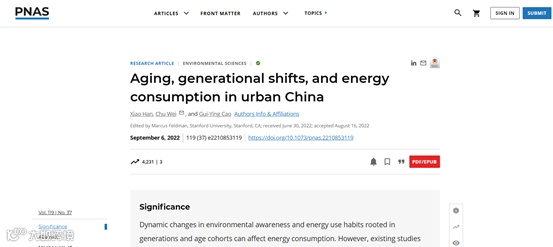
中国人民大学应用经济学院魏楚教授团队与国际应用系统分析研究所(IIASA)学者合作的最新研究成果《Aging, generational shifts, and energy consumption in urban China》成功在国际顶尖学术期刊《美国科学院院刊》(PNAS)上发表。该研究论文聚焦于中国城市化进程中的人口老龄化与代际变迁对能源消费的影响,由应用经济学院博士研究生韩晓担任第一作者,魏楚教授担任通讯作者,中国人民大学作为第一通讯单位,标志着该校在社会科学领域的又一重要突破。
皮皮侠相关数据
更多数据请前往:ppmandata.cn
论文概述
摘要:
China is recognized as the largest energy consumer and is also the country with the largest and fastest-aging population. Ongoing demographic changes may reshape China’s household-based energy consumption patterns because of the large gap in consumption behavior between the elderly and the young as well as varying attitudes toward the environment among generations. However, when the impact of China’s aging population on energy consumption is projected, the heterogeneous cognitive norms of generations in the process of demographic transition are not well understood. In this study, we assessed the future impact of China’s demographic transition on energy consumption using a proposed theoretical framework to distinguish between age and generational effects. Specifically, we used age–period–cohort (APC) detrended analysis to estimate age and generational effects based on China’s urban household survey data from 1992 to 2015. The results indicated large differences in energy use propensity across ages and generations. The elderly and younger generations tended to be energy-intensive consumers, resulting in higher energy consumption in this aging society. Our results consequently show that future changes in China’s elderly population will result in a substantial increase in energy consumption. By 2050, the changing consumption share of the elderly population will account for ∼17 to 26% of total energy consumption in the residential sector, which is close to 115 million tons of standard coal (Mtce). These findings highlight the need to interlace environmental education policies and demographic transitions to promote energy conservation behavior in children and youth for low-carbon, sustainable development.
论文核心内容介绍:
该研究专注于能源需求领域,成功构建了一个精细化的理论框架,用于深入理解和量化年龄和代际变迁对能源需求的影响。它利用代际效应来揭示不同世代人群在认知规范和行为模式上的异质性,同时借助年龄效应来描绘个体在其生命周期中行为模式的变化。
基于中国城市居民的微观调查数据,研究团队构建了“年龄-时期-队列”(APC)模型,以进行实证分析。此外,还结合了多态预测模型来预测城镇老龄人口的增长趋势,并据此评估了未来不同情境下人口结构变化对中国能源消费的影响。
研究的主要发现揭示了不同年龄和世代人群在能源使用偏好上的显著差异。特别是,老年人和年轻一代往往展现出较高的能源密集型消费特征,这在老龄化社会中导致能源消费总量上升。据预测,到2050年,老年人口的能源消费份额在住宅能源总消费量中的占比将达到17-26%。
这一成果不仅丰富和深化了“老龄化-需求”分析的理论框架和传导机制,而且通过结合发展中国家的微观数据,为人口老龄化、代际变迁和住宅能源消耗之间的关系提供了定量评估和预测分析。这为后续的研究提供了有力的分析框架和基础参数,有助于政策制定者制定更加精准和有效的能源政策,以应对人口结构变化带来的挑战。
点击“数据皮皮侠”关注我们
