th
Anniversary
中国日报即将在6月1日迎来35周岁生日。在接下来的几天,双语君将给大家带来中国日报资深人士撰写的专栏文章。他们会和我们的读者一起分享,35年来他们眼中的社会变迁和生活改变。
今天的文章由中国日报副总编康兵撰写,他在此文中回顾了自己三十年前的留学生涯。

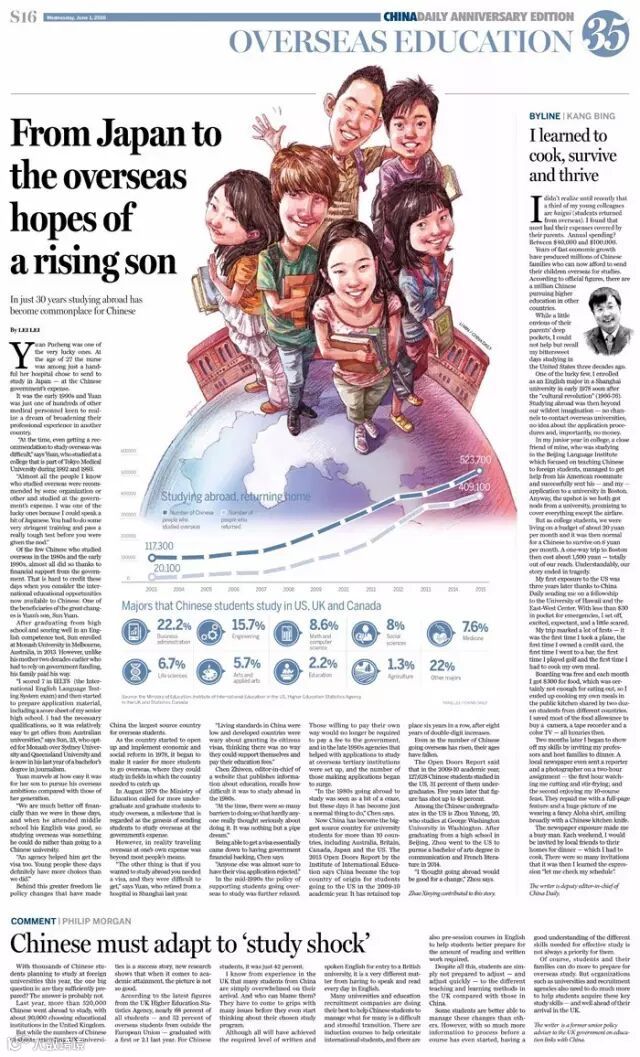
I didn't realize until recently that a third of my young colleagues are haigui (students returned from overseas). I found that most had their expenses covered by their parents. Annual spending? Between $40,000 and $100,000.
Years of fast economic growth have produced millions of Chinese families who can now afford to send their children overseas for studies. According to official figures, there are a million Chinese pursuing higher education in other countries.
While a little envious of their parents' deep pockets, I could not help but recall my bittersweet days studying in the United States three decades ago.
One of the lucky few, I enrolled as an English major in a Shanghai university in early 1978 soon after the "cultural revolution" (1966-76). Studying abroad was then beyond our wildest imagination -- no channels to contact overseas universities, no idea about the application procedures and, importantly, no money.
In my junior year in college, a close friend of mine, who was studying in the Beijing Language Institute which focused on teaching Chinese to foreign students, managed to get help from his American roommate and successfully sent his -- and my -- application to a university in Boston. Anyway, the upshot is we both got nods from a university, promising to cover everything except the airfare.
But as college students, we were living on a budget of about 20 yuan per month and it was then normal for a Chinese to survive on 6 yuan per month. A one-way trip to Boston then cost about 1,500 yuan -- totally out of our reach. Understandably, our story ended in tragedy.
My first exposure to the US was three years later thanks to China Daily sending me on a fellowship to the University of Hawaii and the East-West Center. With less than $30 in pocket for emergencies, I set off, excited, expectant, and a little scared.
My trip marked a lot of firsts -- it was the first time I took a plane, the first time I owned a credit card, the first time I went to a bar, the first time I played golf and the first time I had to cook my own meal.
Boarding was free and each month I got $300 for food, which was certainly not enough for eating out, so I ended up cooking my own meals in the public kitchen shared by two dozen students from different countries. I saved most of the food allowance to buy a camera, a tape recorder and a color TV -- all luxuries then.
Two months later I began to show off my skills by inviting my professors and host families to dinner. A local newspaper even sent a reporter and a photographer on a two-hour assignment -- the first hour watching me cutting and stir-frying; and the second enjoying my 10-course feast. They repaid me with a full-page feature and a huge picture of me wearing a fancy Aloha shirt, smiling broadly with a Chinese kitchen knife.
The newspaper exposure made me a busy man. Each weekend, I would be invited by local friends to their homes for dinner -- which I had to cook. There were so many invitations that it was then I learned the expression "let me check my schedule".
The writer is deputy editor-in-chief of China Daily.
本篇文章将会刊登在中国日报6月1日的纪念专版,欢迎届时阅读。欣赏更多中国日报版面,可以关注“中报赏媒会”的微信哦。